

How to Elope in the Redwoods – Locations, Permits & California Elopement Packages (2026)
There are very few places in the world where a wedding ceremony can feel genuinely small in the best possible way. The redwoods are one of them. Standing beneath trees that have lived for over a thousand years has a way of grounding a moment — of making two people feel both utterly present and connected to something far larger than themselves.
If you're dreaming of exchanging vows in one of California's ancient forests, you've found the right guide. A redwoods elopement is one of the most awe-inspiring experiences available to couples eloping in the U.S. — but it requires more intentional planning than most couples expect. Permits, park-specific rules, crowd patterns, and seasonal access all shape how your day actually feels. Getting those details right before your elopement day is what separates a calm, meaningful experience from a stressful one.
This guide covers everything you need to plan a redwoods elopement with confidence: California marriage laws, permit requirements broken down by park, the best locations across the state, seasonal timing, real elopement galleries from couples I've guided here, and what a fully supported redwoods elopement experience looks like from start to finish.
California's redwood forests are part of a broader landscape of incredible elopement destinations across the state. If you're still weighing your options or want to understand the full picture of eloping in California — including marriage laws, costs, and locations beyond the redwoods — start with the complete California elopement guide before diving in here.
Already set on the redwoods? Keep reading — everything you need is below.
Ready to start planning your redwoods elopement? Let's talk through your vision →
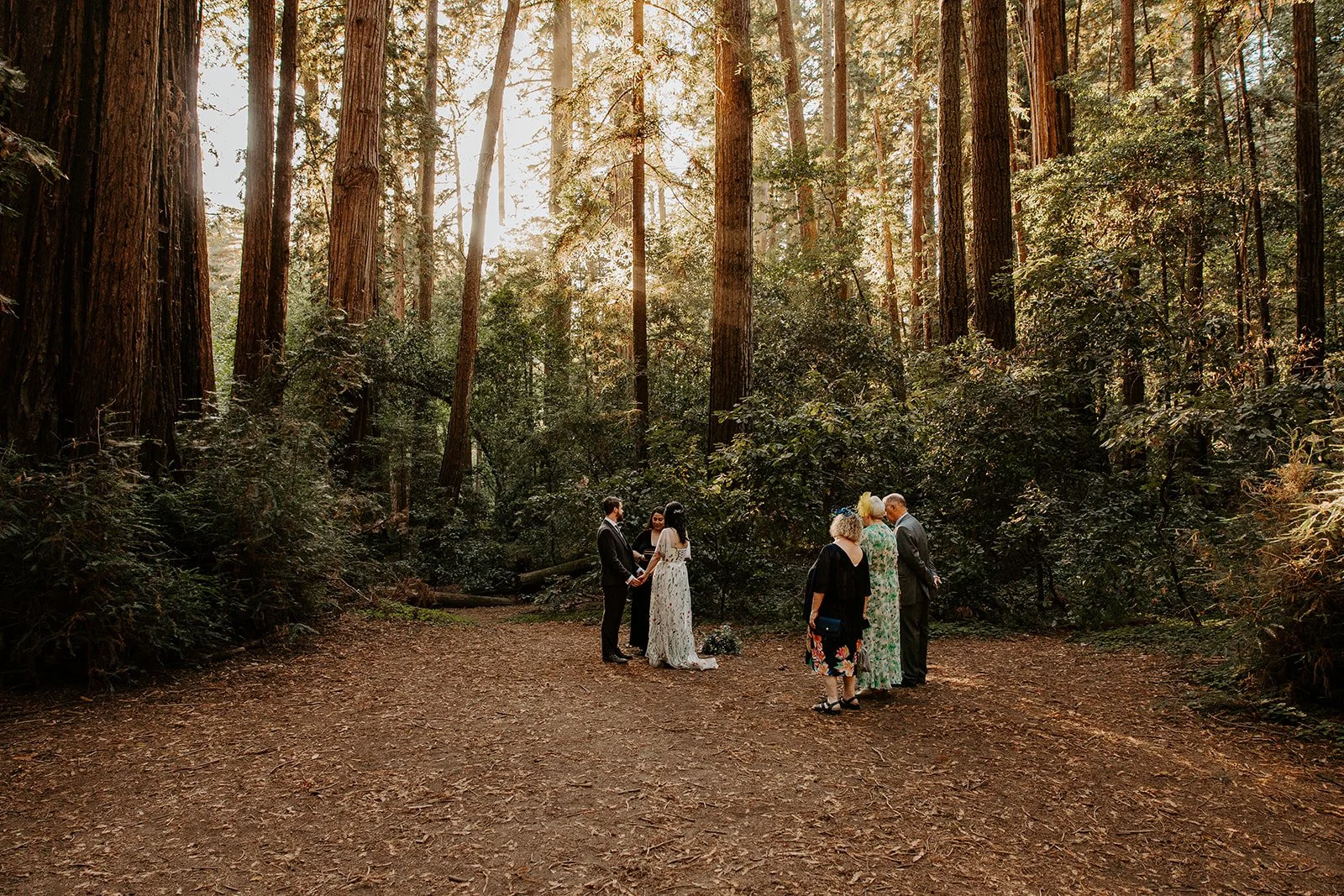
Why Elope in the Redwoods?
There are elopement destinations that are beautiful. And then there are destinations that are genuinely humbling, places that put your wedding day in perspective in a way that makes everything feel more meaningful, not less. The redwoods are one of those destinations.
Couples who elope here consistently describe the same thing: a stillness that settles over the day the moment they step into the forest. The scale of the trees, the filtered cathedral light, the moss-covered ground underfoot. It creates an atmosphere that no venue could replicate and no amount of décor could improve. Your ceremony isn't decorated by the redwoods. It's held by them.
What Makes a Redwoods Elopement Different
Most elopement locations ask you to bring the meaning with you. The redwoods already have it.
Coastal redwoods are the tallest living things on Earth, with some specimens standing over 350 feet and living well beyond a thousand years. Standing among them as you exchange vows isn't just a backdrop. It's context. Your marriage is beginning in a place that has witnessed centuries of seasons, storms, and silence. That weight is real, and couples who elope here feel it.
Beyond the emotional experience, the redwoods offer something that's increasingly rare in popular elopement destinations: genuine seclusion. The northern California parks — Jedediah Smith, Prairie Creek, Humboldt — cover hundreds of thousands of acres of old-growth forest. Even during peak season, it's possible to find groves that feel entirely private, where the only sound is the river and the wind moving through the canopy above you.
The light inside a redwood forest is unlike anything else. Soft, filtered, and diffused through layers of canopy, it's naturally flattering at almost any time of day. Morning fog drifting through the grove. Shafts of afternoon light reaching the forest floor. That quality of light is one of the reasons photographers and couples keep coming back.
Redwoods vs. Sequoias — Which Is Right for Your Elopement?
If you're dreaming of a forest elopement in California, you'll quickly encounter both coastal redwoods and giant sequoias. They're often spoken about interchangeably, but for elopement planning purposes they're meaningfully different experiences, and the right choice depends on what you're actually looking for.
Coastal redwoods grow along the Pacific coast from Big Sur north through the Oregon border. They're the tallest trees on Earth, with a lush fern-filled understory, river access, proximity to the coastline, and a misty moody forest atmosphere. If you want dramatic vertical scale, soft filtered light, and the option to combine your forest ceremony with a coastal sunset, coastal redwoods are your answer.
Giant sequoias grow in the Sierra Nevada Mountains, primarily in Sequoia and Kings Canyon National Parks. They're the largest trees by volume on Earth, with the iconic broad trunks you've likely seen photos of. The atmosphere is different: drier, more open, higher elevation, with a more structured national park experience. Permitting is stricter and crowds are heavier in peak season.
| Coastal Redwoods | Giant Sequoias | |
|---|---|---|
| Location | Pacific Coast, Northern CA + Southern OR | Sierra Nevada Mountains, Central CA |
| Best known for | Height, misty light, fern understory | Massive trunks, ancient scale |
| Elopement atmosphere | Intimate, moody, lush | Grand, open, structured |
| Coast access | Yes — often within an hour | No |
| Permit complexity | Moderate | Higher |
| Crowds | Manageable with planning | Heavy at peak locations |
| Best for | Experience-first, multi-location days | Couples drawn specifically to Sequoia NP |
For most couples planning a guided, experience-first elopement, coastal redwoods offer more flexibility, more intimate settings, and more options to build a full day around. The sequoias are breathtaking, but if you want a ceremony that feels genuinely private and a day that combines forest and coast, the northern California coastal redwoods are the stronger choice.
Is a Redwoods Elopement Right for You?
A redwoods elopement is an exceptional fit if you're drawn to:
Ancient, immersive natural settings where the environment itself carries emotional weight
Privacy and seclusion, even in well-known locations — the scale of these forests makes it genuinely possible
Documentary, presence-first photography that captures how a place actually feels rather than performing for it
A multi-location or multi-day experience that combines forest and coastline into something layered and complete
A day that feels unhurried — the redwoods naturally slow everything down, which is exactly the point
A redwoods elopement may not be the right fit if you're hoping for a walk-up, same-day ceremony with no advance planning. Permits, seasonal access, and crowd patterns all require thoughtful preparation, and the couples who have the most meaningful experiences here are the ones who plan with intention rather than improvise on the day.
If you're still weighing whether the redwoods are the right setting, this guide on National Park vs. State Park elopementswalks through the key decision factors including how permit requirements, privacy, and planning complexity differ between land types.
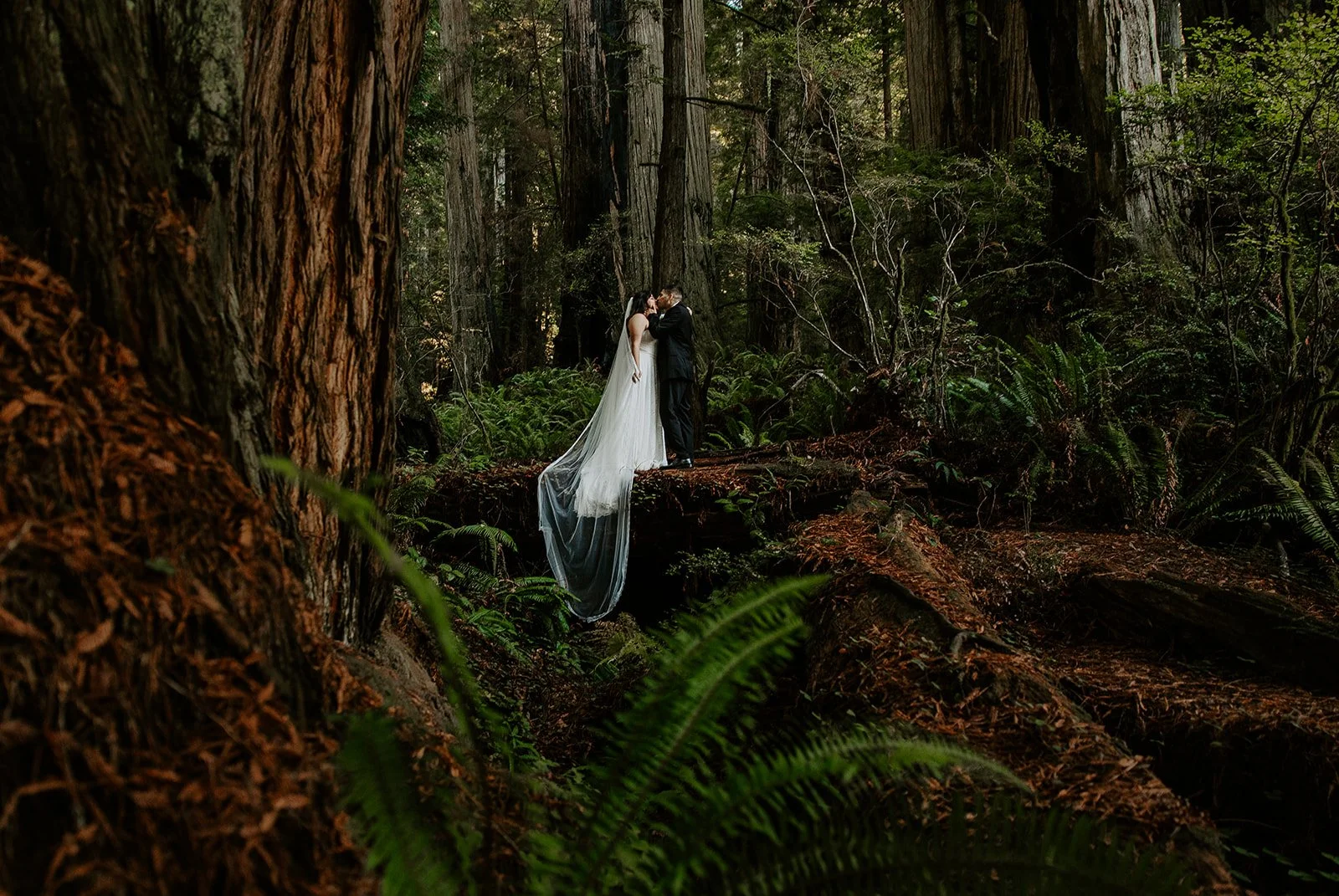
Where Are the Redwoods Located?
California's redwood forests stretch nearly 500 miles along the Pacific Coast, from the Santa Cruz Mountains south of San Francisco all the way north to the Oregon border. The northern parks — Redwood National Park, Jedediah Smith, Prairie Creek, and Humboldt — contain the most ancient and expansive old-growth groves and are the most popular destinations for elopements. Further south, Muir Woods, Henry Cowell, and Big Basin offer more accessible options for couples flying into the Bay Area or San Jose.
The redwoods also extend across the Oregon border, where Samuel H. Boardman State Scenic Corridor and southern Oregon's coastal forests offer a quieter, less-traveled alternative for couples open to a multi-state experience.
The map below shows all major redwood elopement locations across California and southern Oregon, including national parks, state parks, and national forest land.
For a detailed breakdown of each location including permits, crowd levels, and what makes each one elopement-friendly, jump to the Best Places to Elope in the Redwoods section below.
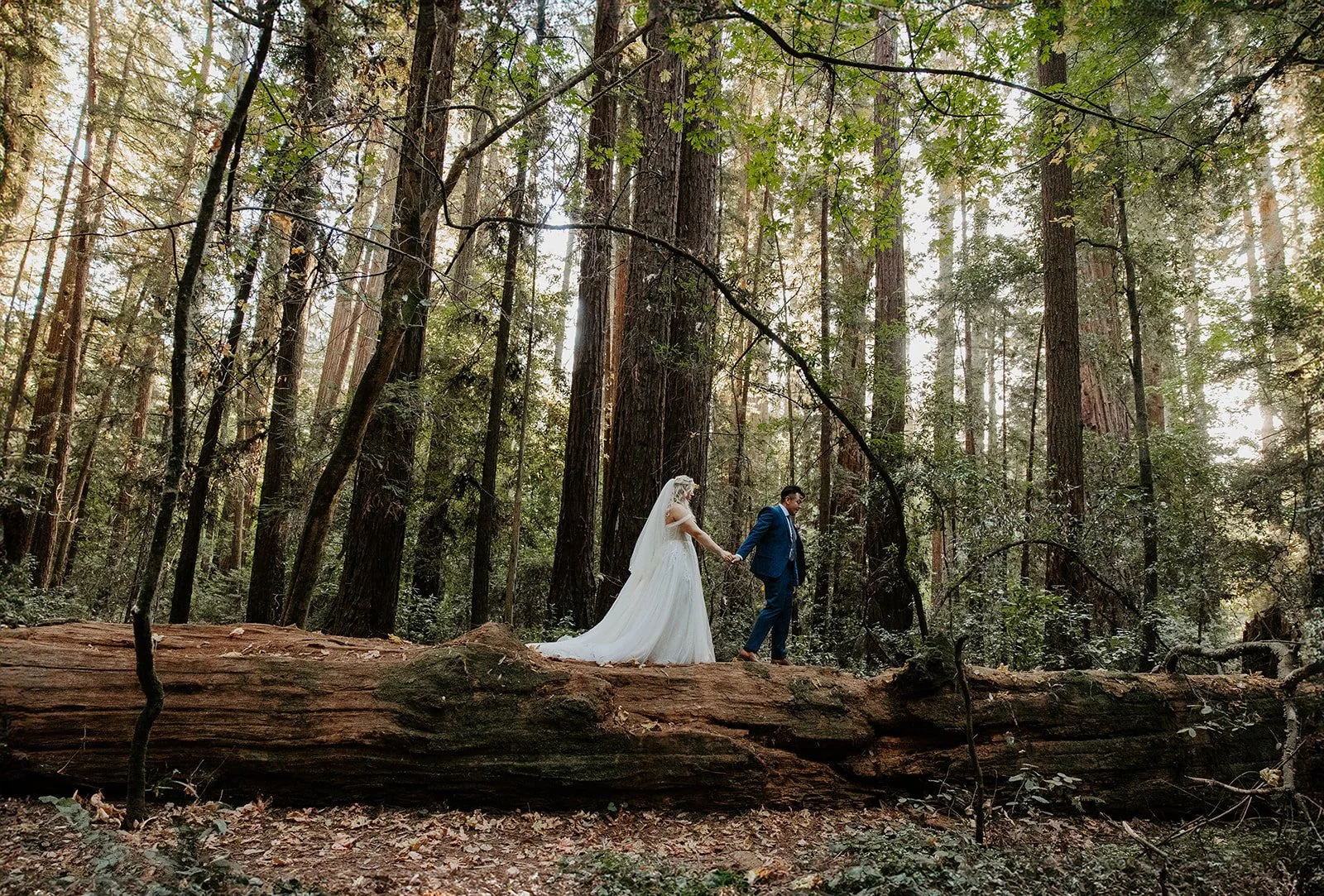
How to Legally Elope in the Redwoods
California's marriage laws are straightforward for out-of-state couples, with no residency requirement, no waiting period, and a flexible licensing process that works in your favor when planning a destination elopement. That said, there are a few California-specific details worth understanding before your day — particularly around the choice between a public and confidential marriage license, which is unique to this state.
California Elopement Requirements at a Glance
Planning to elope in California? Here are the key legal requirements to know.
Marriage license required: Yes
Where to apply: Any County Clerk or Recorder's Office in California
Residency requirement: None
Waiting period: None
Officiant required: Yes
Witnesses required: One (public license) / None (confidential license)
Self-solemnization allowed: No
License validity: 90 days
License usable statewide: Yes
Outdoor ceremony permit: Often required (varies by land)
Public vs. Confidential Marriage License — Which Is Right for You?
California is one of the only states that offers couples a choice between two types of marriage licenses, and for eloping couples the distinction matters.
A public marriage license is the standard option. It requires at least one witness present at your ceremony, and the completed license becomes a public record that anyone can request a copy of. If you're eloping with a small group of family or friends, this is typically the simpler path.
A confidential marriage license requires no witnesses and is not a public record. Copies can only be obtained by the couple themselves with valid identification. For couples eloping just the two of you — which is the majority of experience-first elopements — the confidential license is often the better fit. It removes the logistical need to find and coordinate a witness, and it keeps your marriage record private.
Both license types are legally equivalent. The choice comes down to your guest situation and your preference for privacy.
For a deeper look at how California compares to other states in terms of marriage law simplicity, see the full Easiest Places to Elope in the U.S. guide.
Steps to Obtain Your California Marriage License
1. Apply at any County Clerk or Recorder's Office in California. Both partners must appear together in person and present valid government-issued photo ID. Accepted forms include a driver's license, passport, military ID, or resident alien card. If either partner was previously married, a certified copy of the divorce decree is required.
2. Pay the license fee. Fees vary by county, typically ranging from $35 to $100. Some counties accept credit cards; others require cash or check. Call ahead to confirm your specific county's requirements and current fee before your appointment.
3. Receive your license immediately. California has no waiting period, which means your license is valid for use the same day it's issued. It remains valid for 90 days from the issue date and can be used anywhere in the state regardless of which county issued it.
4. Have your ceremony performed by a qualified officiant. Your officiant must complete and sign the license at or after your ceremony.
5. Return the license within 10 days. Your officiant is responsible for returning the completed license to the appropriate county office within 10 days of your ceremony. Public licenses go to the County Recorder's Office. Confidential licenses go to the County Clerk's Office.
6. Receive your certified marriage certificate. After the license is registered, certified copies of your marriage certificate can be ordered through the county or through the California Department of Public Health.
Finding an Officiant for Your Redwoods Elopement
California requires a legally recognized officiant to perform your ceremony — self-solemnization is not permitted. The good news is that California broadly recognizes online ordination, which gives you significant flexibility in who leads your ceremony.
Your options include:
A professional officiant hired through platforms like WeddingWire, The Knot, or Thumbtack. A good choice for couples who want a polished, experienced ceremony leader without involving family or friends.
A friend or family member ordained online through organizations like the Universal Life Church or American Marriage Ministries. California recognizes these ordinations, making it easy for someone meaningful to you to legally perform your ceremony.
A judge, commissioner, or other authorized civil official, which is less common for outdoor elopements but legally valid.
One important note specific to the redwoods: some permit applications ask for officiant information in advance, particularly in Redwood National Park. Having your officiant confirmed before you submit a permit application keeps the process moving smoothly.
If you're unsure whether to hire a professional officiant or involve someone close to you, this guide on eloping with family walks through how to thoughtfully involve loved ones in your ceremony without complicating the experience.
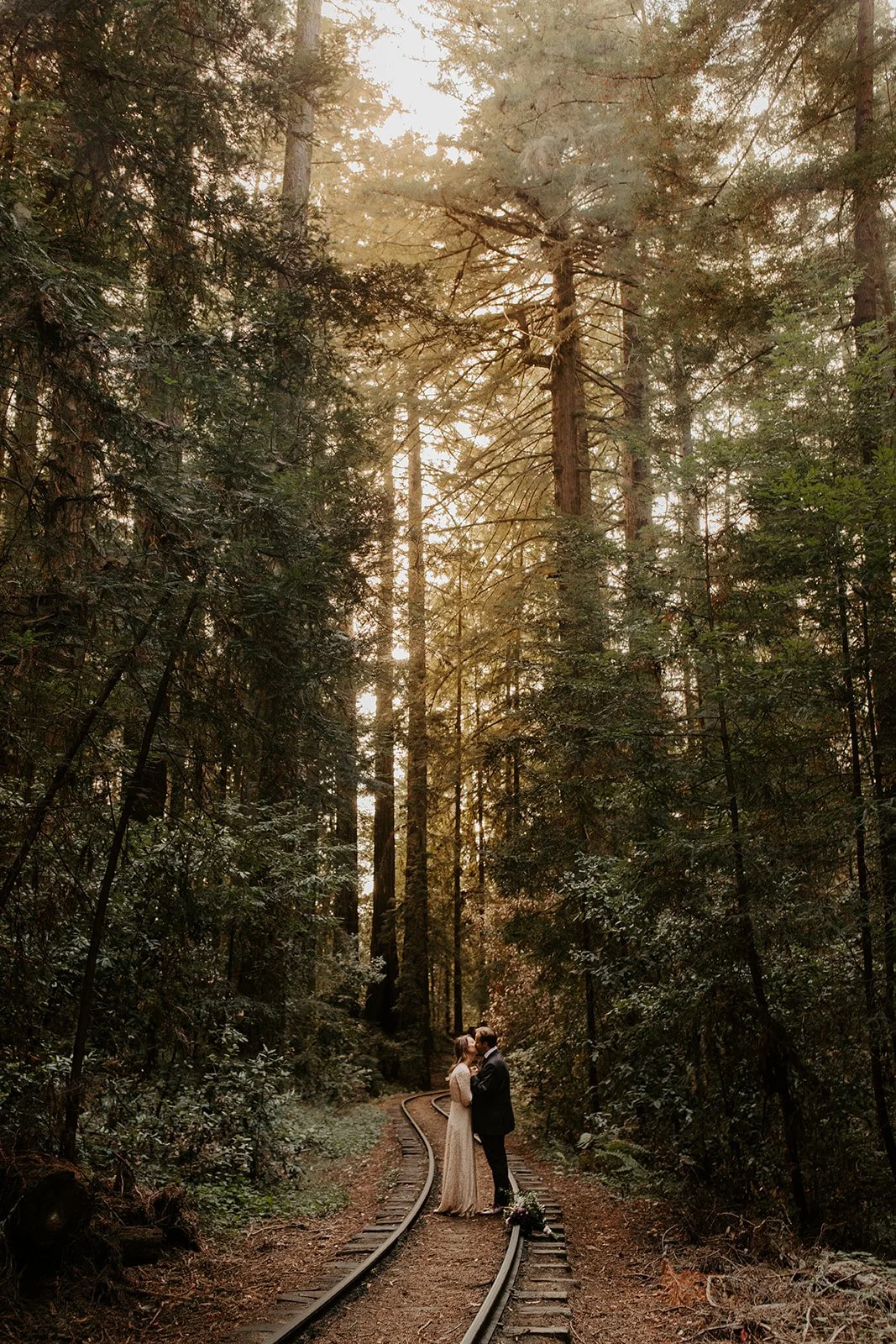
Do You Need a Permit to Elope in the Redwoods?
In most cases, yes — and this is the section of redwoods elopement planning that couples most frequently underestimate. Permit requirements vary significantly depending on which park or land type you choose, and in some locations the application process needs to begin months in advance. Understanding the requirements for your specific location before you finalize your date is one of the most important steps in planning a redwoods elopement that feels calm rather than stressful.
The general rule is this: any ceremony on public land that involves a photographer, an officiant, or a defined gathering of people is typically considered a special event and requires a permit. A couple quietly exchanging vows with no photographer and no guests may fall outside that definition in some locations — but for any planned, documented elopement experience, assume a permit is required and confirm directly with the managing agency.
For a broader look at how permit requirements differ between national parks and state parks, this guide on National Park vs. State Park elopements breaks down the key differences in planning complexity, privacy, and logistics.
Note: Permit requirements, fees, and approved location lists are subject to change. Always confirm current requirements directly with the relevant park or land management agency before finalizing your plans.
Redwood National Park Permits
Redwood National Park is managed by the National Park Service and has some of the most structured permit requirements of any location in this guide. Two separate permits are typically required for a documented elopement here.
Wedding/Special Event Permit Required for any ceremony or formal gathering. Applications are submitted through the park's Special Use Permit process. Standard approved locations are available with a standard application fee. Non-standard or custom locations require a $200 application fee, staff review, and are subject to approval — not all requests are granted. Peak-hour blackout periods may also apply at high-traffic locations.
Commercial Photography Permit A separate commercial use permit is required for any professional photographer working within the park. This is standard across National Park Service land and applies regardless of whether you're shooting for personal or commercial use if compensation is involved.
Key considerations:
Apply early — NPS permit processing can take 4–6 weeks or longer during peak seasons
Group size limits apply and vary by location
Decorations, amplified sound, and open flames are generally prohibited
Some locations require pack-in / pack-out protocols with no trace left behind
Jedediah Smith Redwoods State Park Permits
Jedediah Smith is managed jointly by California State Parks and the National Park Service as part of the Redwood National and State Parks complex. A Special Use Permit is required for elopement ceremonies.
California State Parks maintains a pre-approved ceremony location list for the Redwood National and State Parks complex. Couples choosing from this list face a more straightforward application process. Locations outside the pre-approved list are subject to individual review and are not guaranteed.
Key considerations:
Applications are submitted through the California State Parks Special Events permit system
Fees vary depending on group size, location, and duration — confirm current fee schedule directly with the park
Guest capacity limits apply at most ceremony locations
Stout Grove is one of the most requested ceremony locations and books up quickly — apply as early as possible if this is your preferred spot
Commercial photography permits may also be required — confirm when submitting your application
Prairie Creek Redwoods State Park Permits
Prairie Creek is also part of the Redwood National and State Parks complex and follows the same joint management structure as Jedediah Smith. A Special Use Permit is required for ceremonies.
Key considerations:
Pre-approved ceremony locations include sites along Cathedral Trees Trail and select areas near Redwood Creek
Fern Canyon is one of the most-requested portrait locations in the park but is not available as a ceremony location — it can be used for portraits before or after your ceremony
A timed entry reservation is required for Fern Canyon from May 15 through September 15 — factor this into your timeline planning
Group size limits are strictly enforced
Pack-in / pack-out required at all locations — no decorations, chairs, or floral arrangements left behind
Humboldt Redwoods State Park Permits
Humboldt is managed entirely by California State Parks and operates independently from the Redwood National and State Parks complex. The permit process here is generally considered more accessible than the northern parks.
Key considerations:
Special Use Permit required for ceremonies — applications submitted through California State Parks
The Avenue of the Giants corridor offers multiple ceremony location options with varying levels of accessibility and privacy
Guest capacity limits apply and vary by specific location
Humboldt is one of the more flexible options for couples wanting guests at their ceremony, with some locations accommodating larger groups than the northern parks allow
Commercial photography permits may be required — confirm at time of application
Other California Redwood Locations — Muir Woods, Henry Cowell, Big Basin
Muir Woods National Monument Managed by the National Park Service. Special Use Permit and commercial photography permit both required. Ceremony locations are limited to specific pre-approved areas within the monument. The permit process is competitive — Muir Woods is one of the most in-demand elopement locations in Northern California and permits at preferred locations book out well in advance. Early morning weekday ceremonies offer the best combination of permit availability and privacy.
Henry Cowell Redwoods State Park Managed by California State Parks. The Redwood Grove Picnic Area is a reservable ceremony space accommodating up to 20 guests. This is one of the more straightforward permit processes among Bay Area redwood locations, making Henry Cowell a good option for couples who want a structured, accessible ceremony with guests. Applications submitted through the California State Parks reservation system.
Big Basin Redwoods State Park California's oldest state park is currently undergoing significant restoration following the 2020 CZU Lightning Complex fire, which burned approximately 97% of the park. Access is limited and variable, and ceremony availability is not guaranteed. Confirm directly with the park before making any plans to elope here — conditions and access points continue to evolve as restoration progresses.
Armstrong Redwoods, Portola, Hendy Woods, Montgomery WoodsThese smaller parks and reserves operate under California State Parks or local land management agencies. Permit requirements vary — some have formal special event permit processes, others operate on a simpler reservation system, and a few currently allow small low-impact ceremonies without formal permits. Always confirm current requirements directly with the managing agency before finalizing any plans.
A Note on the Southern Oregon Redwoods
The redwood groves along the southern Oregon coast — including the Oregon Redwoods Trail, Redwood Nature Trailhead, and Winchuck State Recreation Site near Brookings — fall under Oregon state and federal jurisdiction rather than California. Permit requirements differ from the California parks and are generally less formal for small, low-impact ceremonies in these locations.
That said, regulations can change and any planned elopement with a professional photographer should be confirmed in advance with the Oregon Department of Forestry or the relevant managing agency. The lower visitor traffic and relaxed atmosphere of these Oregon locations make them genuinely worth considering for couples open to crossing the border — particularly when the California northern parks feel logistically overwhelming.
The bottom line on permits: the redwoods are not a walk-up elopement destination. The permit process is manageable when you plan ahead, but it requires research, lead time, and flexibility. This is one of the most common areas where couples feel overwhelmed during planning — and one of the most valuable things a guided elopement experience handles on your behalf.
How To Elope in the Redwoods
Obtain a Marriage License in California
Choose between a public or confidential marriage license.
Public License
Couples must have at least one witness, however, there cannot be more than two on the license if additional witnesses are desired. The marriage license is a public record and copies may be purchased by anyone at any time.
Confidential License
No witnesses or witness signatures are required. Copies of the license may only be purchased by the couple with valid identification. Persons other than the couple requesting a copy of the marriage license may only do so through a court order.
Note: There is no official age requirement for witnesses in California, however, they must be conscious and mature enough to know and understand they are witnessing a marriage ceremony. They must also be able to sign their own name on the marriage license with full knowledge of what they’re doing. This means it is up to each couple when determining their chosen witness and if they meet these expectations.
Meet the Additional Requirements to Obtain a Marriage License
Both parties must be 18 years or older
Note: couples will need valid photo IDs. Passports, naturalization certificates, resident alien cards, driver’s licenses, or military IDs are accepted.
Both parties must be unmarried
Note: If either party was previously married, they must provide a certified copy of the divorce issued by the court.
Obtain & Register Your Marriage License
Purchase your license
Apply for a marriage license at any County Clerk or Recorder’s Office throughout the state. You can do this online or in person.
Note: Couples must appear together and present valid identification.
Note: Once your marriage license is issued, it is eligible to be used anywhere in California for up to 90 days.
Register your license
Have your marriage ceremony performed by an authorized officiant within 90 days of receiving your license. The officiant must complete the license and return it to the County Recorder’s Office (for public marriages) or the County Clerk’s Office (for confidential marriages) within 10 days of the ceremony. Couples will then have to wait for their marriage certificate to be registered and mailed to them by the state office.
Note: You do NOT have to get married in the same county your marriage license was purchased and registered.
Best Places to Elope in the Redwoods
California's redwood forests span nearly 500 miles of coastline and extend into the Sierra Nevada Mountains, offering an enormous range of elopement settings. Choosing the right location isn't just about which grove looks most beautiful in photos — it's about matching the setting to your priorities: privacy, accessibility, permit complexity, guest count, and how you want your day to feel from start to finish.
The comparison table below gives you a quick overview of every major location. Detailed breakdowns follow for each park.
← Scroll to view full table →
| Location | Region | Closest Airport | Permit Required | Crowd Level | Coast Access | Guest Friendly | Best For |
|---|---|---|---|---|---|---|---|
| Jedediah Smith SP | Northern CA | CRQ — 20 min | Yes | Low–Moderate | 45 min | Small groups | Intimate old-growth ceremonies |
| Prairie Creek SP | Northern CA | ACV — 1 hr | Yes | Low–Moderate | 20 min | Small groups | Forest + beach multi-location days |
| Del Norte Coast SP | Northern CA | CRQ — 15 min | Yes | Low | 10 min | Couples only | Maximum seclusion |
| Redwood National Park | Northern CA | ACV — 45 min | Yes | Moderate | 30 min | Limited | Iconic NPS scenery |
| Humboldt SP | Northern CA | ACV — 30 min | Yes | Low–Moderate | 1 hr | Moderate | Guests + flexibility |
| Oregon Redwoods Trail | Southern OR | CRQ — 30 min | Confirm | Very low | 30 min | Couples only | Off-the-radar privacy |
| Muir Woods | Bay Area | SFO — 30 min | Yes | High | 45 min | Very limited | Iconic Bay Area setting |
| Armstrong Redwoods | Bay Area | STS — 20 min | Yes | Low | 1 hr | Small groups | Sonoma wine country pairing |
| Henry Cowell SP | Bay Area | SJC — 45 min | Yes | Low–Moderate | 30 min | Up to 20 guests | Accessible Bay Area ceremony |
| Big Basin SP | Bay Area | SJC — 1 hr | Confirm | Very low | 45 min | Limited | Post-restoration seclusion |
| Hendy Woods SP | Mendocino | STS — 1.5 hrs | Confirm | Very low | 1 hr | Small groups | Wine country + forest pairing |
| Montgomery Woods | Mendocino | STS — 1.5 hrs | Confirm | Very low | 1.5 hrs | Couples only | Complete privacy |
| Pfeiffer Big Sur SP | Big Sur | MRY — 1 hr | Yes | Moderate | 5 min | Small groups | Big Sur forest + coast |
| Julia Pfeiffer Burns SP | Big Sur | MRY — 1.5 hrs | Yes | Moderate | 5 min | Small groups | Waterfall + forest ceremony |
| Portola Redwoods SP | Santa Cruz | SJC — 1 hr | Yes | Very low | 45 min | Small groups | Quiet Santa Cruz mountains |
| Sequoia NP | Sierra Nevada | FAT — 1.5 hrs | Yes | High | None | Limited | Monumental giant sequoia scale |
| Kings Canyon NP | Sierra Nevada | FAT — 1.5 hrs | Yes | Moderate | None | Limited | Rugged canyon + sequoia scenery |
| Mariposa Grove, Yosemite | Sierra Nevada | FAT — 2 hrs | Yes | High | None | Limited | Yosemite sequoias |
| Merced Grove, Yosemite | Sierra Nevada | FAT — 2 hrs | Yes | Very low | None | Couples only | Quiet Yosemite alternative |
| Calaveras Big Trees SP | Sierra Nevada | SMF — 2 hrs | Yes | Low | None | Small groups | Accessible sequoia experience |
| Nelder Grove | Sierra Nevada | FAT — 1.5 hrs | Confirm | Very low | None | Couples only | Hidden gem sequoia seclusion |
CRQ — Jack McNamara Field, Crescent City CA | ACV — California Redwood Coast–Humboldt County Airport, Arcata CA | SFO — San Francisco International Airport | STS — Charles M. Schulz–Sonoma County Airport | SJC — San Jose International Airport | MRY — Monterey Regional Airport | FAT — Fresno Yosemite International Airport | SMF — Sacramento International Airport
Jedediah Smith Redwoods State Park
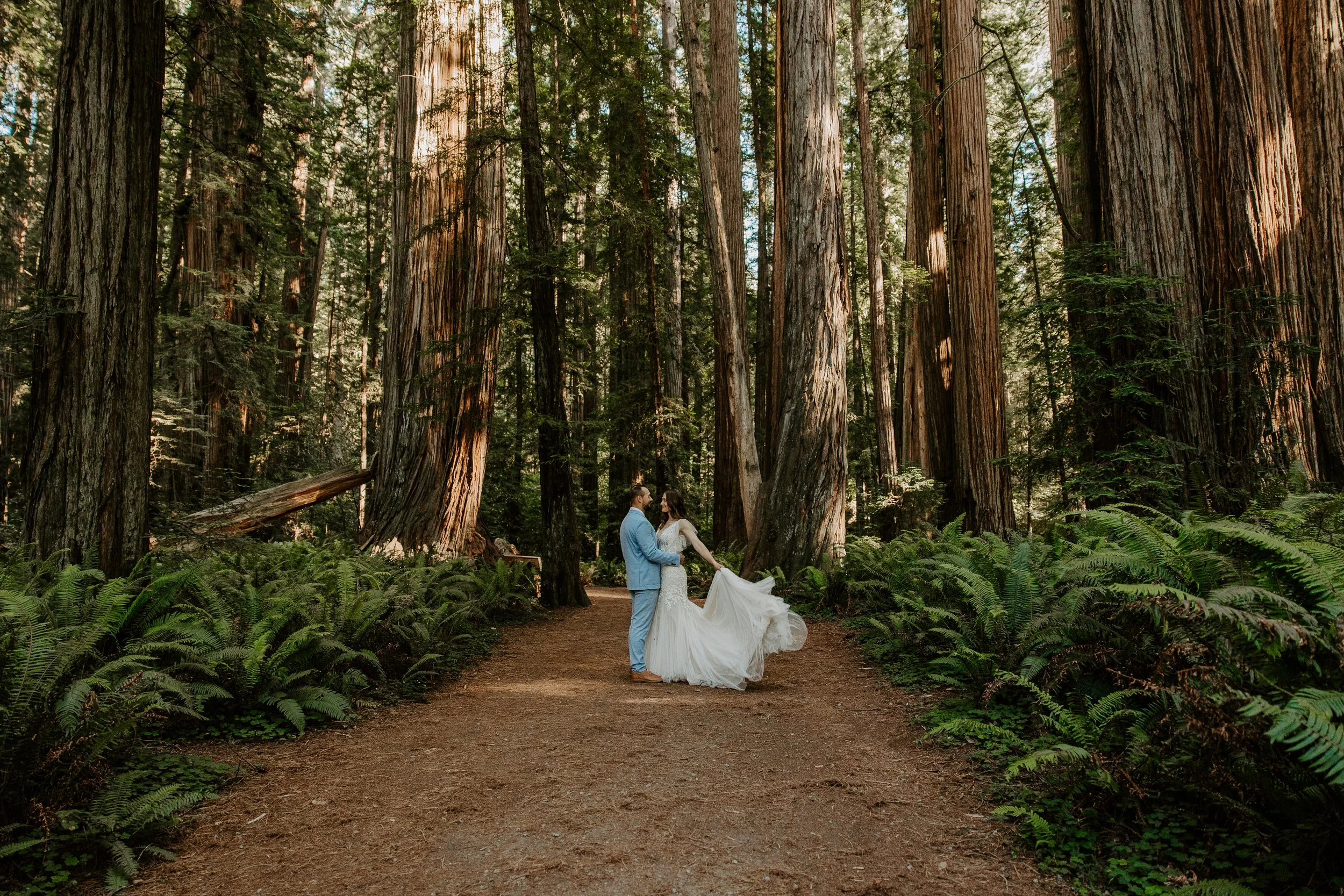
Jedediah Smith is the most requested redwood elopement location on the site — and for good reason. The old-growth groves here are among the most pristine and undisturbed in the entire redwood range. Stout Grove in particular is consistently considered one of the most beautiful old-growth groves in California, with massive ancient trees, a quiet river bend, and soft filtered light that makes almost every time of day workable for photography.
What sets Jedediah Smith apart from other northern parks is its combination of forest intimacy and accessibility. The groves are not a strenuous hike from the trailhead, which makes it a realistic option for couples of varying fitness levels while still feeling genuinely remote. The Smith River — one of the last major undammed rivers in California — runs through the park and adds a layer of natural sound and scenery that few elopement locations anywhere can match.
Proximity to the Oregon border is also worth noting. Couples staying in Brookings, Oregon can access Jedediah Smith in under an hour, making a cross-border elopement experience genuinely practical.
Best season: late spring through early fall for mild temperatures and full river flow. Fall brings quieter trails and beautiful light. Winter is possible but weather can be unpredictable and some roads close seasonally.
See a real elopement at Jedediah Smith: Jedediah Smith Redwoods Elopement — McKenzie + Nathan
Prairie Creek Redwoods State Park
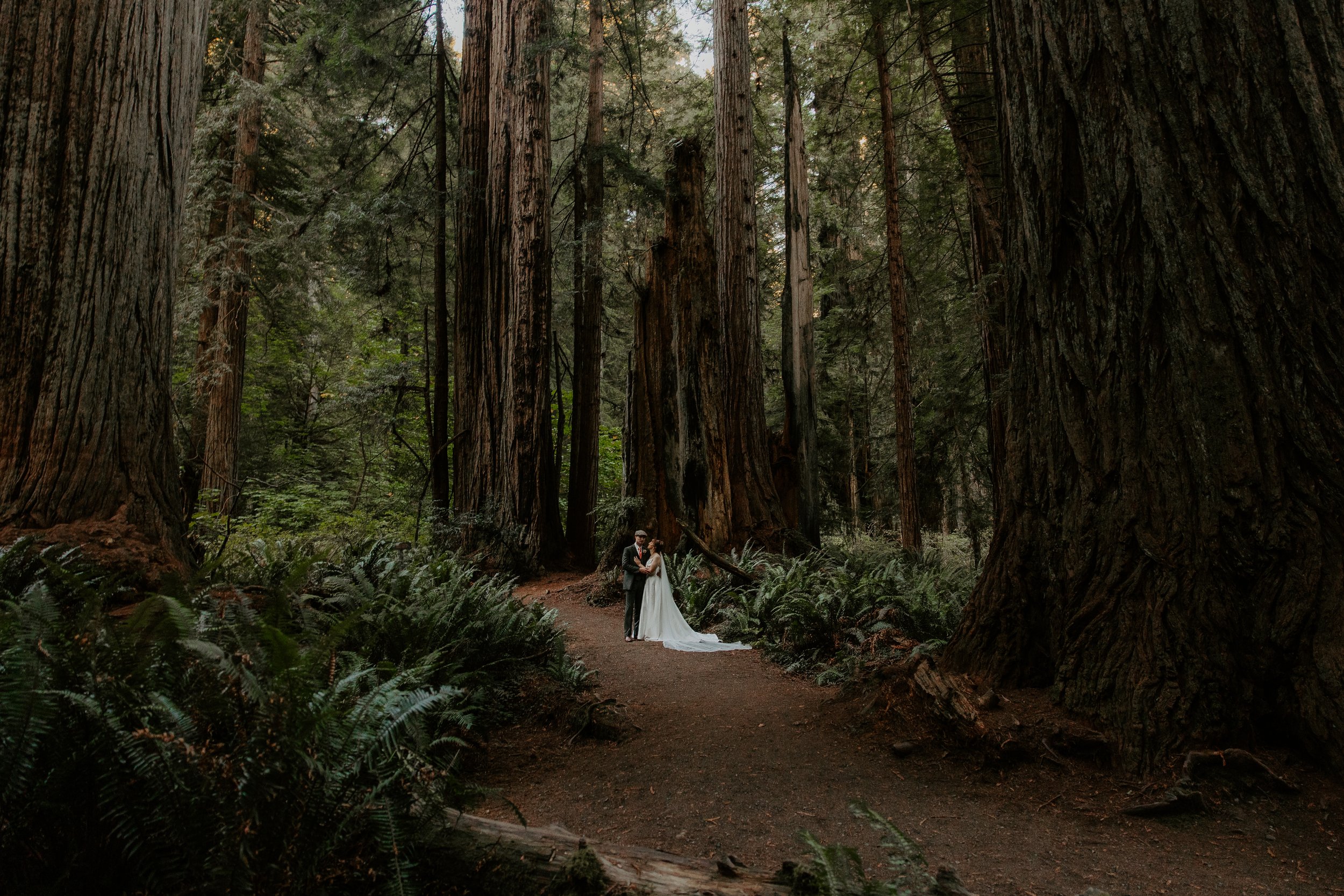
Prairie Creek is the most versatile location in the northern parks for couples wanting a multi-experience elopement day. The park offers genuine old-growth forest ceremony options, the extraordinary Fern Canyon for portraits, and Redwood Creek Beach for a coastal element — all within a relatively compact area that keeps driving time minimal.
Cathedral Trees Trail is one of the most requested ceremony locations within Prairie Creek, offering a towering grove of ancient redwoods that genuinely earns its name. The sense of scale and the quality of light along this trail are exceptional throughout the day.
Fern Canyon deserves its own mention. The canyon walls lined floor-to-ceiling with five-fingered ferns create one of the most otherworldly portrait environments available to eloping couples anywhere in the U.S. It cannot be used as a ceremony location but as a portrait destination it is genuinely unmatched. Factor in the timed entry reservation requirement from May 15 through September 15 when building your timeline.
Best season: spring and fall for optimal trail conditions, wildflower blooms, and manageable crowds. Summer works well for couples committed to early morning ceremonies before day visitors arrive.
See a real elopement at Prairie Creek: Prairie Creek Redwoods Elopement — Dovi + Dan
Del Norte Coast Redwoods State Park
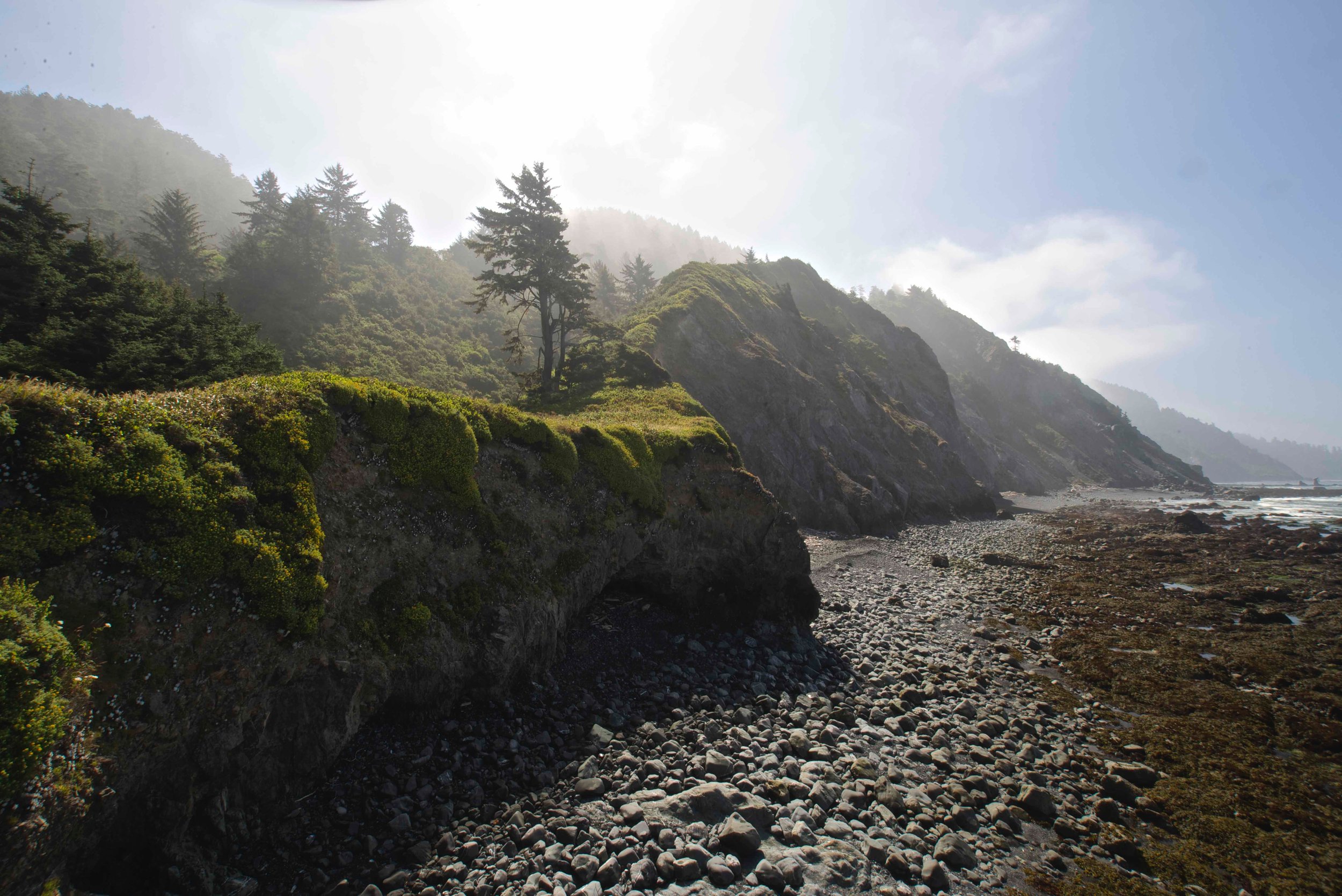
Del Norte is the most underutilized park in the northern redwood complex and one of the best-kept secrets for couples prioritizing seclusion. Situated between Jedediah Smith to the north and Prairie Creek to the south, it receives a fraction of the visitors of either neighboring park while offering equally dramatic old-growth scenery combined with rugged coastal bluffs and ocean views.
For couples who want the redwood forest experience without the planning complexity of the higher-profile parks, Del Norte consistently delivers. Trails like Damnation Creek offer steep, rewarding hikes to coastal overlooks that feel genuinely remote even during peak season.
Best season: spring and fall for manageable conditions. Winter brings heavy rainfall and dramatic moody light — a genuinely beautiful option for the right couple.
Redwood National Park
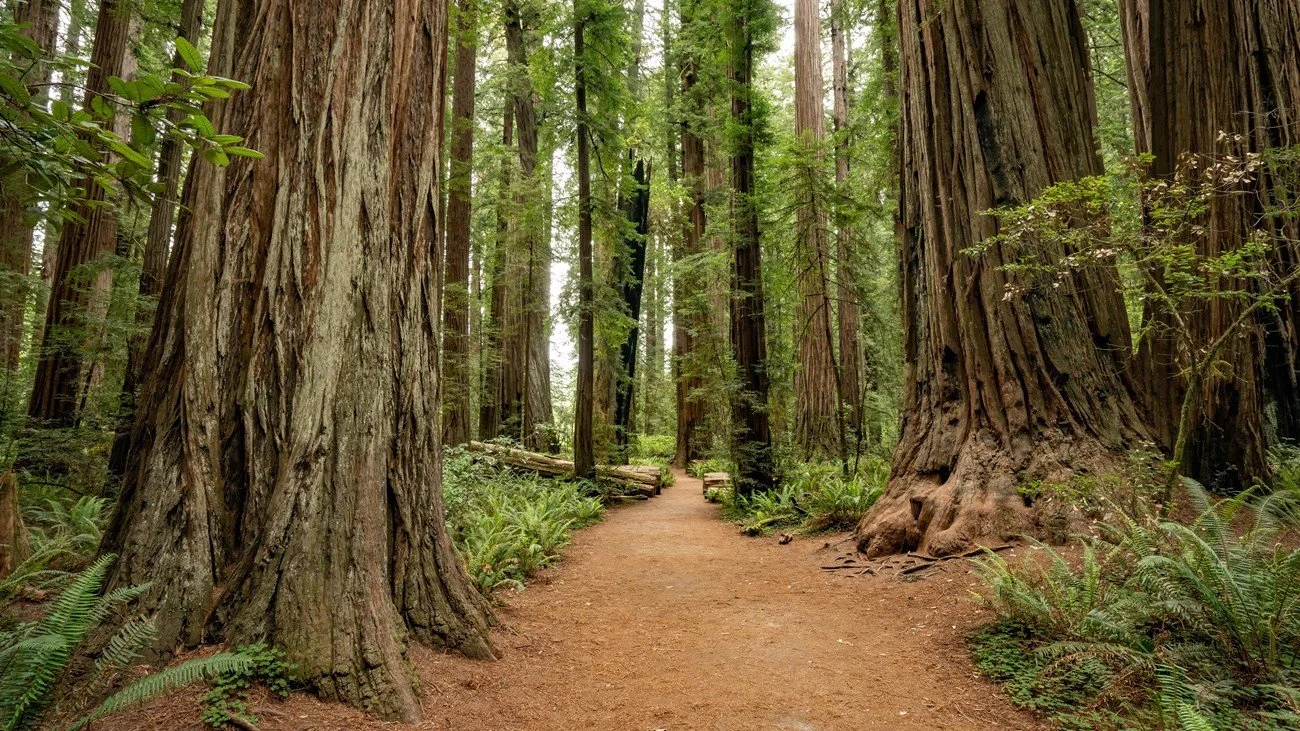
Redwood National Park provides the most iconic federally protected old-growth scenery in the redwood range, including access to the Tall Trees Grove — home to some of the tallest individual trees on Earth. The NPS management structure means the permit process is more involved than state parks, but the scenery and the weight of eloping on nationally protected land carries a significance that many couples find meaningful.
Key planning notes: two permits are required (wedding permit and commercial photography permit), non-standard locations carry a $200 application fee and are subject to staff review, and peak-hour blackout periods apply at high-traffic areas. Begin the permit process at least 3 to 4 months before your elopement date to allow adequate processing time.
The national park works best for couples who have a specific vision tied to the NPS designation and are comfortable with a more structured planning process. For couples who want maximum flexibility and privacy, the state parks immediately surrounding Redwood National Park often deliver a comparable experience with less logistical complexity.
For more on how national park and state park elopement experiences differ, see National Park vs. State Park: Which Is Better for Your Elopement?
Humboldt Redwoods State Park
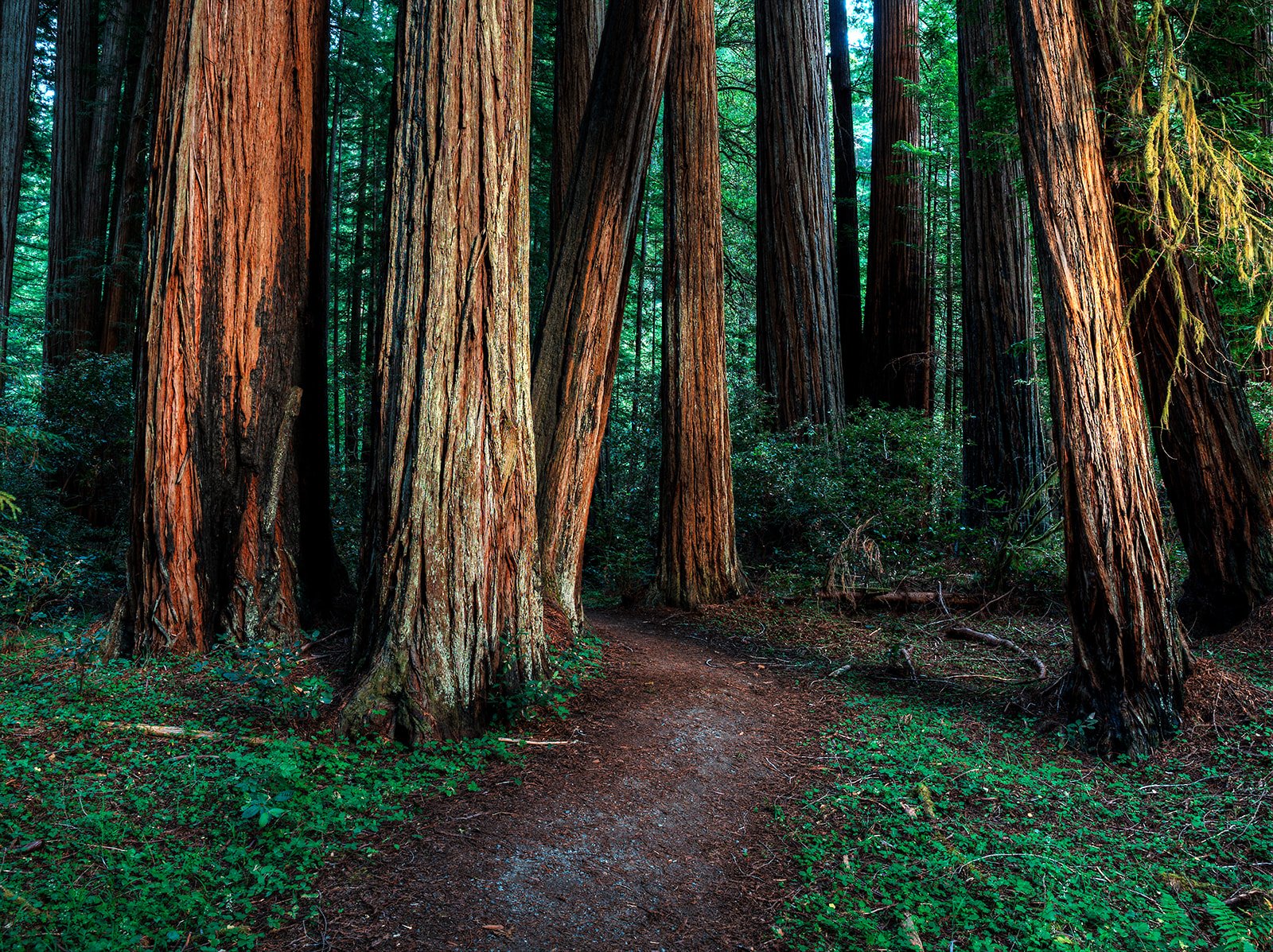
Humboldt is the largest redwood state park in California and one of the most accessible options for couples who want old-growth scenery without the logistical intensity of the northern parks complex. The Avenue of the Giants — a 31-mile scenic highway running through the heart of the park — offers multiple pull-off ceremony locations ranging from intimate grove settings to more open, accessible areas suitable for small groups.
Humboldt is also one of the better options for couples wanting guests at their ceremony. Some ceremony locations within the park accommodate larger groups than Jedediah Smith or Prairie Creek allow, making it a practical choice for couples eloping with immediate family.
The park's size and the variety of accessible locations along the Avenue of the Giants also mean backup options are genuinely available if your primary ceremony site is impacted by weather or unexpected visitors — something that matters more than most couples realize when planning an outdoor experience.
Best season: fall for peak foliage color and cooler temperatures. Spring for wildflowers and full waterfall flow. Summer is manageable with early morning timing.
Oregon Redwoods Trail, Redwood Nature Trailhead & Winchuck State Recreation Site
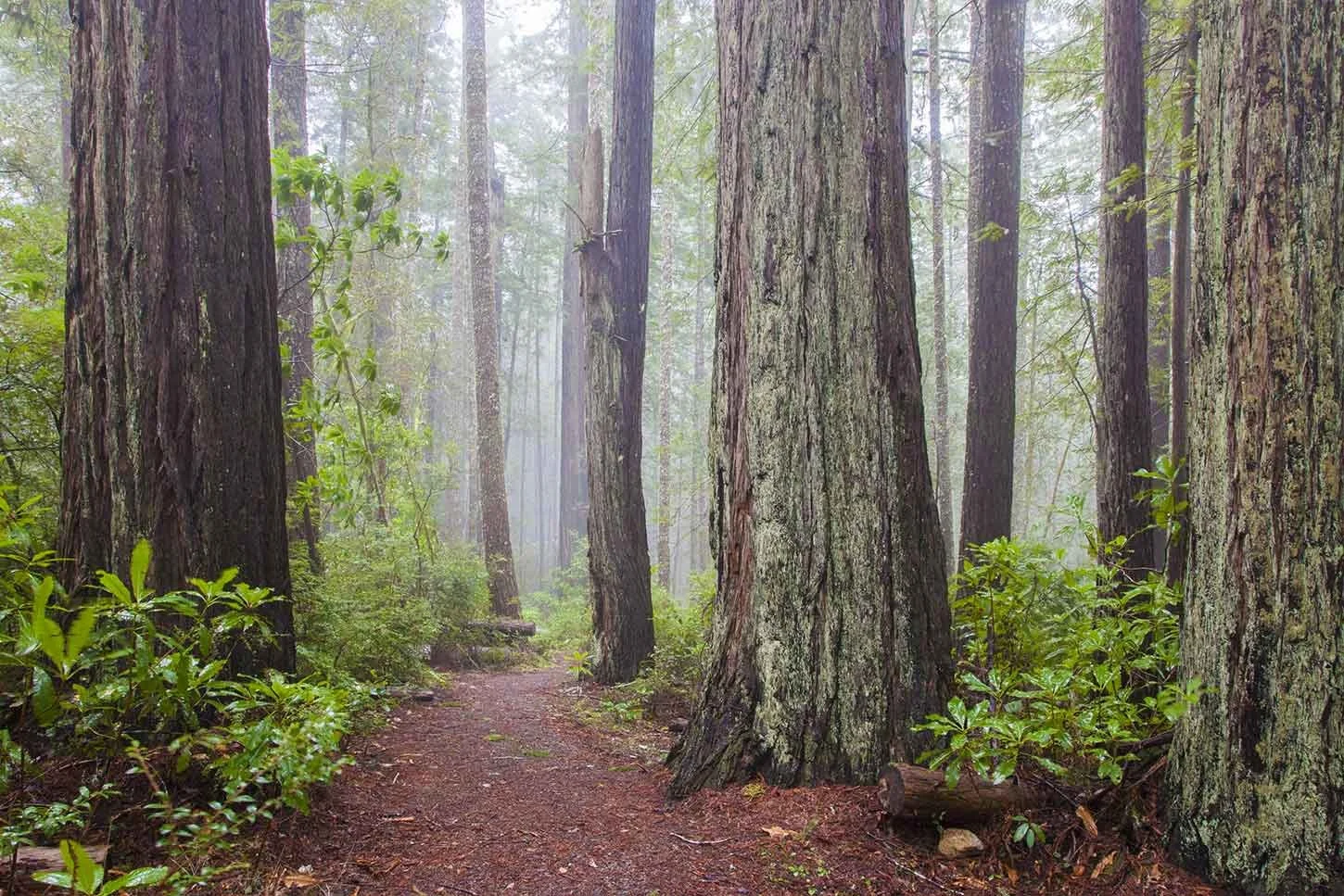
The southern Oregon redwood locations near Brookings represent one of the most genuinely off-the-radar elopement options in this entire guide. Very few elopement photographers or planning resources mention these locations — which is precisely what makes them worth knowing about.
The Oregon Redwoods Trail offers a short but stunning hike through one of Oregon's only old-growth redwood groves, with a quiet intimacy that the busier California parks can rarely match. The Redwood Nature Trailhead provides easy access to old-growth trees just inside the Oregon border. Winchuck State Recreation Site adds a peaceful riverside element adjacent to the forest.
For couples open to a slightly longer drive from Crescent City — or staying in Brookings — these Oregon locations offer a genuinely unique and private experience. Permit requirements are less formalized than the California parks but should always be confirmed in advance with the Oregon Department of Forestry or relevant managing agency.
Muir Woods National Monument
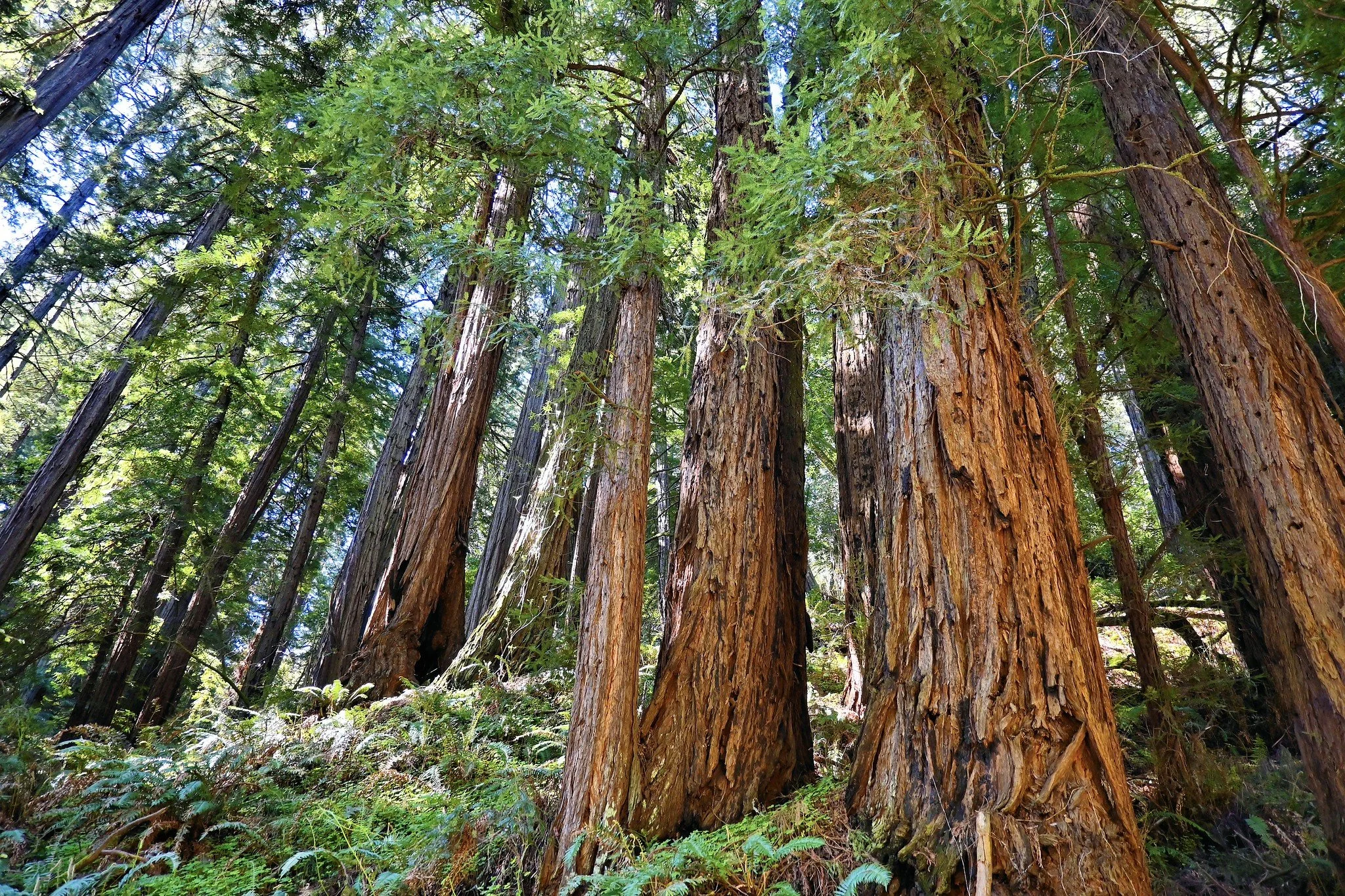
Muir Woods is the most accessible old-growth redwood location in the United States, sitting just 30 minutes north of San Francisco. Its proximity to a major international airport and one of the country's most visited cities makes it the default first option for many couples considering a redwood elopement — which is also what makes it the most challenging location for privacy.
That said, a well-planned Muir Woods elopement can still feel intimate. Early morning weekday ceremonies — before the park opens to general visitors — offer a window of genuine quiet. The cathedral-like quality of the Cathedral Grove, the boardwalk trails, and the towering canopy overhead create an undeniably beautiful and meaningful ceremony setting.
Two permits are required: a special use permit and a commercial photography permit. Permit availability at preferred locations is competitive — begin the application process well in advance, particularly for spring and fall dates.
For couples flying into San Francisco, Muir Woods pairs beautifully with a Marin Headlands golden hour session and dinner in Sausalito or Mill Valley, creating a complete Bay Area elopement day without extensive driving.
Armstrong Redwoods State Natural Reserve
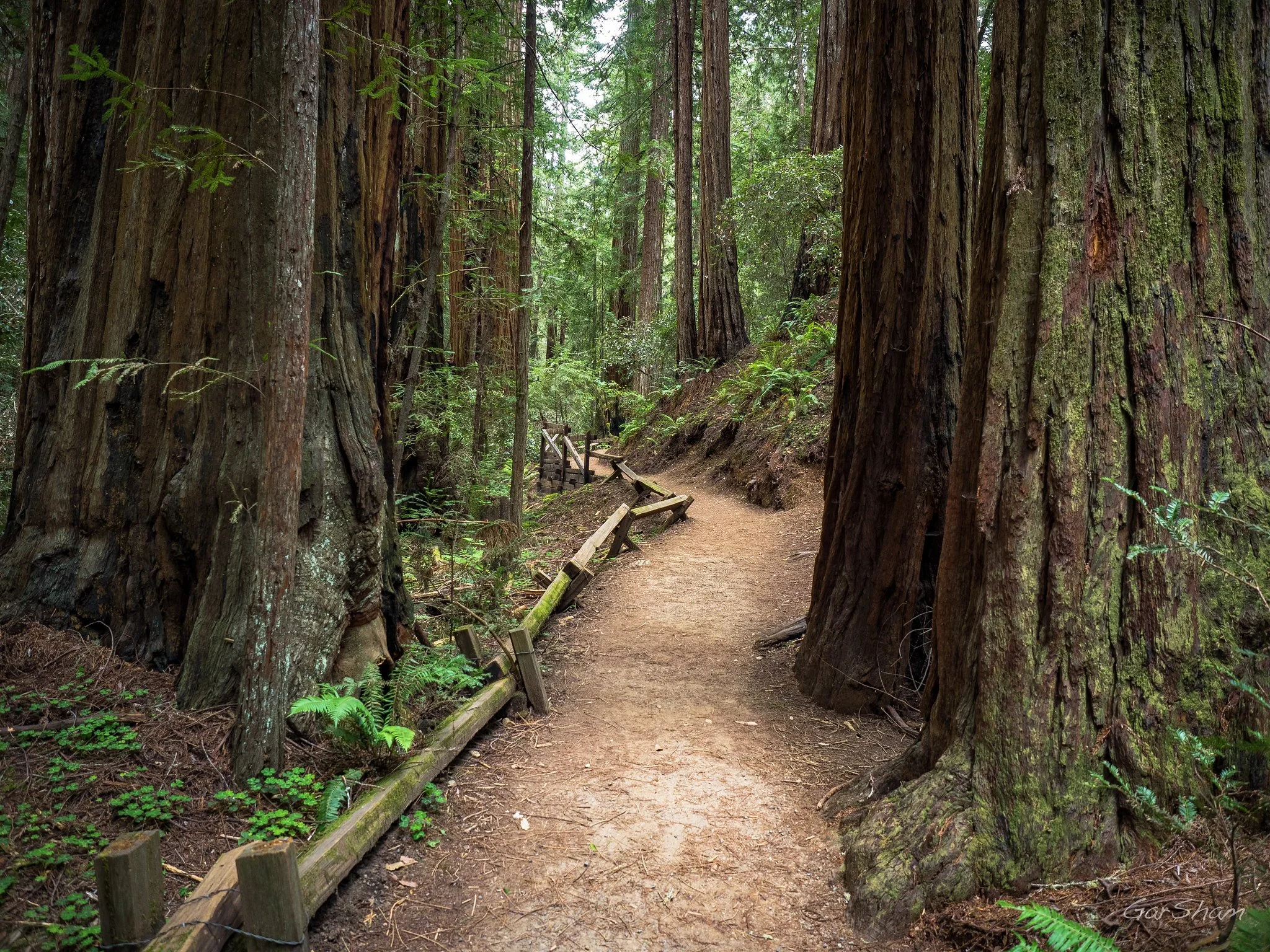
Armstrong Redwoods offers old-growth coastal redwoods in the heart of Sonoma County wine country, making it one of the most naturally appealing multi-experience elopement locations on the California coast. A morning forest ceremony at Armstrong can flow naturally into an afternoon of exploring the Russian River Valley, followed by a private wine country dinner — all within a compact geographic area.
The reserve's relatively flexible permit process and welcoming atmosphere make it one of the more accessible options for couples who want a genuine old-growth experience without the intensity of the northern parks. Well suited for small ceremonies with guests.
Henry Cowell Redwoods State Park
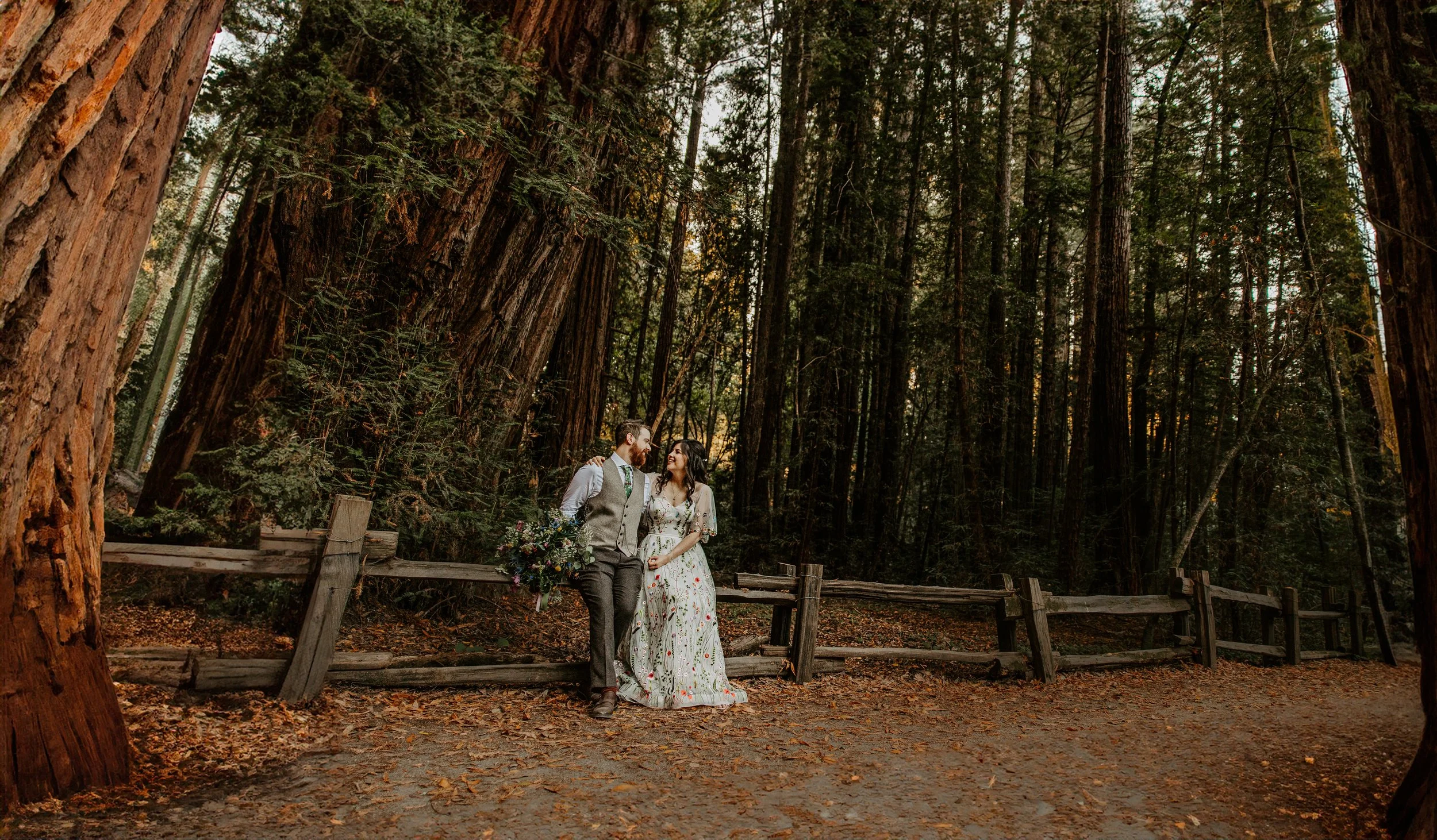
Henry Cowell offers one of the most logistically straightforward redwood elopement experiences in the state. The reservable Redwood Grove Picnic Area provides a formal ceremony space accommodating up to 20 guests with a clear reservation process through the California State Parks system.
Located near Felton in the Santa Cruz Mountains, Henry Cowell is an easy drive from San Jose International Airport and approximately 90 minutes from San Francisco. Its proximity to the Santa Cruz coastline makes it a natural choice for couples wanting a forest ceremony followed by a coastal celebration — similar to the northern parks experience but significantly more accessible from the Bay Area.
See a real elopement at Henry Cowell: Henry Cowell Redwoods Elopement — Kate + Antonio and Henry Cowell Redwoods Elopement — Julie + Alexander
Big Basin Redwoods State Park
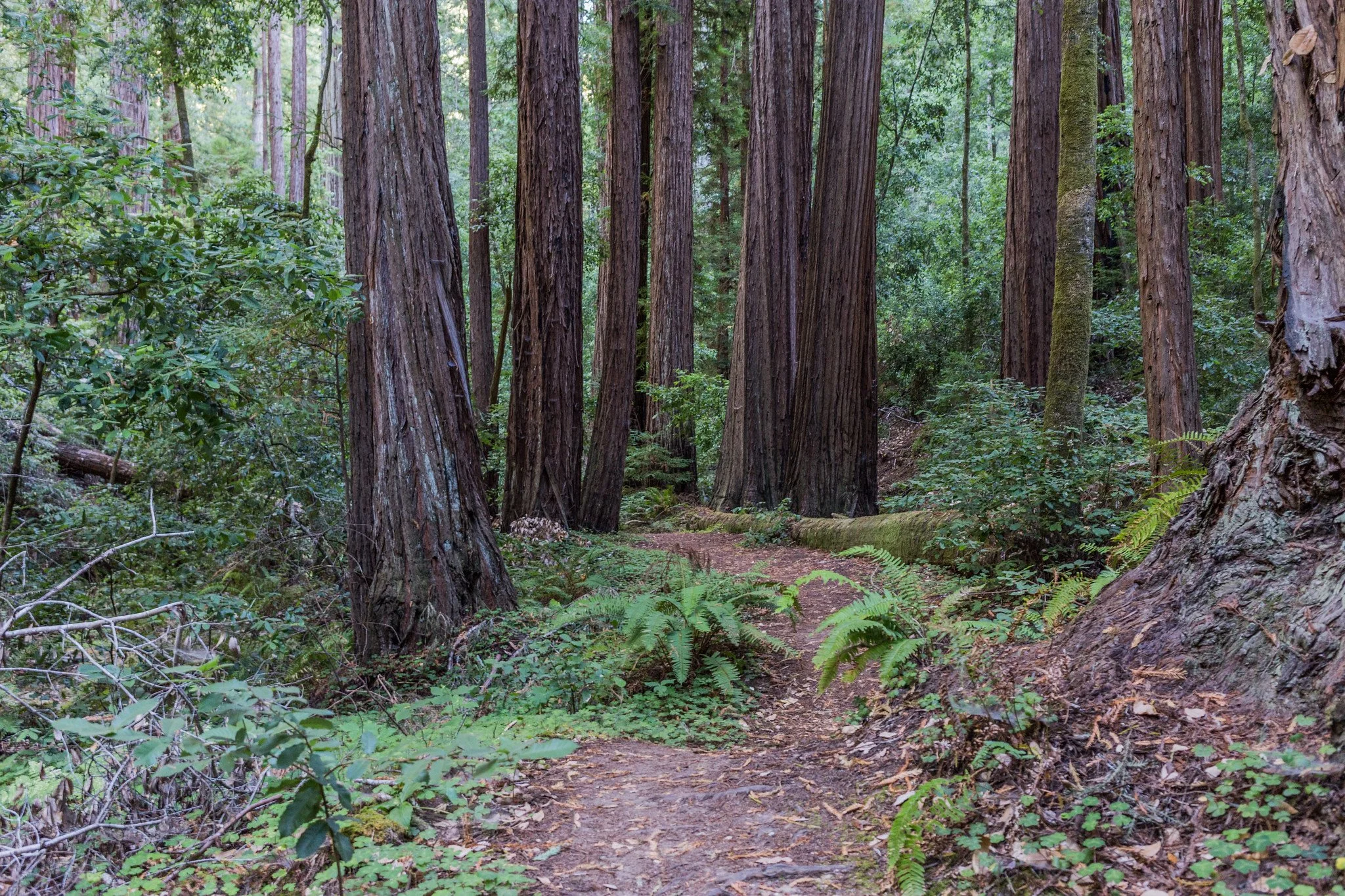
California's oldest state park is currently undergoing significant restoration following the 2020 CZU Lightning Complex wildfire, which burned approximately 97% of the park. Access has been gradually reopening as restoration progresses, but conditions and available areas change regularly.
For couples drawn to Big Basin specifically, the restoration has created something unexpected: an unusually quiet and contemplative forest atmosphere as the land regenerates. Some couples find deep meaning in eloping in a place of renewal and resilience. If this resonates with you, it's worth confirming current access and permit availability directly with the park before building plans around it.
Pfeiffer Big Sur State Park
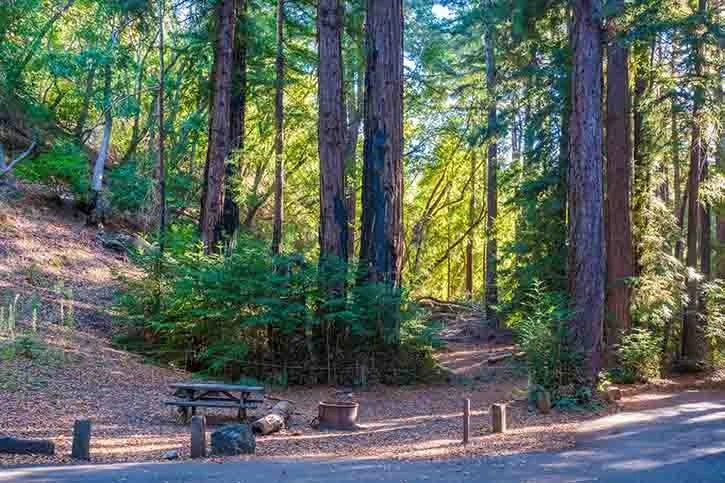
Pfeiffer Big Sur sits at the southernmost end of the coastal redwood range and combines old-growth redwood groves along the Big Sur River with the dramatic coastal scenery Big Sur is famous for worldwide. For couples who want both the ancient forest experience and the rugged California coastline within minutes of each other, Pfeiffer Big Sur is unmatched in terms of geographic convenience.
The Big Sur River running through the park adds a beautiful natural element to ceremony and portrait locations. The surrounding lodging — including Big Sur Lodge within the park itself — makes it an excellent choice for couples wanting a seamless, self-contained elopement experience without extensive driving.
Best season: spring and fall for temperate weather and manageable crowds. Summer is the busiest season on the Big Sur coast and early morning timing becomes essential.
Julia Pfeiffer Burns State Park
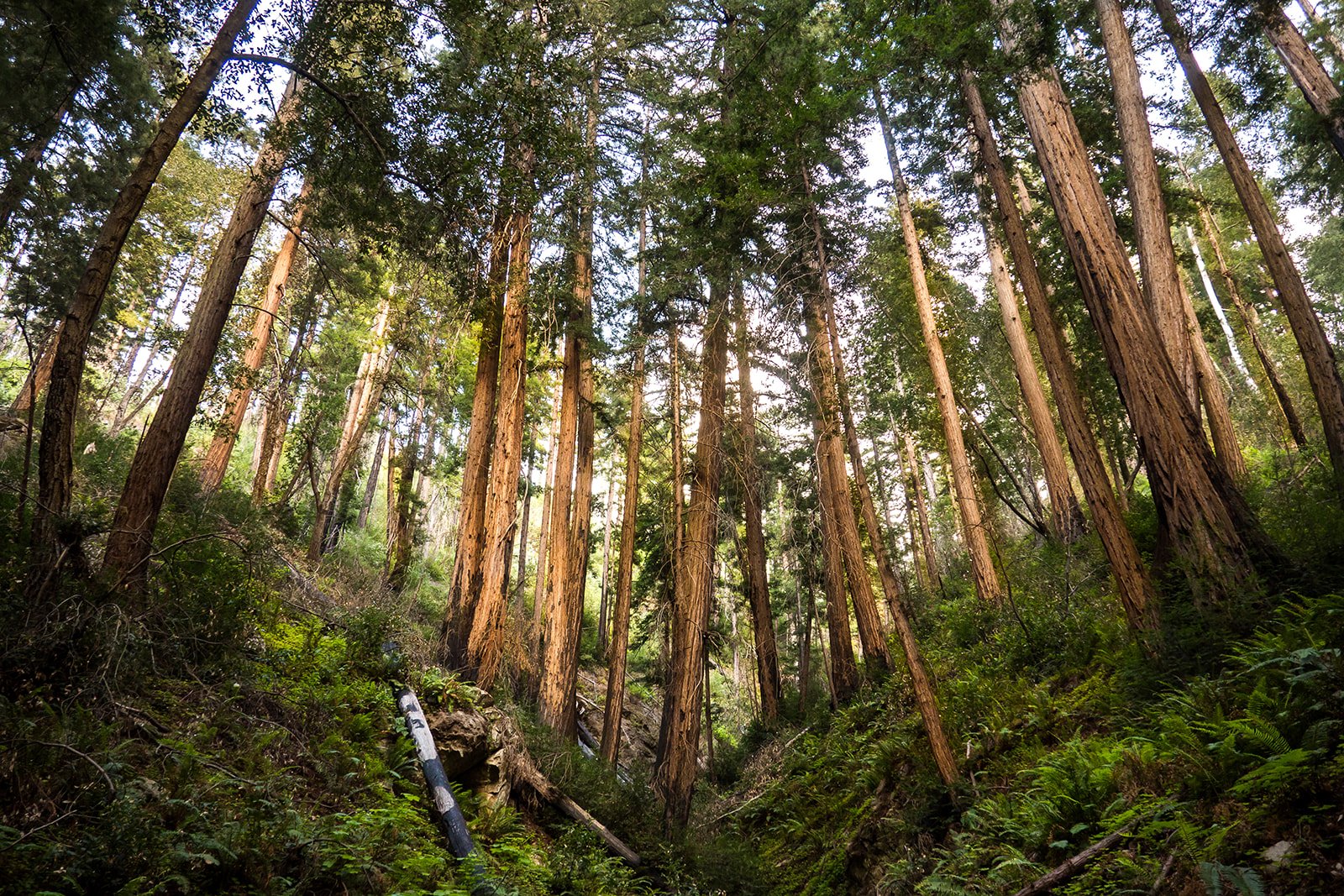
Julia Pfeiffer Burns combines coastal redwood forest with the iconic McWay Falls, an 80-foot waterfall that tumbles directly onto a secluded beach cove. This combination of ancient trees and dramatic coastal waterfall makes it one of the most visually distinctive elopement locations in California.
Permit availability here is limited and competitive given the location's popularity. Plan well in advance — particularly for spring and fall dates when Big Sur sees the highest visitor traffic. The intimate scale of the park and the natural drama of the McWay Falls viewpoint create a ceremony setting that requires very little additional planning to feel extraordinary.
If waterfall settings appeal to you, this guide on Waterfall Wedding Venues offers additional options across multiple states worth exploring.
Portola Redwoods State Park
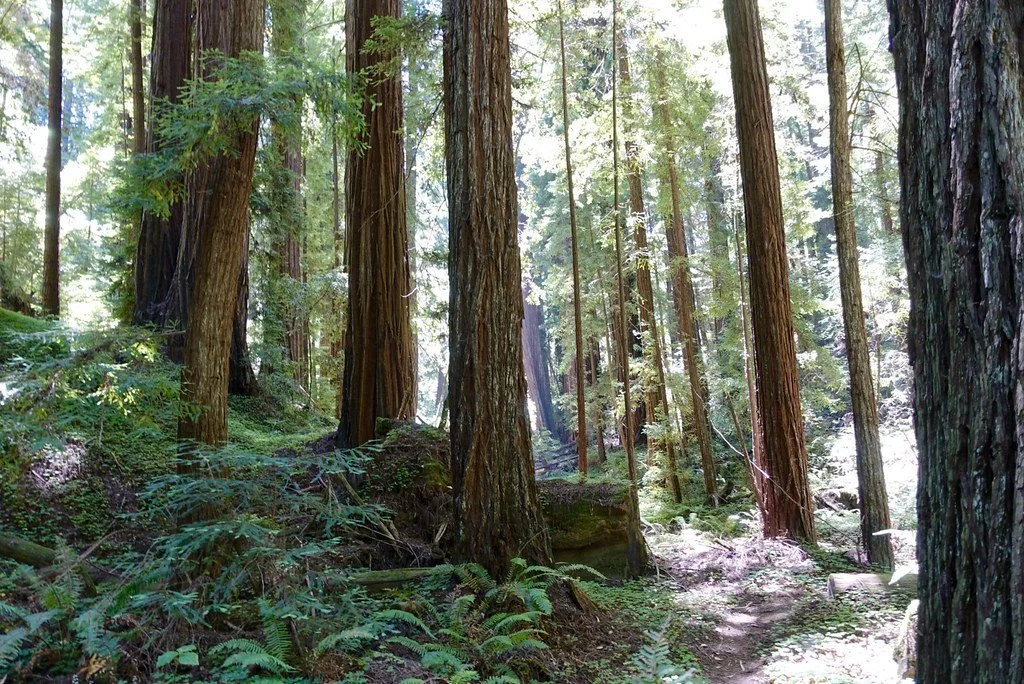
Portola Redwoods sits in the Santa Cruz Mountains south of San Francisco and is one of the most genuinely undervisited old-growth redwood parks in the state. While neighboring Big Basin draws more attention, Portola quietly offers comparable old-growth scenery with significantly fewer visitors and a more intimate, unhurried atmosphere.
The park's remote feel is one of its greatest assets for eloping couples. Trails wind through towering coastal redwoods with very little foot traffic even on weekends, and the surrounding terrain creates natural pockets of privacy that are difficult to find in the more accessible Bay Area parks.
Proximity to Silicon Valley and the Bay Area makes Portola a practical choice for couples flying into San Jose. It's approximately an hour's drive from SJC, and its location in the Santa Cruz Mountains puts it within reasonable reach of both the Santa Cruz coastline and the broader Monterey Peninsula for a multi-location day.
Best season: spring and fall for mild temperatures and lush forest conditions. Worth confirming current permit requirements and access directly with the park before finalizing plans.
Hidden Gems and Less-Traveled Locations
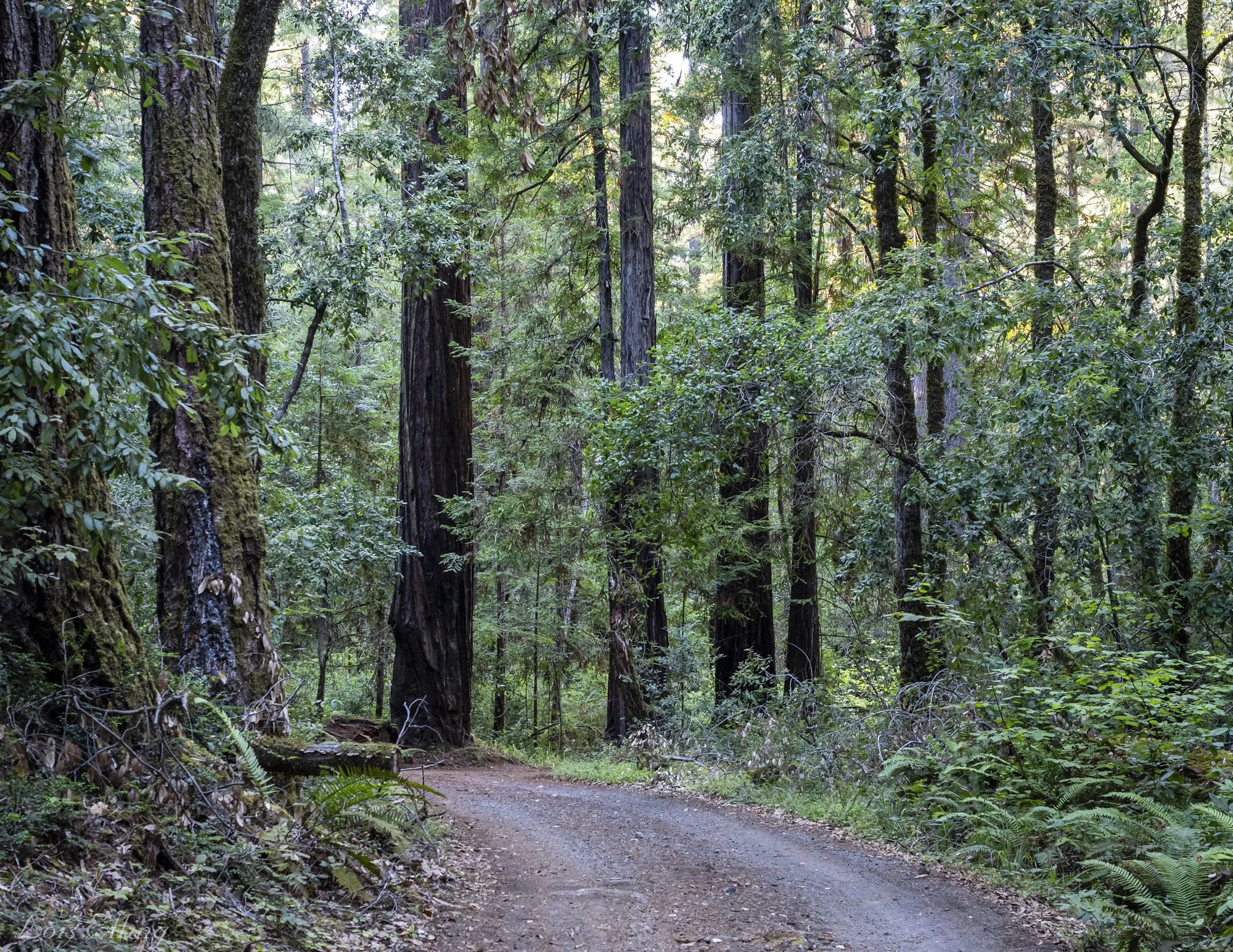
Beyond the well-known parks, California's redwood range includes several exceptional low-traffic locations that rarely appear on elopement planning resources.
Hendy Woods State Park in Mendocino County pairs two intimate old-growth groves with the surrounding Anderson Valley wine region. For couples drawn to the combination of ancient forest and California wine country, Hendy Woods creates a natural multi-experience elopement day.
Montgomery Woods State Natural Reserve near Ukiah is one of the least-visited old-growth redwood groves in the state and one of the most genuinely private. No amenities, very few visitors, and a quiet that is difficult to find anywhere in the more accessible parks.
Sequoia National Park
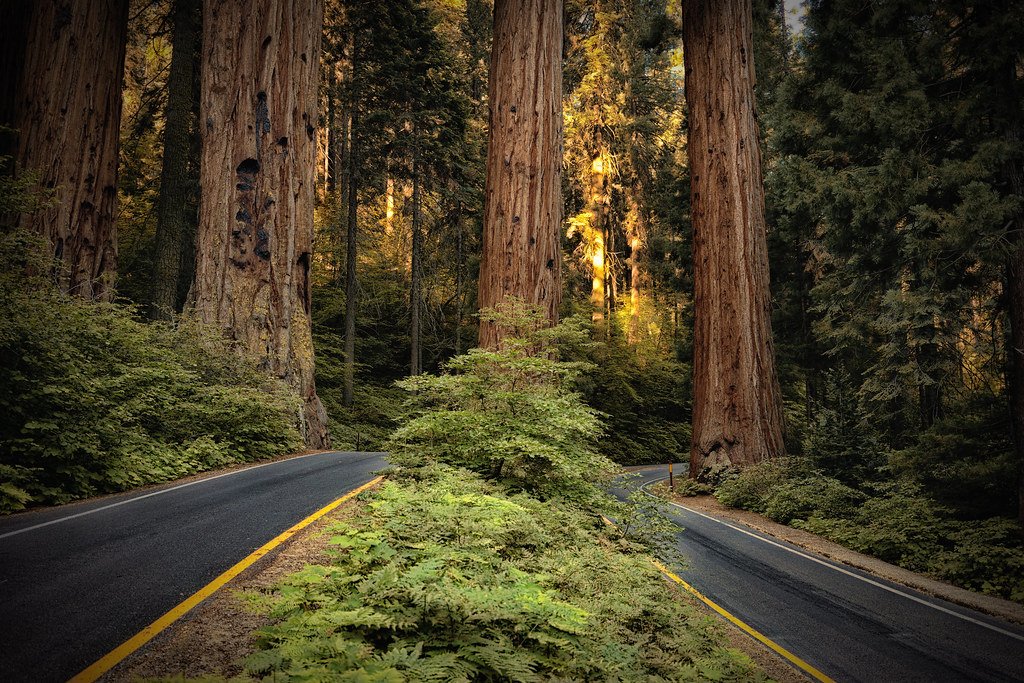
Sequoia National Park is home to General Sherman — the largest known living tree on Earth by volume, standing 274 feet tall with a base circumference of over 100 feet. Eloping in the presence of a tree that has been growing for an estimated 2,200 years is an experience that genuinely defies description. The scale of the Giant Forest grove is humbling in a way that even experienced travelers rarely anticipate until they're standing inside it.
For elopement planning purposes, Sequoia requires thoughtful preparation. Permits are required and the park sees heavy visitation during peak summer months and fall color season. Shoulder seasons — late April through early June and mid-September through October — offer a significantly more intimate experience while still providing full access to the Giant Forest and surrounding groves.
The park pairs naturally with Kings Canyon National Park immediately to the north, making a multi-day Sierra Nevada elopement experience genuinely compelling for couples drawn to ancient landscapes and high-elevation scenery.
Best season: late spring and early fall for manageable crowds and optimal conditions. Winter brings snow to the Giant Forest — beautiful for the right couple, but road access can be limited and chains are often required.
Kings Canyon National Park
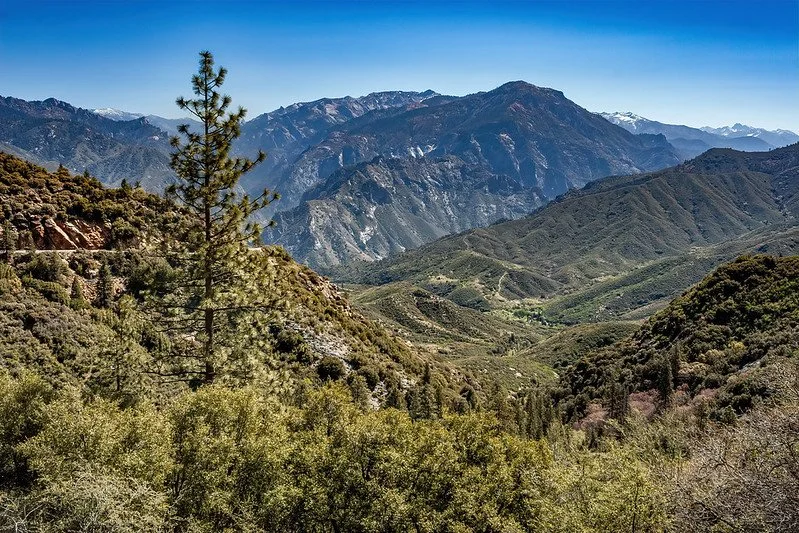
Kings Canyon sits immediately north of Sequoia and is managed jointly with it, but it offers a noticeably different elopement atmosphere. Where Sequoia centers on the massive scale of the Giant Forest, Kings Canyon adds dramatic canyon scenery — one of the deepest canyons in North America — to its sequoia groves, creating a more rugged and varied landscape.
Grant Grove is home to General Grant, the second-largest tree in the world and designated the Nation's Christmas Tree. The grove is accessible and genuinely awe-inspiring, with a more open atmosphere than Sequoia's Giant Forest.
Kings Canyon typically sees fewer visitors than Sequoia despite being equally spectacular, which makes it a strong option for couples prioritizing privacy within the Sierra Nevada. The canyon itself — accessible via Kings Canyon Scenic Byway — adds an entirely different photographic dimension beyond the sequoia groves.
Permit required for ceremonies. Best combined with Sequoia for a multi-day Sierra Nevada elopement experience.
Mariposa Grove, Yosemite National Park
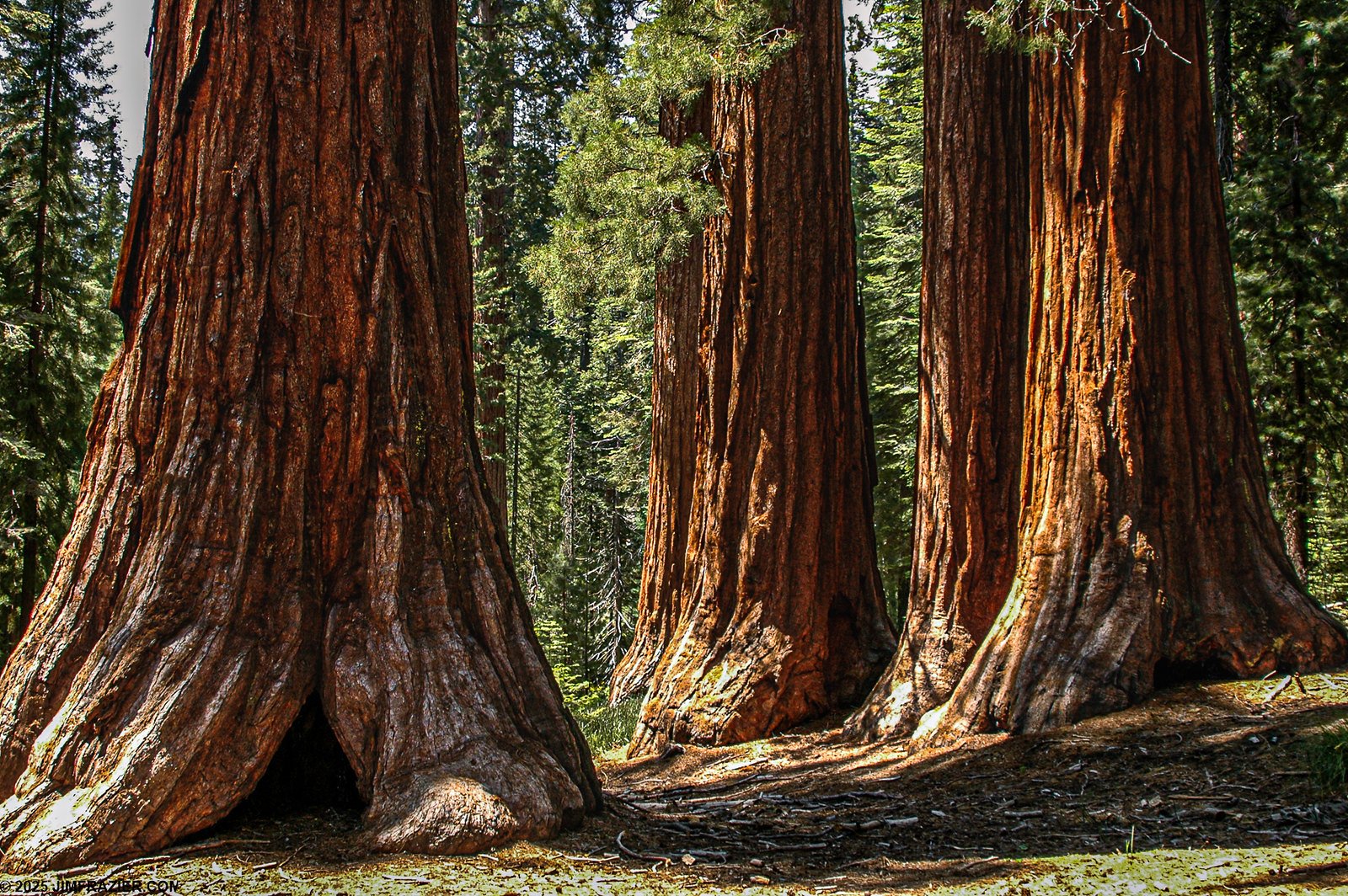
Mariposa Grove is Yosemite's largest sequoia grove and the most visited of the park's three sequoia locations. The grove contains over 500 mature giant sequoias including the Grizzly Giant — one of the oldest living sequoias on Earth — and the California Tunnel Tree, a hollowed sequoia that visitors can walk through.
The combination of Yosemite's iconic valley scenery and ancient sequoia forest makes Mariposa Grove one of the most visually compelling elopement locations in this entire guide. For couples who want their elopement to feel genuinely historic and monumental, few locations anywhere deliver that experience as completely.
Planning considerations are significant. Commercial photography permits are required, the grove is heavily visited particularly in summer and fall, and shuttle access from the Mariposa Grove Welcome Plaza is required during peak season. Early morning weekday ceremonies offer the most realistic path to an intimate experience.
For a quieter Yosemite sequoia experience, Merced Grove and Tuolumne Grove are both worth serious consideration as alternatives.
Merced Grove, Yosemite National Park
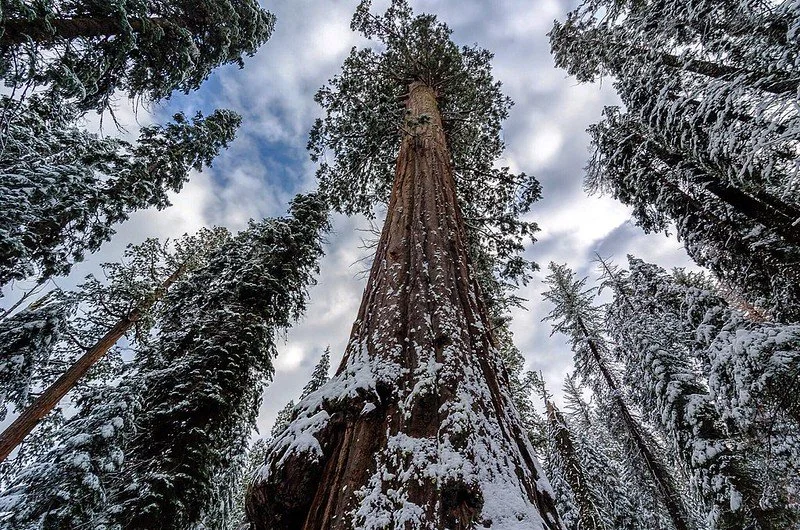
Merced Grove is Yosemite's smallest and least-visited sequoia grove — and for eloping couples, that's exactly what makes it worth knowing about. While Mariposa Grove draws the overwhelming majority of Yosemite's sequoia visitors, Merced Grove sits quietly off a dirt road near the Big Oak Flat entrance, receiving a fraction of the foot traffic despite containing genuinely impressive old-growth sequoias.
The 2-mile round trip hike to the grove keeps casual visitors away while remaining accessible for most couples. The grove itself has a quiet, unhurried atmosphere that is nearly impossible to find at Mariposa during peak season. A cabin site within the grove adds a unique historical element to the experience.
For couples wanting a Yosemite sequoia elopement without the crowds, Merced Grove is the strongest recommendation in this guide. It rarely appears on competitor elopement resources, which makes it both a genuine hidden gem and a meaningful differentiator for couples who want their day to feel completely their own.
Permit required. Confirm current requirements with Yosemite National Park before finalizing plans.
Calaveras Big Trees State Park
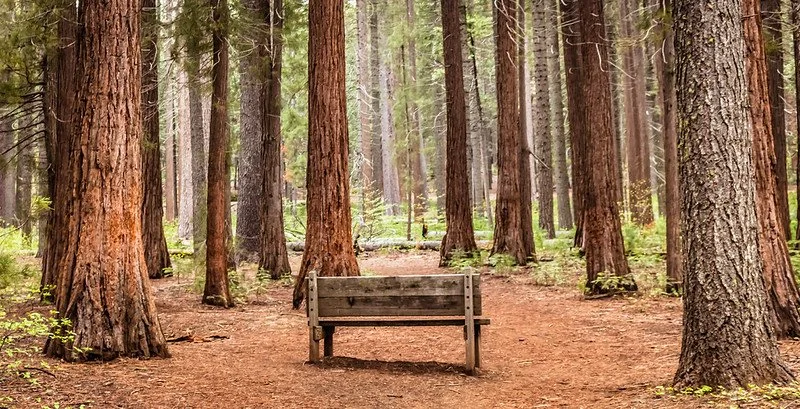
Calaveras Big Trees offers one of the most accessible giant sequoia experiences in California outside the national parks, with two distinct groves — the North Grove and the South Grove — and a permit process that is generally more straightforward than the national park system.
The North Grove is easily accessible with a short, flat loop trail and contains some genuinely impressive sequoias including the Discovery Tree stump, historically significant as the first sequoia brought to wide public attention in the 1850s. The South Grove is more remote, requiring a longer hike, and offers a significantly more private and intimate atmosphere.
Located in the Sierra Nevada foothills near Arnold, California, Calaveras is approximately two hours from Sacramento and within reasonable driving distance of the Bay Area — making it an accessible sequoia option for couples who can't commit to the longer drive to Sequoia or Yosemite. The surrounding area includes several wineries and historic Gold Rush towns that pair well with a celebration dinner after the ceremony.
Best season: late spring through fall, with the South Grove particularly beautiful in late spring when the hike is dry and uncrowded.
Nelder Grove
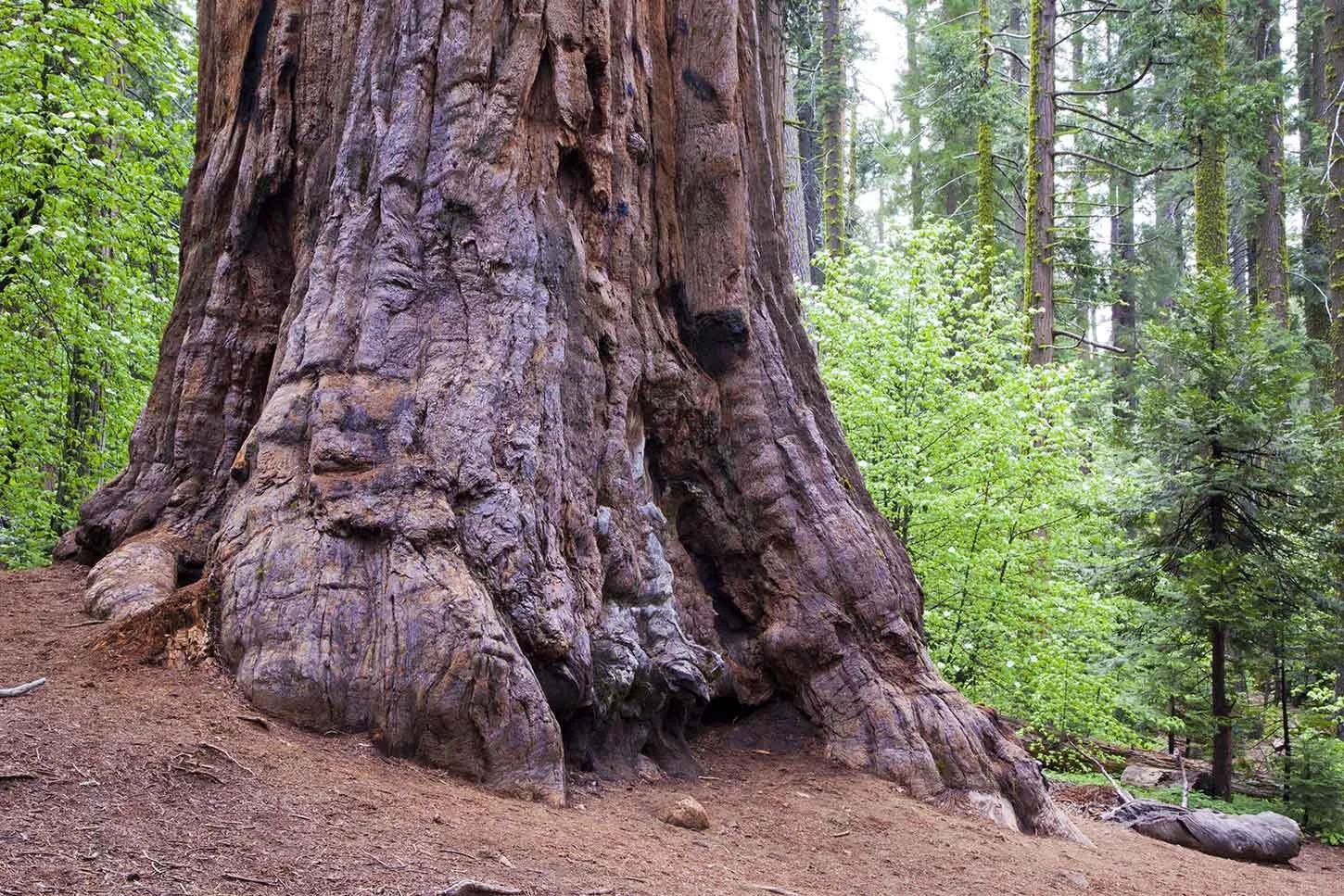
Nelder Grove is one of the best-kept secrets in this entire guide. Located within Sierra National Forest southeast of Yosemite, Nelder contains over 100 mature giant sequoias — including the Shadow of the Giants National Recreation Trail — in a setting that sees a tiny fraction of the visitors of any of the national park sequoia groves.
There are no entrance fees, no timed reservations, and no shuttle systems required to access Nelder Grove. The atmosphere is genuinely wild and unhurried in a way that the more developed parks simply cannot replicate. Couples willing to do a modest amount of research and planning to get here are rewarded with an experience that feels completely private and entirely their own.
Permit requirements are less formalized than the national parks but should always be confirmed with the Sierra National Forest ranger district before finalizing plans. The grove is best accessed via a dirt forest road — a high-clearance vehicle is recommended, particularly earlier in the season when road conditions can be unpredictable.
For couples who value true seclusion, zero crowds, and a sequoia experience that almost no other eloping couple will have had, Nelder Grove is the strongest recommendation in the giant sequoia layer of this guide.
Best season: late spring through early fall when forest roads are fully accessible and conditions are stable.
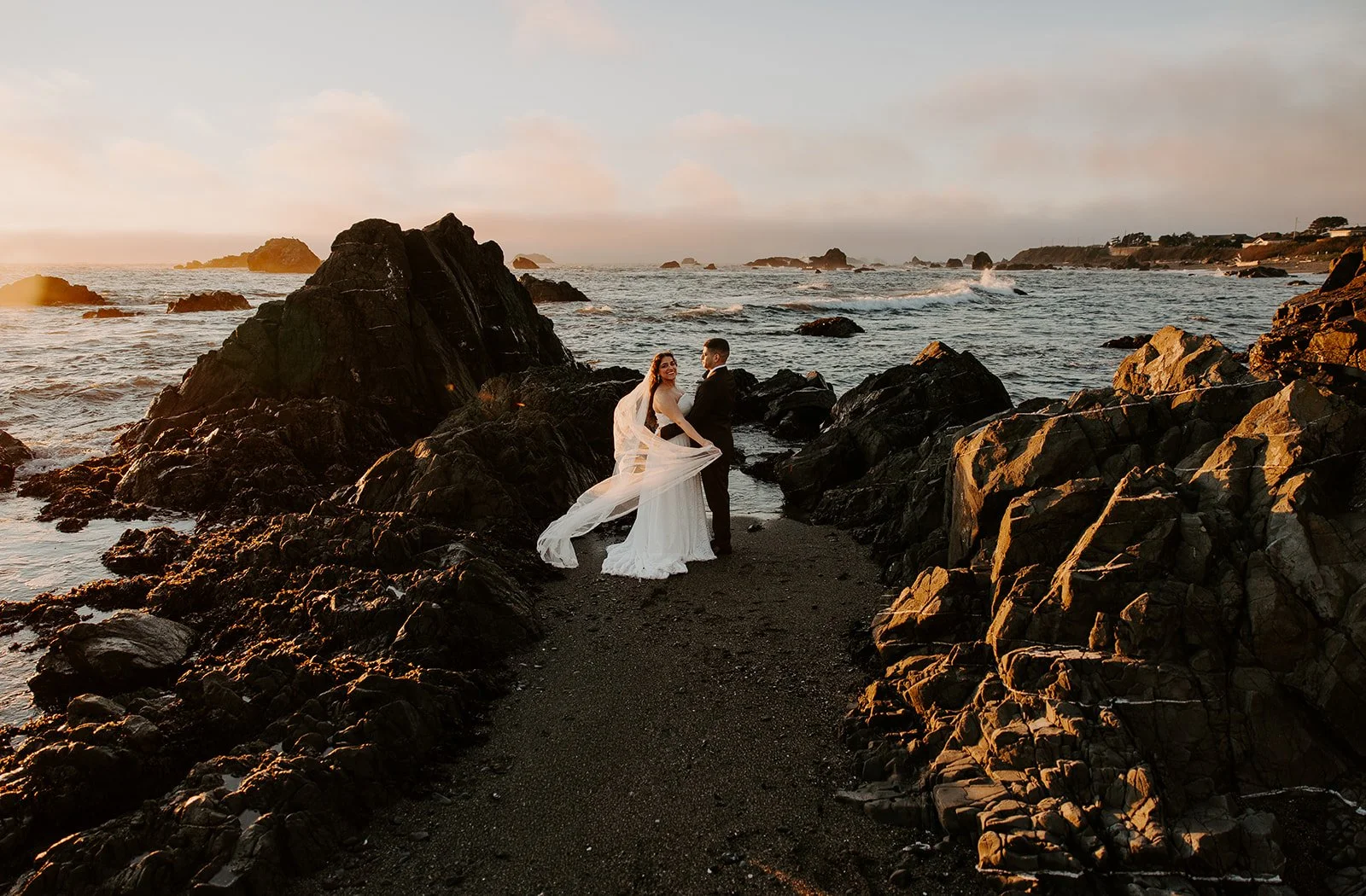
Combining the Redwoods With the California Coast
One of the most compelling aspects of a northern California elopement is a geographic reality that few other destinations can offer: ancient forest and dramatic Pacific coastline are often within 20 to 45 minutes of each other. Couples who recognize this and plan around it tend to create elopement days that feel layered, complete, and genuinely unlike anything available anywhere else in the world.
A redwoods ceremony followed by a coastal golden hour isn't a compromise between two experiences. It's two entirely different emotional registers in a single day — the stillness and scale of the forest giving way to the open horizon and salt air of the Pacific. For couples who are drawn to both environments, combining them isn't just possible. It's one of the strongest arguments for choosing northern California over any other elopement destination.
Why Couples Choose Both in One Day
Most elopement destinations ask you to choose one primary setting and commit to it. The northern California redwoods are unusual in that the coast is genuinely close enough to incorporate without the day feeling rushed.
Couples who choose a combined forest and coast day consistently describe the same thing: a sense that their elopement captured something complete. The ceremony in the grove feels sacred and grounded. The golden hour portraits on the coastal bluffs feel expansive and celebratory. The two experiences complement each other in a way that neither could achieve alone.
There's also a practical photography benefit worth understanding. The light inside a redwood forest is soft and diffused at almost any time of day — which means your ceremony and forest portraits aren't dependent on a specific lighting window. That flexibility allows your timeline to position the coast for golden hour, when the Pacific light is at its most dramatic, without sacrificing the quality of your forest coverage.
Best Redwoods + Coast Pairings
Not every redwood location pairs equally well with the coast. Distance, driving time, and the character of the nearby coastline all shape how a combined day actually feels. Here are the strongest pairings by region:
Jedediah Smith + Enderts Beach or Crescent Beach Overlook This is one of the most natural pairings in the northern parks. Jedediah Smith's old-growth groves are approximately 20 minutes from the Del Norte coastline, with Enderts Beach offering rugged sea stacks and tidepools and Crescent Beach Overlook delivering sweeping Pacific views. A forest ceremony in Stout Grove followed by a coastal golden hour here creates a complete, deeply northern California experience.
Prairie Creek + Redwood Creek Beach Prairie Creek's unique advantage is that Redwood Creek Beach sits at the park's western boundary, making it one of the only locations in this guide where old-growth redwood forest and a Pacific beach are accessible within the same park. A Cathedral Trees ceremony followed by a walk to the beach for sunset portraits requires almost no driving at all.
Muir Woods + Marin Headlands or Rodeo Beach The Marin Headlands sit just a short drive from Muir Woods and offer some of the most dramatic coastal scenery in Northern California — iconic Golden Gate Bridge views, cliffside trails, and the distinctive fog-swept atmosphere of the Bay Area coast. Rodeo Beach, with its unusual black and green pebbled shoreline, adds a wilder, more intimate coastal option. This pairing creates a quintessentially Bay Area elopement day that combines two of the region's most compelling landscapes.
Pfeiffer Big Sur + McWay Falls or Garrapata State Park Big Sur's redwood groves and coastal access are essentially inseparable — the two environments sit within minutes of each other along Highway 1. A Pfeiffer Big Sur forest ceremony can flow naturally into portraits at McWay Falls and then golden hour at Garrapata State Park, where the rugged coastal bluffs and crashing surf create one of the most dramatic sunset backdrops in California.
Henry Cowell + Santa Cruz Coastline For couples flying into San Jose, Henry Cowell's redwood groves and the Santa Cruz coast form a natural pairing that keeps the entire day within a compact geographic area. A morning or early afternoon forest ceremony at Henry Cowell flows naturally into a coastal celebration along the Santa Cruz cliffs or Natural Bridges State Beach for golden hour.
How to Build a Multi-Location Timeline
Combining two distinct environments in a single elopement day requires more intentional timeline planning than a single-location day — but it doesn't need to feel complicated. A few principles that make combined days work well:
Let the forest ceremony be unhurried. The temptation on a multi-location day is to rush the first location to make time for the second. Resist this. The forest ceremony and portraits deserve as much breathing room as a single-location day would receive. Build at least 2 to 3 hours at your forest location before accounting for travel.
Drive time is always longer than it looks on a map. Coastal roads in northern California — particularly along Highway 1 and the roads serving the northern parks — are scenic, winding, and frequently slower than navigation apps predict. Add buffer time generously.
Position the coast for golden hour. Because redwood forest light is soft and workable throughout the day, you have flexibility on when you schedule the forest portion. Use that flexibility to ensure you arrive at the coast 60 to 90 minutes before sunset — the window when coastal light is at its most extraordinary.
Have a weather contingency. Coastal fog and wind are realities of northern California elopement planning, particularly in summer. A backup coastal location — or the flexibility to extend your forest time if conditions at the coast are unfavorable — keeps the day feeling calm rather than stressful when conditions shift.
For a deeper look at how to structure a elopement timeline that accounts for multiple locations, lighting, and travel time, this guide on sunrise vs. sunset elopements walks through the key timing considerations in detail.
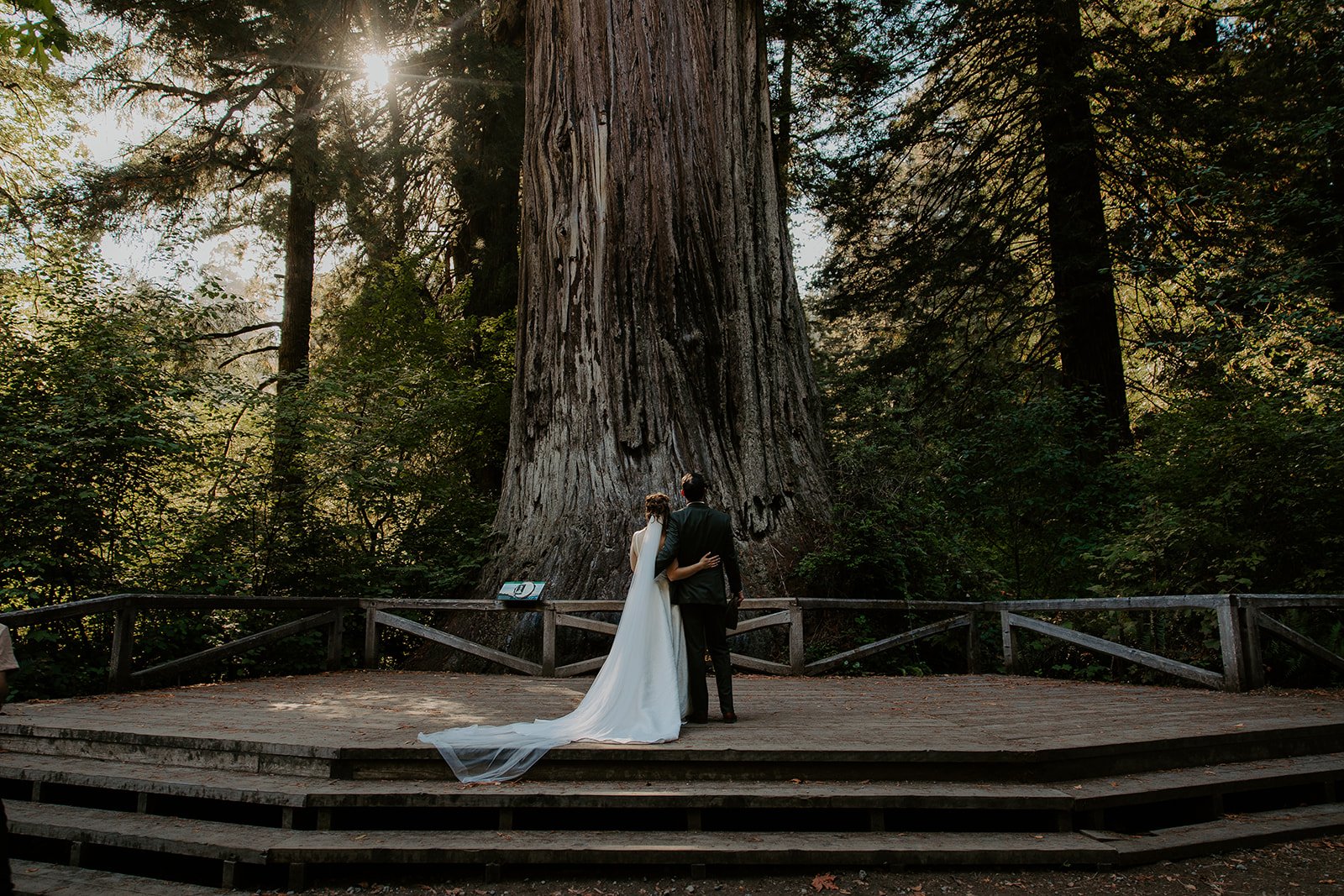
When Is the Best Time to Elope in the Redwoods?
The honest answer is that every season in the redwoods offers something genuinely worth experiencing — and the right choice depends less on finding a universally "best" month and more on matching seasonal conditions to what you actually want your day to feel like. Light, crowds, trail conditions, and coastal weather all shift significantly throughout the year, and understanding those shifts is what allows your elopement to feel intentional rather than accidental.
Spring (March through May)
Spring is one of the two strongest seasons for a redwoods elopement and the most consistently recommended for couples who want a combination of beauty, manageable conditions, and relative privacy.
The forest floor comes alive in spring with wildflowers, blooming rhododendrons, and the vivid green of new fern growth pushing through the redwood understory. Waterfalls and rivers run full from winter rainfall, adding a layer of sound and movement to the landscape that drier months can't replicate. The light filtering through the canopy has a particular quality in spring — soft, green-tinted, and deeply atmospheric.
Crowd levels are lower than summer across most northern parks, particularly in March and early April before the main tourism season begins. Weekday ceremonies in spring can feel genuinely private even at well-known locations.
A few considerations: March can bring unpredictable rainfall and some trail mud, particularly in the northern parks. April and May see increasing visitor numbers on weekends. Early May tends to be the sweet spot — rhododendrons typically peak in late April through mid-May, temperatures are comfortable, and the summer crowds haven't fully arrived yet.
Best for: couples who want lush green scenery, full waterfalls, wildflower blooms, and manageable crowds.
Summer (June through August)
Summer brings long daylight hours, warm temperatures, and the lush peak-green forest that many couples picture when they imagine a redwoods elopement. It is also the busiest season across virtually every location in this guide, which requires more deliberate planning around timing and location choice.
The northern California coast has a natural temperature advantage in summer that many couples don't anticipate. While inland California bakes in triple-digit heat, the coastal redwood parks are frequently kept cool by Pacific fog and ocean breezes — average temperatures in the northern parks typically range from 55 to 68°F even in July and August. This makes the northern redwoods one of the most comfortable summer elopement destinations in California.
Fog is both an asset and a consideration in summer. Morning fog drifting through the redwood canopy creates some of the most extraordinary photographic conditions available at any time of year — ethereal, moody, and completely unique to this landscape. By afternoon the fog typically burns off, giving way to clearer light. Planning your ceremony for late morning or early afternoon takes advantage of both conditions.
Crowd management is the primary planning challenge in summer. Popular locations like Muir Woods, Fern Canyon, and the Jedediah Smith grove areas see their highest visitor numbers from June through August. Early morning weekday ceremonies are the most reliable path to privacy. Permit applications for summer dates should be submitted as early as possible — peak-season permit slots fill up months in advance at the most requested locations.
Best for: couples who want lush summer greenery, morning fog atmosphere, and long golden-hour evenings and are committed to early morning or weekday timing.
Fall (September through November)
Fall is the other peak season for redwoods elopements and for many couples the most atmospheric time of year to be in the forest. September and October bring cooling temperatures, dramatically shifting light, and the beginning of the seasonal changes that give the redwood understory its autumn character.
While coastal redwoods themselves are evergreen and don't change color, the surrounding forest does. Bigleaf maples, alders, tanbark oaks, and dogwoods all turn in fall, adding splashes of gold, amber, and red to the otherwise green forest floor. The contrast between the warm fall color of the understory and the deep evergreen of the redwood canopy overhead creates a forest atmosphere that is genuinely different from any other season.
September is an excellent month that is frequently underestimated by couples fixated on October foliage. Crowds drop noticeably after Labor Day, temperatures remain comfortable, and the light begins its fall transition toward the warmer, lower-angle quality that photographs beautifully. Late October and early November bring peak color to the understory alongside the increased rainfall that begins the transition to winter.
The coastal pairing is particularly strong in fall. Cleaner air, lower angle sun, and the drama of fall storm light on the Pacific cliffs create coastal portrait conditions that rival any other time of year.
Best for: couples who want fall color in the understory, cooler temperatures, lower crowds than summer, and dramatic coastal light.
Winter (December through February)
Winter in the redwoods is a genuinely extraordinary experience that very few eloping couples choose — which is precisely what makes it worth considering for the right couple. Heavy rainfall, frequent coastal storms, and short daylight hours define the season, but so does an atmosphere of complete quiet, misty mystery, and a forest alive with moss, ferns, and fungi in ways that drier seasons can't match.
Privacy is essentially guaranteed in winter. Even well-known locations like Stout Grove and Cathedral Trees see minimal visitors during December and February. A winter redwoods elopement can feel like the entire forest belongs to you.
The light in a rain-wet redwood forest in winter has a particular drama that is impossible to replicate in other seasons. Saturated colors, reflective surfaces, fog hanging low through the canopy, the sound of rain on ancient bark — for couples who are drawn to moody, cinematic, deeply atmospheric imagery, winter delivers something no other season can.
Practical considerations are real. Some forest roads close seasonally and high clearance or four-wheel drive may be required at certain locations. Coastal access can be impacted by storm conditions. Flexibility and contingency planningare more important in winter than any other season — but for couples who embrace that flexibility, winter elopements in the redwoods tend to produce some of the most visually distinctive galleries of any elopement experience.
Best for: couples who want complete privacy, misty moody atmosphere, saturated winter light, and a genuinely rare elopement experience.
Weekday vs. Weekend — Why It Matters in the Redwoods
Across every season, choosing a weekday over a weekend is one of the single most impactful decisions you can makefor a redwoods elopement. The difference in visitor traffic between a Tuesday morning and a Saturday morning at most northern California redwood locations is not subtle — it can be the difference between a grove that feels entirely private and one where strangers are walking through your ceremony.
Beyond privacy, weekday elopements offer practical advantages that compound throughout the day:
Permit availability is stronger on weekdays, particularly at high-demand locations like Muir Woods and Stout Grove
Parking is reliably available, eliminating one of the most common sources of timeline stress at popular parks
Lodging rates are typically lower, often meaningfully so at popular coastal and forest destinations
Vendors have more availability, including florists, hair and makeup artists, and officiants who prioritize weekends for larger weddings
If your dates are flexible, a Tuesday through Thursday ceremony in any season will consistently deliver a more private, more relaxed, and more logistically smooth experience than an equivalent Saturday. It's one of the recommendations I make to every couple planning a redwoods elopement regardless of when they're planning to go.
For more on how timing shapes the overall elopement experience, this guide on sunrise vs. sunset elopements walks through how time of day compounds with season to shape the light, mood, and pacing of your day.
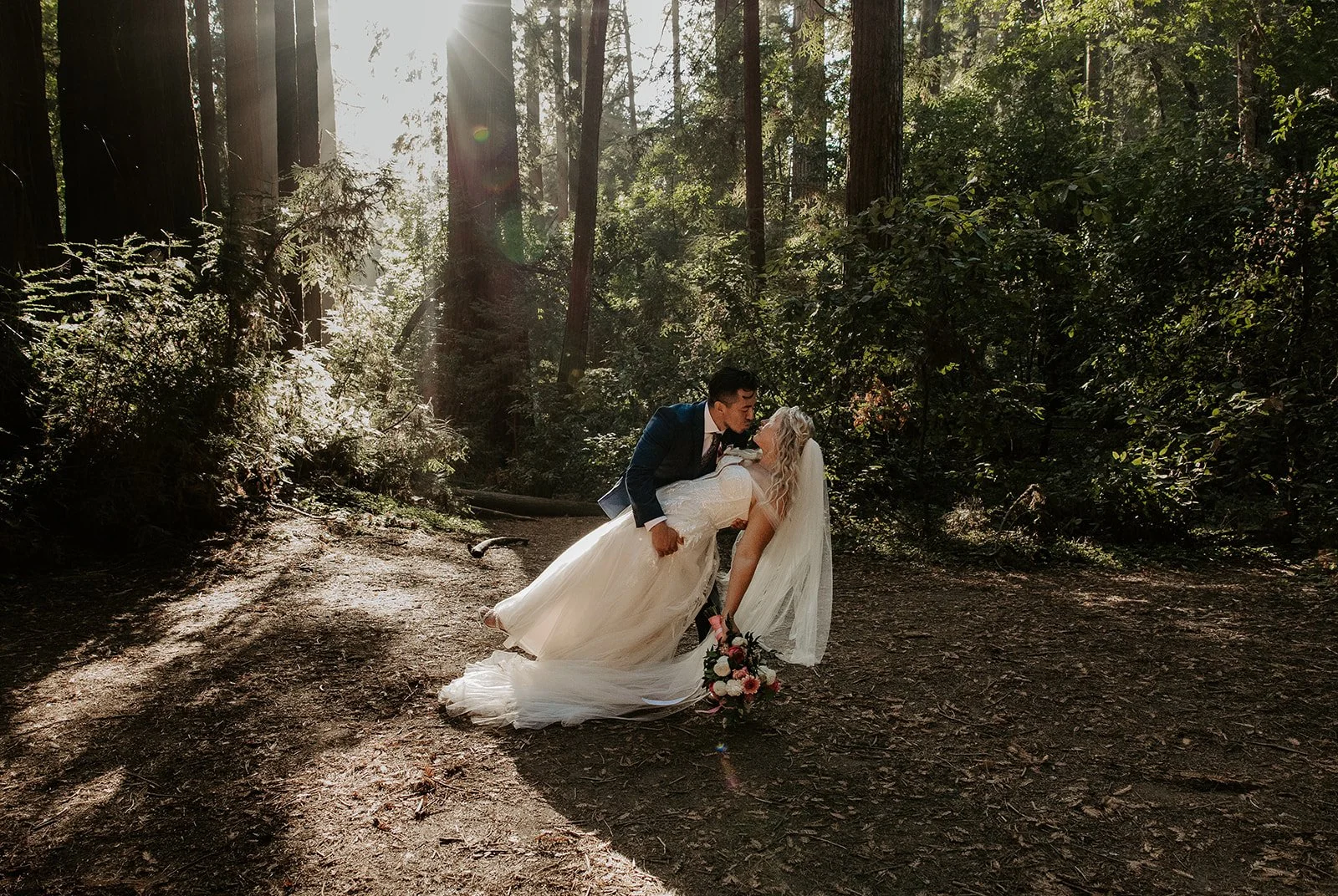
What to Wear for a Redwoods Elopement
Choosing what to wear for a redwoods elopement involves a different set of considerations than a traditional wedding venue. The forest environment is active, unpredictable, and beautiful in ways that reward practical preparation.Couples who dress thoughtfully for the terrain and conditions spend their day feeling comfortable and confident — which shows in every photograph. Couples who don't tend to spend their day managing discomfort, and that shows too.
The goal isn't to sacrifice elegance for practicality. It's to find attire that delivers both — and the good news is that the redwoods are a forgiving and flattering environment for a wide range of styles.
For a broader look at elopement attire across different environments and terrain types, this guide on what to wear when you elope covers the full range of considerations worth thinking through before your day.
Dresses and Attire for the Forest Environment
The redwood forest rewards flowy, lightweight, and movement-friendly silhouettes more than almost any other elopement environment. The reason is simple: the forest asks you to move. You'll be walking trails, stepping over roots, standing on uneven ground, and — if your day includes a coastal element — navigating wind and open terrain. A dress that moves beautifully with you in those conditions photographs far better than one that fights them.
What works well:
A-line and flowy bohemian silhouettes that move naturally with walking and wind
Lightweight fabrics like chiffon, georgette, and soft tulle that catch forest light beautifully
Earthy, muted, and natural tones — ivory, cream, sage, dusty rose, and warm neutrals all photograph exceptionally well against redwood bark and green fern understory
Shorter hemlines or high-low styles for couples planning significant hiking or trail walking
Simple, unstructured gowns that don't require extensive maintenance throughout the day
What to approach with caution:
Heavy ball gowns and structured corset bodices that restrict movement and become genuinely uncomfortable over several hours of walking
Long cathedral trains on trails with roots, mud, and uneven terrain — beautiful in photos but logistically challenging in practice
Bright white can wash out against the soft filtered forest light — off-white and ivory tend to photograph more warmly and naturally
Highly embellished or delicate fabrics that snag easily on branches or trail vegetation
If you're committed to a more structured or formal gown, bring comfortable shoes for the trail portions and change into your dress shoes at the ceremony location — this is standard practice for forest elopements and worth planning into your timeline.
Footwear — What Actually Works on Redwood Trails
Footwear is the single most practical decision you'll make for a redwoods elopement and the one most couples underestimate until they're standing on a root-covered trail in heels. The forest floor in the redwoods is uneven, often damp, and consistently more challenging than it looks in photos.
What works well:
Ankle boots with a low block heel or flat sole — the most versatile option for forest terrain, stylish in photos, and genuinely walkable on most redwood trails
White or ivory sneakers — increasingly popular for forest elopements and a completely legitimate choice that photographs beautifully and keeps the day comfortable
Hiking boots or trail runners for couples planning significant hikes to ceremony locations — no apology needed, and they photograph better than you'd expect styled with the right dress or suit
Flat sandals with good grip for summer ceremonies at accessible grove locations
Practical approach:Bring two pairs. Wear your practical shoes for the hike and trail portions, change into your more formal or photogenic shoes at the ceremony location. Keep both pairs accessible throughout the day so you can switch back for comfortable walking between locations.
If your ceremony location involves a stream crossing, wet rocks, or a beach element — plan for your feet to potentially get wet and choose footwear accordingly. Some of the most memorable moments of a redwoods elopement happen at the water's edge, and being comfortable there matters.
Suits, Layers, and Coastal Wind Considerations
For partners wearing suits, the redwood environment rewards well-fitted, breathable, and layer-friendly choices over formal structured formalwear that doesn't adapt to changing conditions.
What works well:
Slim or relaxed-fit suits in natural tones — warm grays, navy, forest green, tan, and earthy browns all complement the forest environment beautifully
Linen and lightweight wool blends that breathe in summer forest conditions and layer well if temperatures drop toward the coast
A well-fitted dress shirt without a tie for a more relaxed, nature-forward aesthetic that suits most redwood elopement styles
Layering pieces — a light jacket, a vest, or a casual blazer that can be removed for trail portions and added back for ceremony and portraits
Coastal wind consideration for everyone: If your day includes a coastal element — and most northern California redwoods days do — plan for wind. Coastal bluffs and exposed beaches in northern California can be genuinely windy, particularly in the afternoon. Flowing dresses photograph beautifully in wind when styled intentionally, but hair and lighter accessories need planning. Discuss this with your hair and makeup artist and consider styles that are designed to look good in movement rather than requiring stillness.
Redwoods Elopement Packing List
Beyond attire, a well-prepared packing list makes the difference between a day that flows smoothly and one that hits unnecessary friction points. Here's what experienced redwood elopement couples consistently wish they had brought:
For the forest:
Comfortable broken-in shoes for trail portions (separate from ceremony footwear)
A small daypack for carrying essentials without holding bags in photos
Snacks and water — trail mix, fruit, a small charcuterie setup, and a champagne flute for a forest toast
A lightweight blanket or picnic spread for a post-ceremony moment in the grove
Bug spray — particularly relevant in summer and early fall at lower elevations and near water
A small first-aid kit including blister bandages for new shoes
For attire maintenance:
Safety pins and fashion tape — non-negotiable for outdoor ceremonies
A lint roller — forest environments introduce debris, particularly on darker suits and structured gowns
A small makeup touch-up kit for portraits
Bobby pins and hairspray especially important if your day includes a coastal element
A tide pen or small stain remover for the inevitable forest floor moment
For the experience:
A vow book or vow cards — printed on thick card stock rather than read from a phone, both for aesthetics and because forest light and screen glare don't mix well
A portable bluetooth speaker for ceremony music if your location is remote enough to require one
A fully charged backup phone battery — cell service in the northern parks is limited and your phone will be working hard all day
Cash — some permit offices, parking areas, and local vendors in the northern California redwood region are cash only
If your elopement includes a significant hike to your ceremony location, this guide on how to plan a small and intimate wedding includes additional logistics and preparation considerations worth reviewing.
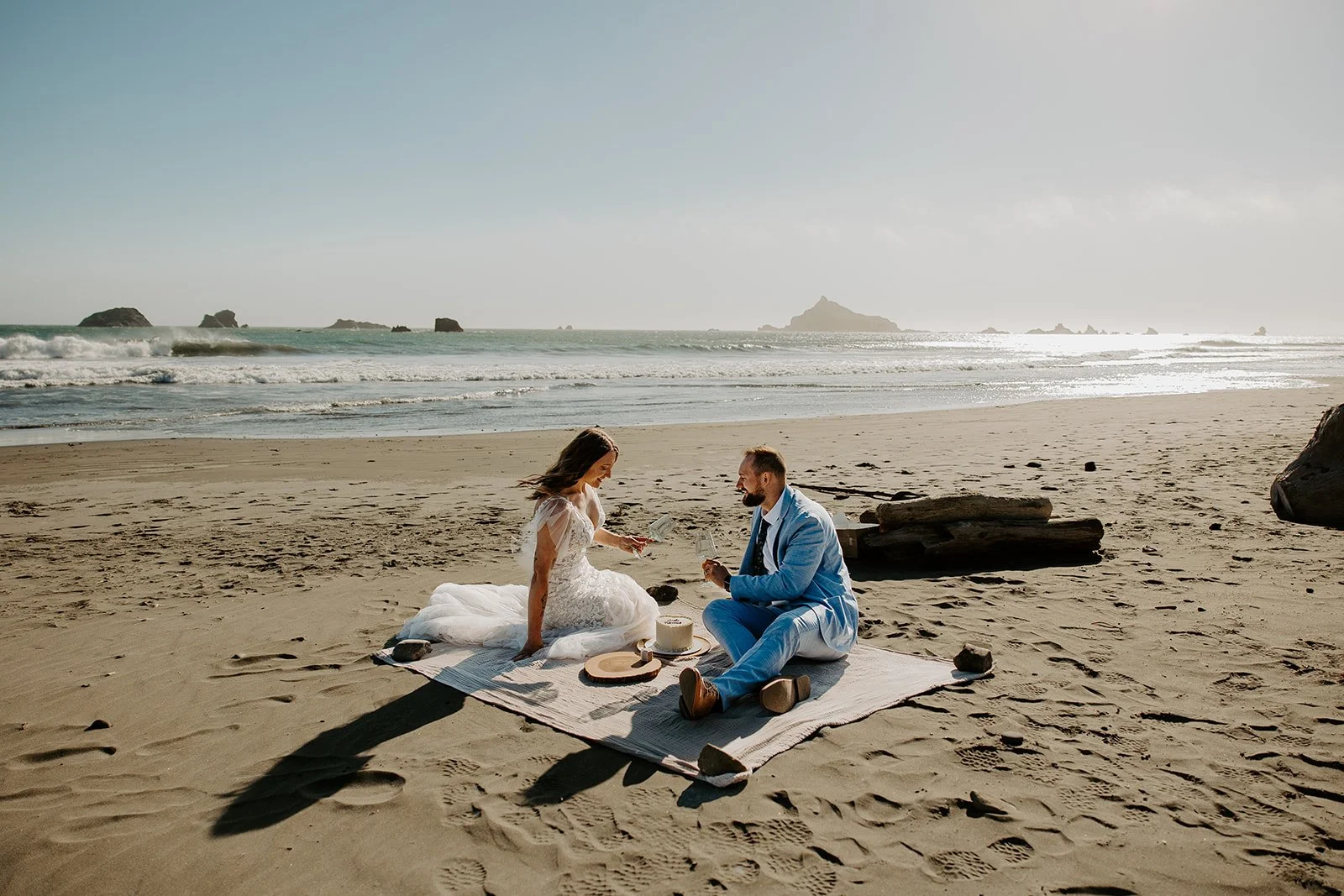
Where to Stay for Your Redwoods Elopement
Where you stay shapes your entire elopement experience — not just where you sleep, but where your day begins. Getting ready photos, slow mornings with coffee, a private first look on a deck surrounded by forest, a celebratory dinner after your ceremony — all of these moments happen at your accommodations, and the right setting makes them feel as intentional as the ceremony itself.
The redwoods region offers an exceptional range of unique stays, from treehouse retreats and A-frame cabins perched above the forest canopy to coastal cottages steps from the Pacific and luxury lodges inside the parks themselves. Choosing a stay that is close to your ceremony location, has strong natural light for getting ready, and offers genuine privacy will make your entire day feel more cohesive and relaxed.
Near Jedediah Smith and Prairie Creek — Northern CA
The northern parks sit in a remote but surprisingly well-serviced region centered around Crescent City, CA and the smaller communities of Klamath and Orick. Couples staying in this area have easy access to both Jedediah Smith and Prairie Creek within 30 to 45 minutes, and the Oregon border redwood locations are within an hour.
What to look for in this region:
Cabins and vacation rentals along the Smith River corridor offer forest immersion with river access — ideal for couples wanting nature surrounding them from the moment they wake up
Crescent City provides more conventional lodging options including hotels, which can work well for couples with guests or those who prefer amenities over seclusion
Airbnb and VRBO inventory in this region books up significantly in advance for summer and fall — the area is popular and unique properties go quickly. Booking 4 to 6 months out is not excessive for peak season dates
What to search for: redwood cabin Smith River, Crescent City vacation rental, Klamath cabin rental, northern California forest cabin.
Near Humboldt Redwoods — Central Northern CA
Humboldt County offers the widest range of unique accommodation options in the northern redwoods region, centered around the communities of Ferndale, Eureka, Arcata, and the small towns along the Avenue of the Giants including Myers Flat and Miranda.
This region is particularly well suited for couples wanting a multi-day elopement experience that combines old-growth forest with the dramatic Lost Coast, the Victorian architecture of Ferndale, and some of the most eclectic and memorable lodging in Northern California.
What to look for in this region:
Treehouses and elevated forest cabins in the hills above the Avenue of the Giants — some of the most distinctive elopement accommodations in the entire redwoods range
Victorian bed and breakfasts in Ferndale for couples wanting a historic, romantic base with easy access to both the coast and the forest
Rustic cabins along the Eel River for couples wanting a quieter, more nature-immersed experience
Eureka and Arcata for couples with guests who need more conventional hotel options while maintaining proximity to the parks
What to search for: Humboldt treehouse rental, Avenue of the Giants cabin, Ferndale bed and breakfast, Eel River vacation rental.
Near Muir Woods and Henry Cowell — Bay Area and South
Couples eloping in the Bay Area redwood locations have access to some of the most sophisticated and well-appointed accommodation options in this entire guide, reflecting the region's proximity to San Francisco and the broader Northern California wine and culinary culture.
Mill Valley and Sausalito are the natural bases for Muir Woods elopements — charming, walkable communities with excellent restaurants and a range of lodging from boutique hotels to vacation rentals. Both are within 30 minutes of Muir Woods and 20 minutes of the Marin Headlands for a coastal golden hour.
For Henry Cowell couples, Felton, Santa Cruz, and the Santa Cruz Mountains offer a mix of forest cabin rentals, boutique accommodations, and vacation homes within easy reach of both the park and the Santa Cruz coastline.
What to look for in this region:
Mill Valley vacation rentals and boutique hotels for Muir Woods elopements — look for properties with strong natural light and outdoor space for getting ready
Sausalito waterfront accommodations for couples wanting Bay Area water views as part of their experience
Santa Cruz Mountains cabins near Felton and Ben Lomond for Henry Cowell elopements — some properties sit within redwood forest themselves
Big Sur lodge and cabin options for couples combining Pfeiffer Big Sur or Julia Pfeiffer Burns with the Big Sur coastline — note that Big Sur lodging books extremely far in advance, particularly for spring and fall
What to search for: Mill Valley vacation rental, Sausalito boutique hotel, Felton redwood cabin, Big Sur cabin rental, Santa Cruz Mountains retreat.
A Note on Booking Timing
Across all three regions, unique and well-appointed properties book up significantly faster than standard vacation rentals. The most distinctive treehouse retreats, forest cabins, and coastal cottages in the redwoods region frequently have availability windows that extend 6 to 12 months out during peak season. If you have a specific property in mind — or a specific type of stay that matters to your experience — securing accommodations early in the planning process is genuinely important.
Your ceremony location and your accommodation should inform each other. Keeping driving time between the two under 45 minutes is one of the most practical timeline decisions you can make — it preserves the relaxed, unhurried pace of your morning and eliminates one of the most common sources of day-of stress for couples who underestimate how much time getting ready, loading up, and traveling actually takes.
If you'd like specific accommodation recommendations based on your ceremony location and the kind of experience you're envisioning, that's part of what the planning process covers. How much you should budget for an elopementincludes lodging cost ranges across different experience levels if you're still working through your overall investment planning.
Real Redwoods Elopements — Couples I've Guided Here
The best way to understand what a redwoods elopement actually feels like is to see one that has already happened. Each of the three experiences below unfolded differently — different parks, different guest situations, different ways of celebrating — but all three share the same quality: a day that felt genuinely their own, unhurried, and grounded in the place they chose.
Dovi + Dan — Prairie Creek Redwoods, September
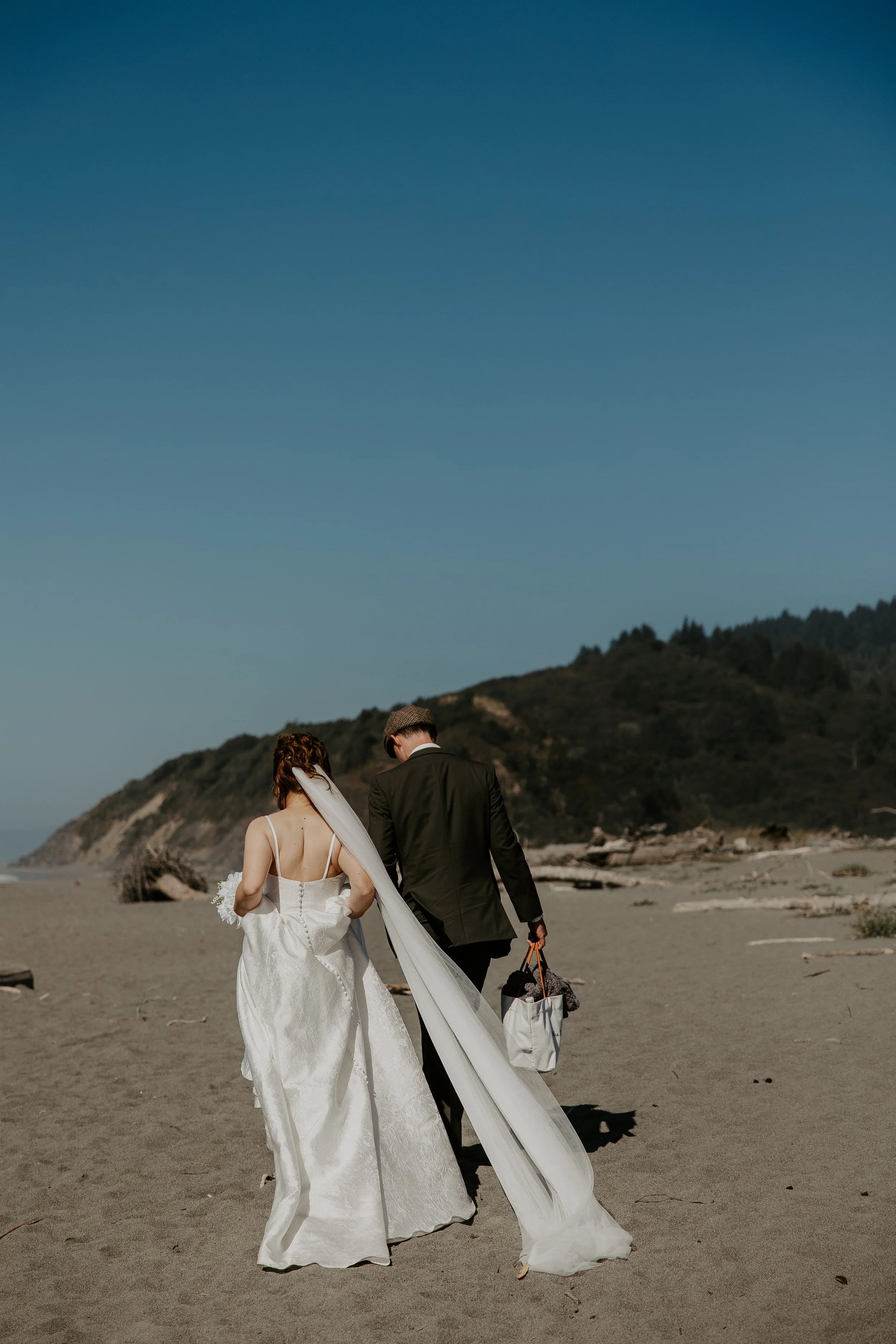

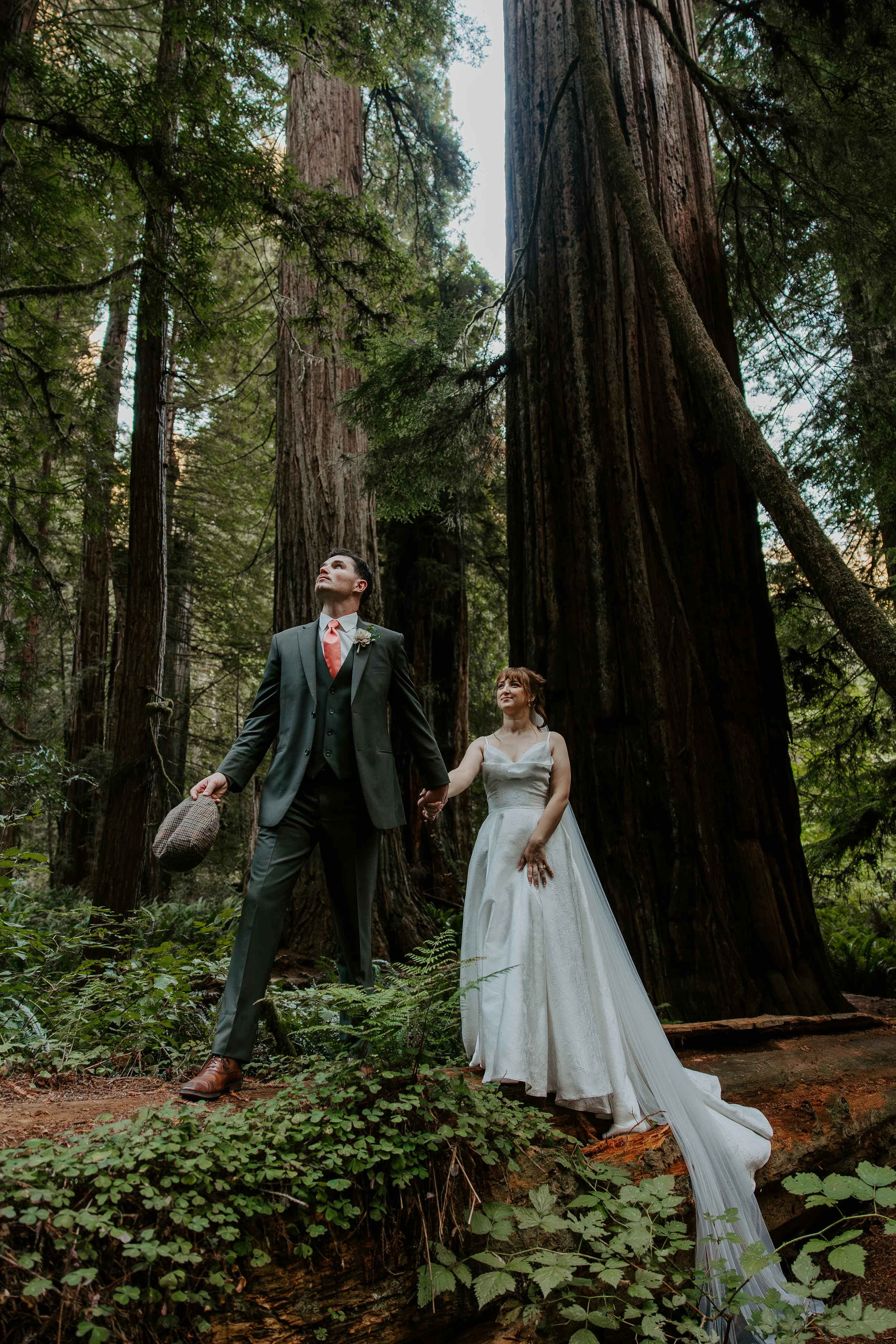

Dovi and Dan's day was built around two completely different environments within a few miles of each other, and the contrast between them is part of what made it so complete.
Their day opened at Redwood Creek Beach with a first look — just the two of them, the sound of the creek, and the old-growth trees rising above the beach on either side. After the first look they settled in for a picnic on the beach with their family, unhurried and relaxed, before making their way into the forest for the ceremony.
Their vows were exchanged on Cathedral Trees Trail surrounded by family, beneath one of the most awe-inspiring old-growth groves in the northern parks. Family portraits followed at the Big Tree, and then the group dispersed while Dovi and Dan stayed for couples portraits along the Circle Trail — winding through the quiet forest as the afternoon light settled in. The day ended in Crescent City with a family dinner, a natural and celebratory close to a day that had moved beautifully between intimacy and togetherness.
View Dovi + Dan's full gallery →
Nathan + Mackenzie — Jedediah Smith Redwoods, July


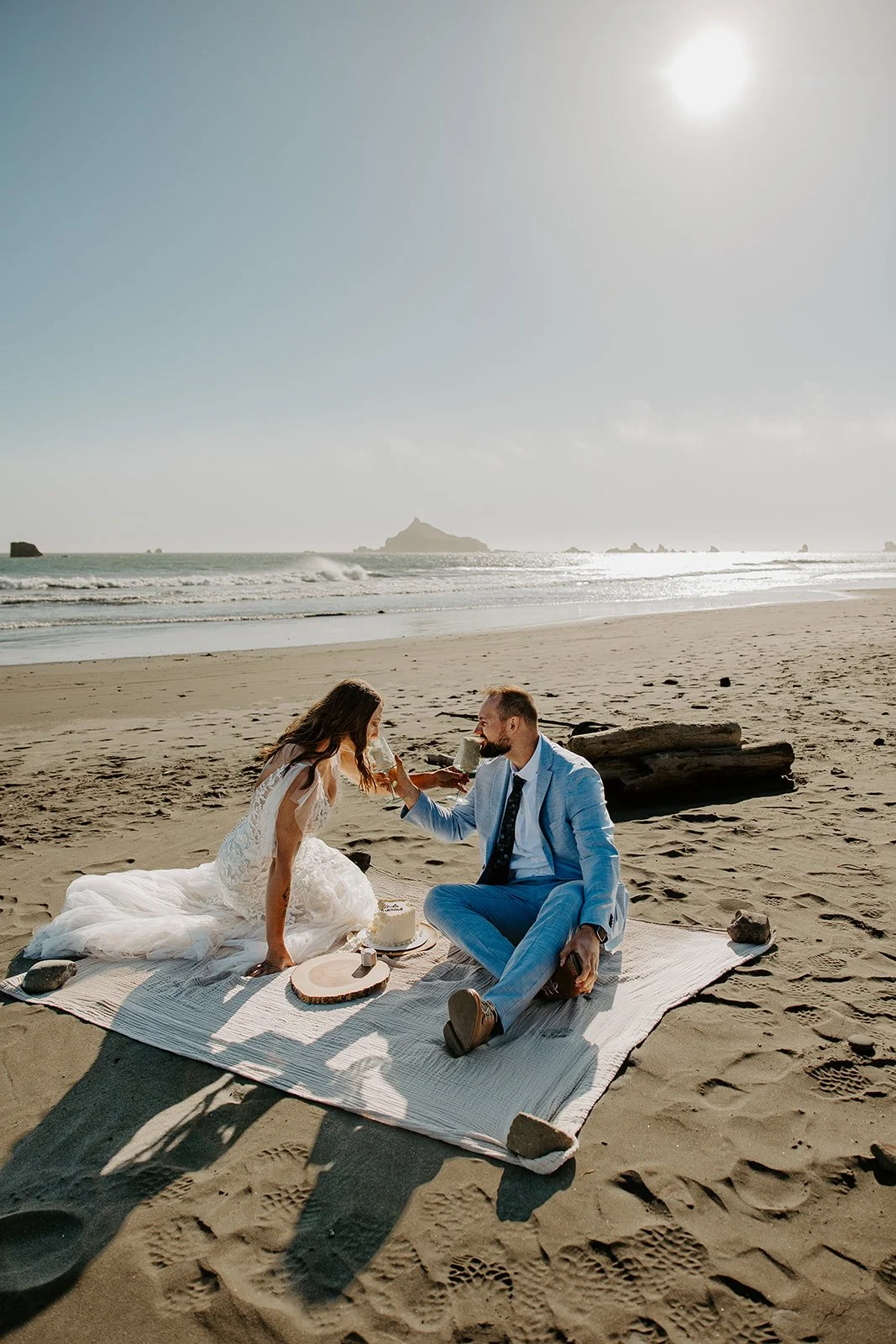
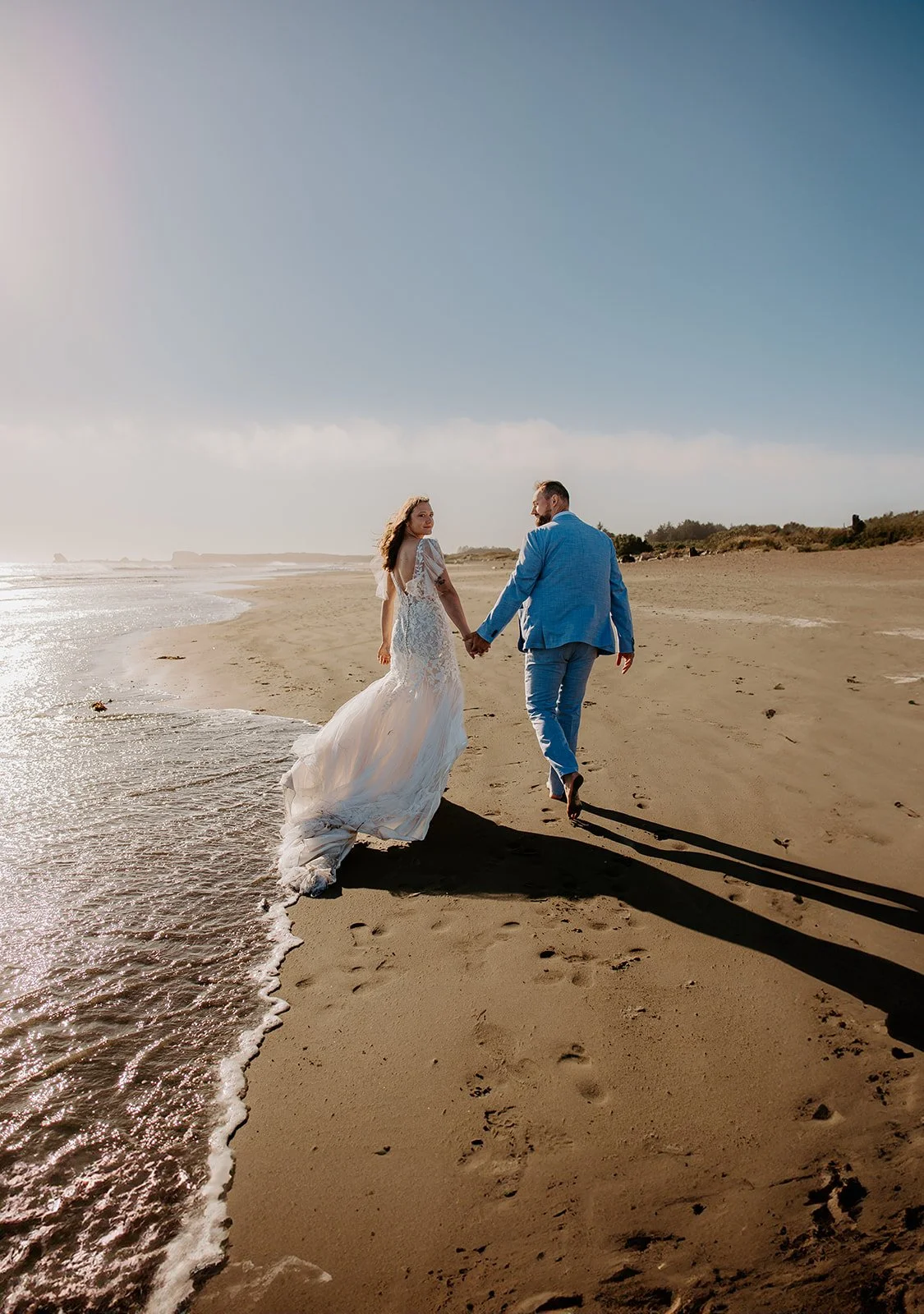
Nathan and Mackenzie eloped just the two of them — and their day is one of the clearest illustrations of what a private, experience-first redwoods elopement can look and feel like when the planning is done well.
Their first look happened at the Jedediah Smith Visitor Center, a quieter and more personal moment before the forest fully claimed the day. From there they made their way to the River Trail for their ceremony — standing beside the Smith River, one of the last undammed rivers in California, exchanging vows with nothing but old-growth trees and moving water surrounding them.
Stout Grove followed for portraits, where the scale of the ancient trees and the soft filtered light created the kind of atmosphere that no other location in the northern parks quite replicates. The day ended at Pebble Beach with cake and a joint — a celebration that was entirely, unapologetically theirs. No performance, no audience, no pressure. Just two people marking the beginning of their marriage exactly the way they wanted to.
View Nathan + Mackenzie's full gallery →
Julie + Alexander — Henry Cowell Redwoods, September
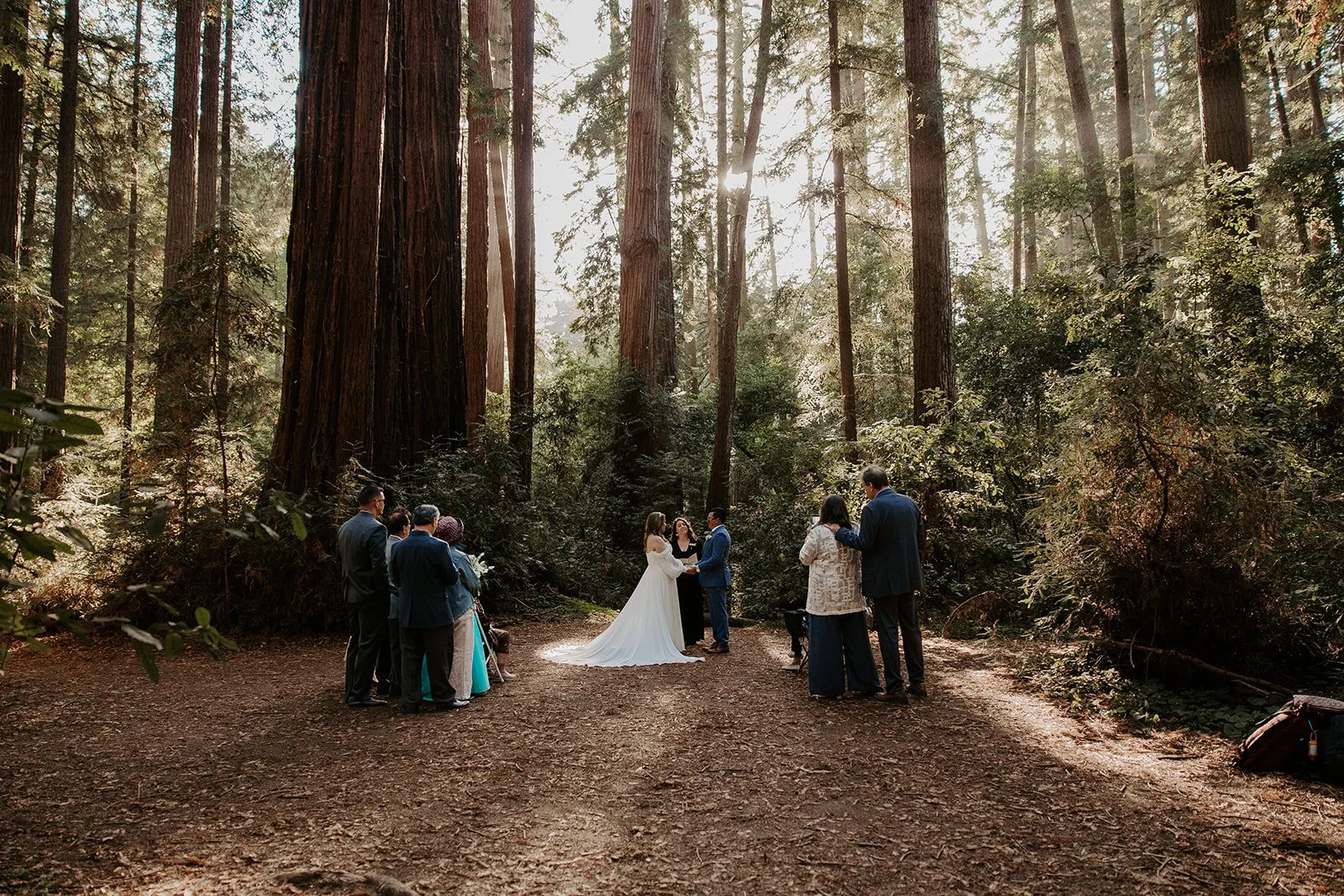

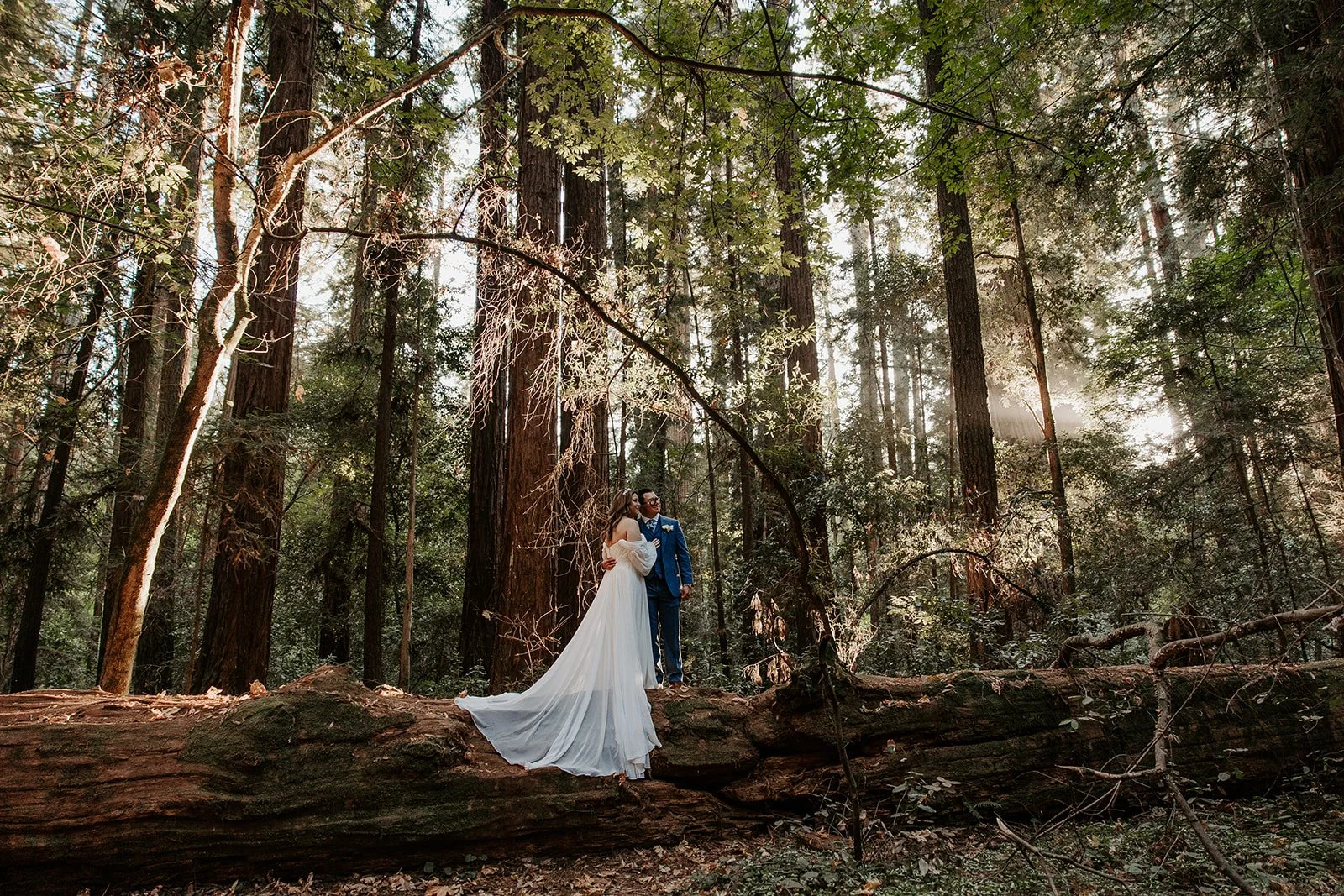
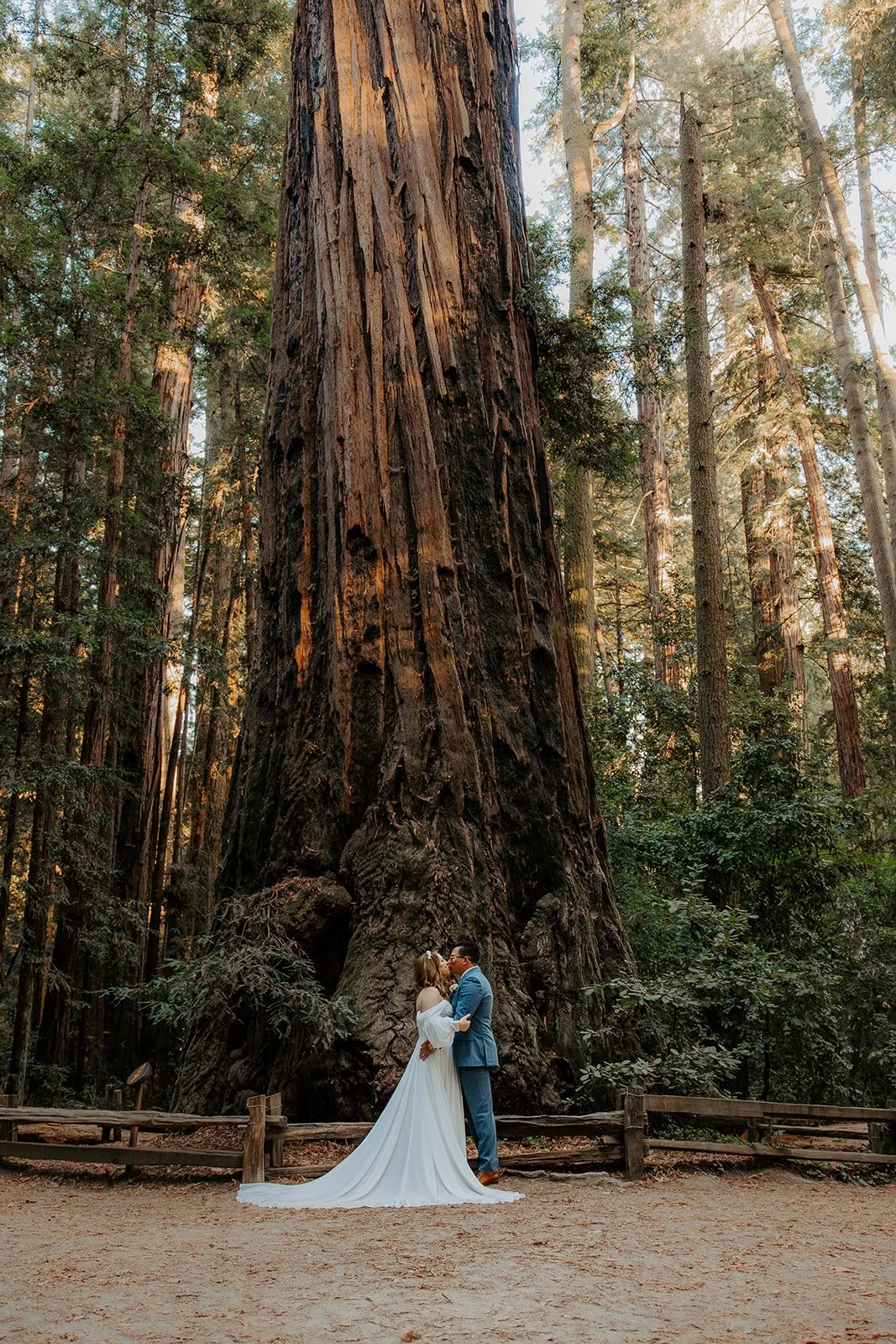
Julie and Alexander's elopement is a strong example of what a family-inclusive redwoods ceremony can feel like when the location and logistics are right. Henry Cowell's Redwood Grove area made the day genuinely accessible for everyone — no long hikes, no complicated logistics, just a walk into one of the most beautiful groves in the Bay Area and a ceremony that felt both intimate and well-held.
The group arrived together at the visitor center before making their way into the grove for the ceremony, surrounded by the towering coastal redwoods that define Henry Cowell's character. Portraits followed along the trail with the family before Julie and Alexander had time together in the grove — and then the whole group headed off for a celebration dinner, a clean and satisfying close to a day that balanced family inclusion with the simplicity and calm that drew them to eloping in the first place.
Their September timing delivered exactly what that month offers at Henry Cowell: comfortable temperatures, soft afternoon light filtering through the canopy, and trails that felt quiet and unhurried without the summer crowds still lingering from peak season.
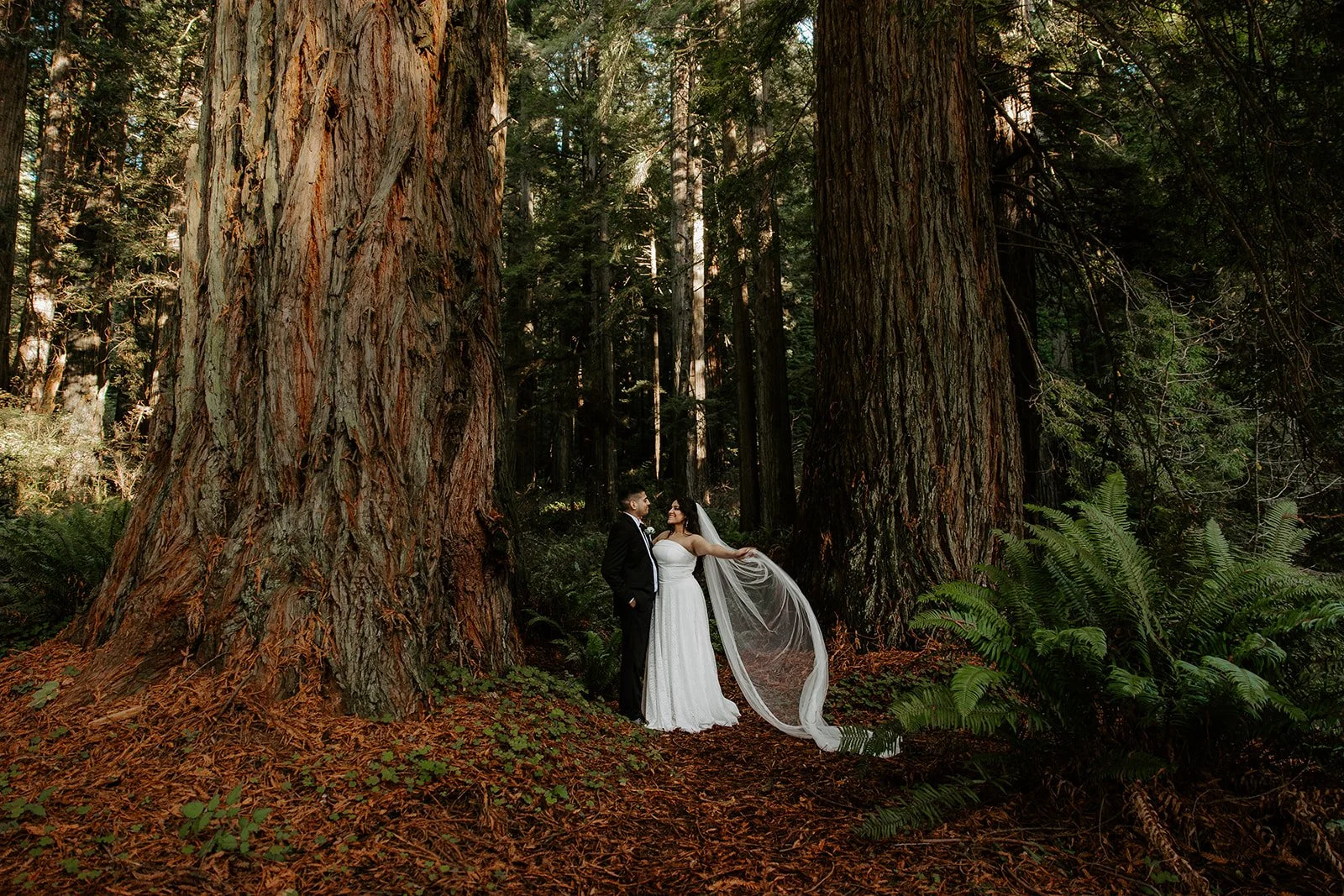
How Much Does it Cost to Elope in the Redwoods?
Redwoods elopement costs vary more widely than most couples expect — not because the forest itself is expensive to access, but because the range of experiences available here spans from beautifully simple to fully layered and multi-day. A couple who flies into Humboldt, hikes to a permit-free National Forest location, and celebrates with a private dinner has a very different investment than a couple who combines Muir Woods with a Marin Headlands golden hour and a Sausalito dinner. Both are meaningful. Both are worth planning carefully. The cost difference between them is significant.
The examples below reflect realistic investment ranges for two different experience levels. If you'd like a broader breakdown of how elopement costs are typically structured across all vendors, this guide on how much you should budget for an elopement walks through each cost category in detail.
Low Cost Redwoods Elopement Example
Designed for couples prioritizing a meaningful, nature-immersive day with minimal extras.
-
$100 — marriage license
$500 — 3 night local hotel stay
$4650 — 4-hour photography coverage
$300 — bouquet + boutonniere
$500 — wedding dress
$200 — suit rental
$200 — restaurant dinner + drinks
$200 – redwoods permit
free — DIY hair + makeup
Total: $6,650
Luxury Redwoods Elopement Example
Designed for couples who want a fully elevated, multi-location experience with additional vendors and extended coverage.
-
marriage license — $100
4 night luxury airbnb stay — $2000
multi-day photography coverage — $10800
bouquet, boutonniere, florals for ceremony and dinner — $1000
wedding dress — $3000
suit purchase — $1000
private chef — $800
5-6” custom cake — $350
onsite hair + makeup — $800
redwoods permit — $200
Total: $20,050
What Affects Cost Most in a Redwoods Elopement
Location and permit complexity. National park locations like Redwood National Park and Muir Woods require both a wedding permit and a commercial photography permit, adding fees and processing time compared to state parks and national forest locations. The permit fee line above reflects a standard state park permit — NPS permit costs vary and should be confirmed directly with the relevant park.
Coverage length. A northern California redwoods day that combines a forest ceremony with a coastal golden hour naturally requires more coverage hours than a single-location ceremony. That structure — which produces the most complete and layered elopement experience in this region — fits most naturally into a full-day or multi-day experience rather than a half-day.
Lodging choice. The redwoods region has exceptional unique accommodation options — treehouses, forest cabins, coastal cottages — that vary significantly in price. Peak season dates at the most distinctive properties carry a meaningful premium over shoulder season availability.
Florals and additional vendors. The northern parks region is remote enough that some vendors charge travel fees to reach ceremony locations in the northern parks complex. Confirming vendor travel policies early in the planning process prevents surprises.
Guest count. Adding guests to a redwoods elopement adds costs across nearly every vendor category — florals, catering, additional lodging — and can also affect permit fees at locations where pricing scales with group size.
Most couples planning a genuine redwoods elopement experience — ceremony, portraits, a coastal element, and a celebration — invest somewhere between $8,000 and $13,000 depending on coverage length, lodging, and vendor choices. The low and luxury examples above represent the outer edges of that range rather than the typical middle.
Redwoods Elopement Checklist
Planning a redwoods elopement involves more moving pieces than most destinations. This free guide walks you through every step so nothing gets missed.

Redwood Elopement Timeline Examples
Every redwoods elopement timeline is built around your specific location, season, permit requirements, and how you want your day to feel — not a fixed template. The examples below illustrate what an intentional redwoods elopement day can look like at two different scales. Use them as inspiration and a starting point rather than a rigid schedule.
Your final timeline will always be customized based on your priorities, locations, lighting windows, travel time, and the overall experience you want to create.
-
Prairie Creek Redwoods + Del Norte Coast — September
10:00 – 11:30 am: Getting Ready at Coastal Lodging Detail photos, slow morning, vow writing
11:30 am – 12:15 pm: First Look + Portraits at Redwood Creek Beach Emotional reveal, quiet beach portraits, forest backdrop
12:15 – 12:45 pm: Picnic on Redwood Creek Beach Charcuterie, champagne toast, unhurried celebration
12:45 – 1:15 pm: Drive to Cathedral Trees Trail, Prairie Creek (Approx. 15 minutes)
1:15 – 1:45 pm: Arrive and Walk to Ceremony Location
1:45 – 2:30 pm: Ceremony on Cathedral Trees Trail Vows beneath old-growth canopy, family or intimate witness present
2:30 – 3:30 pm: Post-Ceremony Portraits on Circle Trail Leisurely walk through the grove, natural documentary coverage
3:30 – 4:00 pm: Drive to Del Norte Coast (Approx. 20 minutes to Enderts Beach or Crescent Beach Overlook)
4:00 – 5:30 pm: Coastal Portraits + Exploration Rugged shoreline, sea stacks, tidepool wandering
5:30 – 6:00 pm: Drive to Sunset Overlook (Crescent Beach Overlook or Damnation Creek viewpoint)
6:00 – 7:30 pm: Golden Hour + Sunset Portraits Cliff-edge light, Pacific horizon, blue-hour close
7:30 – 8:00 pm: Drive back toward Crescent City
8:00 – 10:00 pm: Celebration Dinner in Crescent City Local restaurant, relaxed end to a full and layered day
-
Jedediah Smith + Southern Oregon Coast — Just the Two of You
On Day 1:
10:00 am – 12:00 pm: Getting Ready at Crescent City or Brookings Lodging Slow morning, detail photos, coffee together
12:00 – 12:30 pm: First Look at Jedediah Smith Visitor Center Private, unhurried, before the forest fully claims the day
12:30 – 1:00 pm: Drive to River Trail Trailhead (Approx. 15 minutes from Crescent City)
1:00 – 1:30 pm: Walk to Ceremony Location on River Trail
1:30 – 2:30 pm: Ceremony on the Smith River Vows beside one of California's last undammed rivers, just the two of you
2:30 – 4:30 pm: Portraits in Stout Grove Old-growth giants, soft filtered light, the full scale of the forest
4:30 – 5:00 pm: Drive to Pebble Beach (Approx. 10 minutes)
5:00 – 6:30 pm: Private Celebration at Pebble Beach Cake, champagne, a quiet end to the ceremony day
6:30 – 7:30 pm: Sunset at the Coast Crescent Beach or Enderts Beach for golden hour close
7:30 – 9:00 pm: Return to Lodging + Private Dinner Cozy evening, first night as a married couple
On Day 2:
9:00 – 10:00 am: Slow Morning at Lodging Coffee, a walk, no schedule
10:00 – 10:30 am: Drive into Southern Oregon (Approx. 30 minutes north of Crescent City to Brookings, OR)
10:30 am – 12:30 pm: Oregon Redwoods Trail + Redwood Nature Trailhead Quiet old-growth groves just across the border, almost no other visitors
12:30 – 1:30 pm: Lunch in Brookings Casual, coastal, unhurried
1:30 – 3:30 pm: Samuel H. Boardman State Scenic Corridor Exploration Sea stacks, coastal arches, dramatic Oregon coastline
3:30 – 4:00 pm: Drive back toward Crescent City or continue north
4:00 – 6:00 pm: Final Portraits at a Coastal Overlook Last golden light of the trip, Oregon coast backdrop
6:00 pm onward: Dinner + travel home or continue the honeymoon
A few notes on these timelines:
Drive times are approximate and consistently longer in this region than navigation apps suggest. The roads serving the northern parks are scenic and winding — build in buffer time generously and treat the drives as part of the experience rather than dead time.
September timing in the northern parks delivers some of the most favorable conditions of the year — crowds have dropped from the summer peak, temperatures are comfortable, and the afternoon light has begun its transition toward the warmer, lower-angle quality that makes fall elopement photography so compelling.
The multi-day structure is particularly well suited to the northern redwoods region because the combination of forest, river, and coast genuinely benefits from more than a single day. Couples who commit to two days here consistently describe a depth of experience that a single-day visit simply can't replicate.
For a broader look at how timeline structure shapes the overall elopement experience, this guide on what an Alabama elopement day actually looks like walks through the thinking behind intentional timeline design — applicable to any elopement destination, not just Alabama.
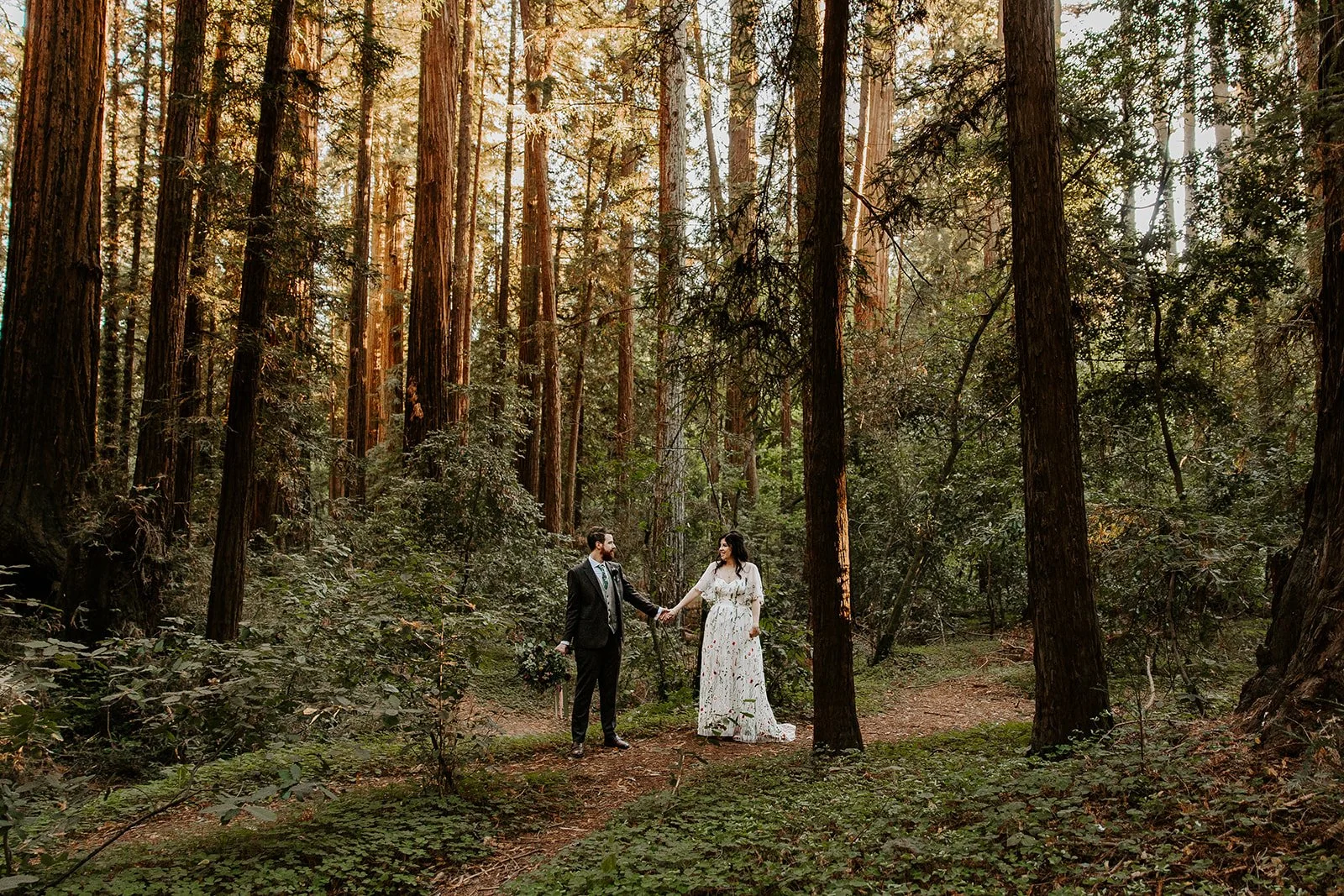
Redwoods Elopement Packages
A redwoods elopement is one of the most logistically layered experiences available to couples eloping in the U.S. Permits, park-specific rules, seasonal access, coastal timing, and the sheer geographic scope of the redwood rangeall require thoughtful planning well before your elopement day. The couples who have the most meaningful experiences here are the ones who arrive knowing that everything has been handled — not the ones who piece it together as they go.
Every redwoods elopement experience I offer is designed around that premise. My role isn't to show up and photograph your day. It's to carry the planning, logistics, and decision-making that tend to overwhelm couples most — so that by the time your elopement day arrives, your only job is to be present with each other.
What's Included in Every Redwoods Elopement Experience
All travel within California — your investment does not change based on which park or location you choose
Personalized location recommendations based on your season, vision, accessibility needs, and privacy priorities
Permit research and application guidance — including park-specific considerations, pre-approved location lists, commercial photography permit requirements, and low-impact ceremony protocols
Curated vendor recommendations for florals, hair and makeup, officiants, private chefs, and lodging
A handcrafted elopement timeline designed around light, travel time, terrain, coastal timing, and the overall pace you want your day to hold
Activity and experience ideas tailored to your relationship and the specific region of the redwoods you're eloping in
Planning support from first conversation through final gallery delivery — you're never left wondering what comes next
Every elopement gallery includes high-resolution digital images with full printing rights, delivered through a private online gallery with a curated slideshow upon delivery and complimentary album design.
Elopement experiences begin at $4,650 for an intimate local experience (up to 4 hours). From there, each experience is shaped around your location, priorities, and how you want your day to unfold.
Not sure on investment yet? See full packages and pricing →
👉 Tell me about your redwoods elopement plans →
Which Experience Is Right for You?
Half-Day Experience (Up to 6 Hours) Best suited for couples wanting an intimate, beautifully simple ceremony at a single accessible location — a redwood grove ceremony followed by portraits along a nearby trail. Ideal for Henry Cowell, Armstrong Redwoods, or accessible areas within Humboldt where driving between locations is minimal.
This experience is right for you if:
You want a short, focused ceremony with portraits
You're planning one primary location with little or no driving between stops
You prefer a calm, unhurried pace without a full-day commitment
You're including a small number of guests and want to keep logistics simple
Full-Day Experience (Up to 12 Hours) The most flexible and complete single-day option. Well suited for the northern parks experience — a forest ceremony combined with a coastal golden hour — or any redwoods day that involves multiple locations, a longer hike, getting ready coverage, and a post-ceremony celebration.
This experience is right for you if:
You want to combine the forest and the coast in a single day
You're planning multiple locations or a longer hike to your ceremony site
You want getting ready coverage, ceremony, portraits, and a celebration captured
You prefer a relaxed flow with room to move slowly between moments
Multi-Day Experience Designed for couples who want their elopement to feel like a genuine journey rather than a single event. Particularly well suited to the northern redwoods region, where the combination of old-growth forest, river, and dramatic Pacific coastline genuinely rewards more than one day of exploration.
This experience is right for you if:
You want to combine multiple parks or regions — Jedediah Smith and the Oregon coast, for example
You value slow mornings, unhurried evenings, and complete storytelling across more than one day
You want to combine your elopement with the beginning of your honeymoon
You're drawn to a layered, travel-forward experience that captures more than a ceremony
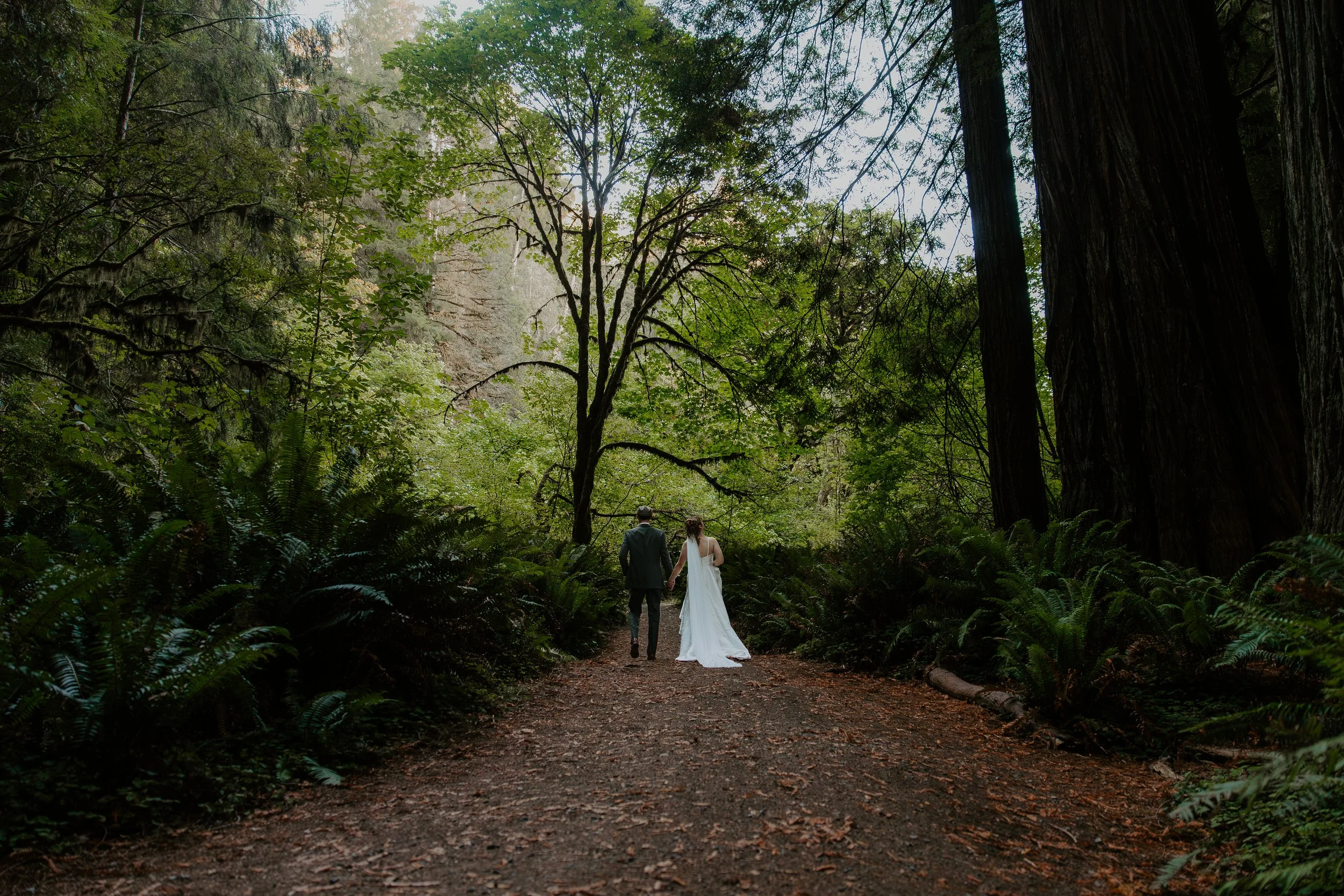
Current Specials for Redwoods Bookings
Redwoods Elopement FAQs
-
In most cases, yes. Permit requirements vary by location. National parks like Redwood National Park require both a wedding permit and a commercial photography permit. State parks like Jedediah Smith, Prairie Creek, and Humboldt require a Special Use Permit submitted through California State Parks. National forest locations may allow small low-impact ceremonies without a formal permit, though this should always be confirmed in advance. Permit applications at popular locations should be submitted at least 3 to 4 months before your elopement date.
-
Late spring (April through early June) and fall (September through October) are the strongest seasons. Spring brings wildflower blooms, full waterfalls, and lush green fern growth with manageable crowds. Fall delivers cooler temperatures, colorful understory foliage, and quieter trails after the summer peak. Summer is beautiful but the busiest season — early morning weekday ceremonies are essential for privacy. Winter offers complete seclusion and a moody, misty atmosphere for couples willing to embrace unpredictable weather.
-
Yes, but it requires advance planning. Muir Woods requires both a Special Use Permit and a commercial photography permit. Ceremony locations are limited to specific pre-approved areas, and permit availability at preferred locations is competitive. Early morning weekday ceremonies offer the best combination of permit availability and privacy. Begin the application process as early as possible, particularly for spring and fall dates.
-
Most couples planning a genuine redwoods elopement experience invest somewhere between $8,000 and $13,000depending on coverage length, lodging, and vendor choices. A simple, intentional elopement with a national forest ceremony location can come in around $7,800. A fully elevated multi-day experience with luxury lodging, extended coverage, and additional vendors can reach $20,000 or more. Photography, lodging, and permit fees are typically the three largest cost variables in a redwoods elopement budget.
-
It depends on which type of marriage license you choose. A public marriage license requires at least one witness. A confidential marriage license requires no witnesses and is not a public record — only the couple can obtain copies. The confidential license is often the better fit for couples eloping just the two of them, as it removes the need to coordinate a witness and keeps your marriage record private. Both license types are legally equivalent in California.
-
Legally, yes. A photographer is not required to elope in the redwoods. However, the redwood forest produces some of the most extraordinary natural light and scenery available at any elopement destination in the world, and having your day documented by someone who understands the environment — the light, the timing, the permit requirements — is something most couples who elope here consider essential. Note that some locations require a commercial photography permit specifically when a professional photographer is present, which is worth confirming for your chosen location.
-
Flowy, lightweight, and movement-friendly silhouettes work best in the forest environment. A-line and bohemian-style dresses in ivory, cream, sage, or earthy neutrals photograph beautifully against redwood bark and fern understory. For footwear, ankle boots with a low block heel, white sneakers, or flat sandals with good grip are all practical and stylish choices for forest trails. Bring two pairs of shoes — practical footwear for walking and your preferred ceremony shoes to change into at your ceremony location. If your day includes a coastal element, plan for wind and choose hair styles and accessories designed for movement.
-
Yes — and significantly underutilized. The southern Oregon redwood locations near Brookings — including the Oregon Redwoods Trail, Redwood Nature Trailhead, and Winchuck State Recreation Site — see a fraction of the visitors that even the quietest California parks attract. Permit requirements are less formalized and the surrounding Oregon coastline at Samuel H. Boardman State Scenic Corridor adds dramatic sea stacks and coastal scenery that rivals anything on the California coast. Couples staying in Crescent City can reach the Oregon redwood locations in under an hour.
-
Coastal redwoods grow along the Pacific coast and are the tallest trees on Earth, offering a lush fern-filled forest atmosphere with proximity to the California and Oregon coastline. Giant sequoias grow in the Sierra Nevada Mountains and are the largest trees by volume, with a drier, more open, higher-elevation atmosphere. For most couples planning an experience-first elopement, coastal redwoods offer more flexibility, more intimate ceremony settings, and the option to combine a forest ceremony with a coastal golden hour in a single day. Sequoias are breathtaking for couples specifically drawn to the Sierra Nevada, but don't offer coast access and the permit environment at the most iconic locations is more complex.
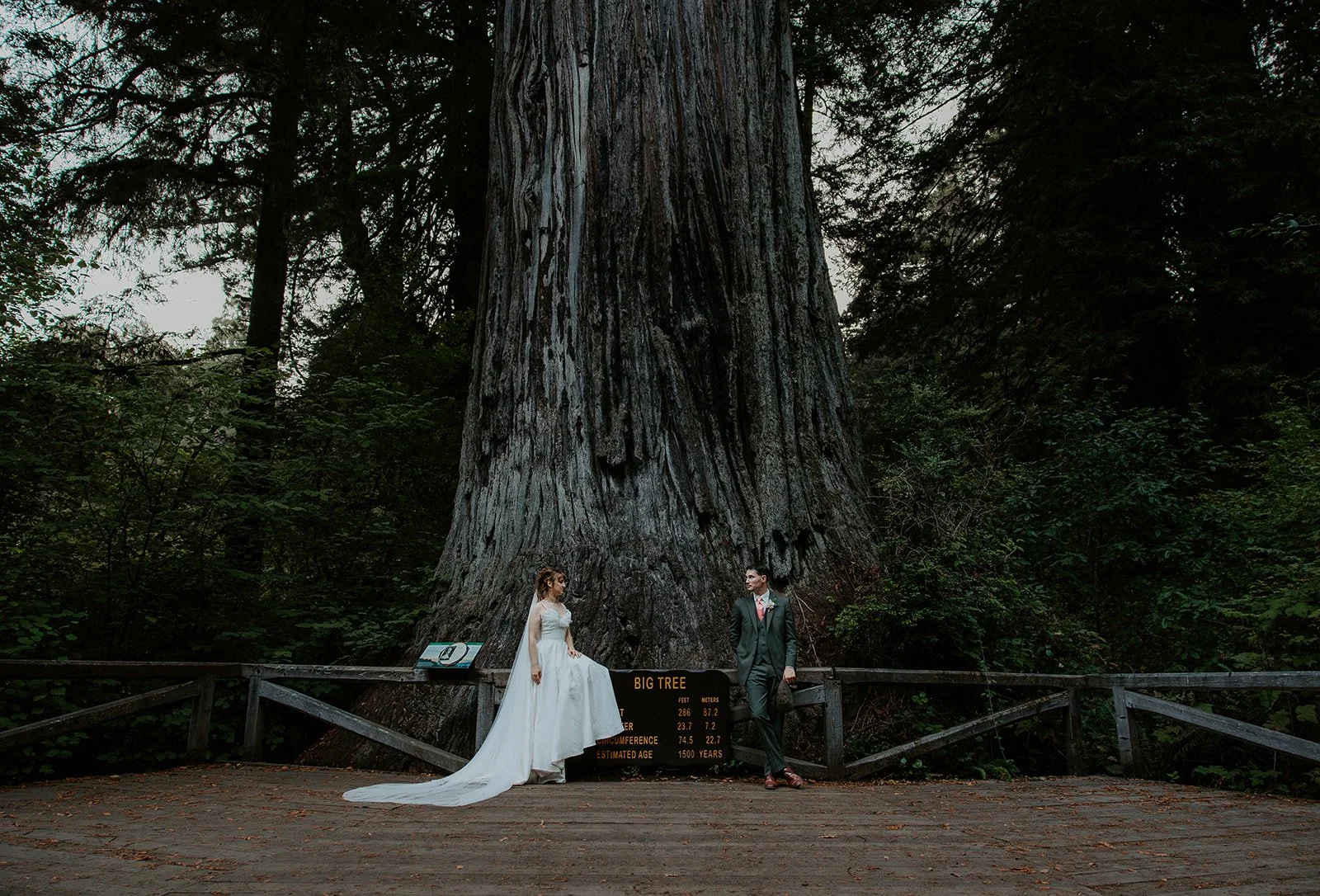
Ready to Start Planning Your Redwood Elopement?
The redwoods are one of the few places in the world where a wedding day can feel genuinely held by something ancient and larger than the moment itself. Couples who elope here consistently describe the same thing — a sense of having been somewhere real, having done something that mattered, in a place that will exist long after the photographs have faded.
If that's the kind of day you're dreaming of, I'd love to help you plan it.
I work with a limited number of couples each year so I can provide the hands-on planning support, location expertise, and permit guidance that a redwoods elopement actually requires. From your first question about which park fits your vision to the final gallery delivered to your inbox, the process is designed to feel clear, supported, and completely centered on you.
You don't need to have everything figured out before reaching out. Most couples who contact me are still in the early stages — narrowing down locations, trying to understand costs, figuring out whether the redwoods are the right fit. That's exactly the right time to start a conversation.
Choosing the right photographer for a redwoods elopement matters more than it does in most destinations. The permit process, the location knowledge, the timing decisions, the coastal pairing — all of it shapes how your day actually feels, not just how it looks. If you're still in the process of deciding, this guide on how to pick a photographer for your elopement walks through what to look for and what questions to ask.
Ready to begin? Reach out below.
Not ready to reach out yet? Wondering about investment first? View packages and pricing →


Learn More About Eloping in California


Bethany Wolf
Guided Public-Lands Elopement Photographer
✔ permits & logistics handled
✔ timeline design
✔ location guidance
✔ travel included nationwide