

How to Elope in Washington, D.C. – Permits, Locations, & Washington, D.C. Elopement Packages
Eloping in Washington D.C. is legal, straightforward, and requires no waiting period or witnesses — making it one of the more accessible cities on the East Coast for couples who want to keep things simple. Couples need a marriage license from the D.C. Superior Court Marriage Bureau ($45), and most popular ceremony locations, including the National Mall and memorials, require an NPS Special Use Permit regardless of group size. If you're still deciding whether D.C. is the right fit, our guide to the Easiest Places to Elope in the U.S. breaks down how D.C. compares to other states by permit requirements, legal simplicity, and overall accessibility. Here's everything you need to know to plan your Washington D.C. elopement from start to finish.
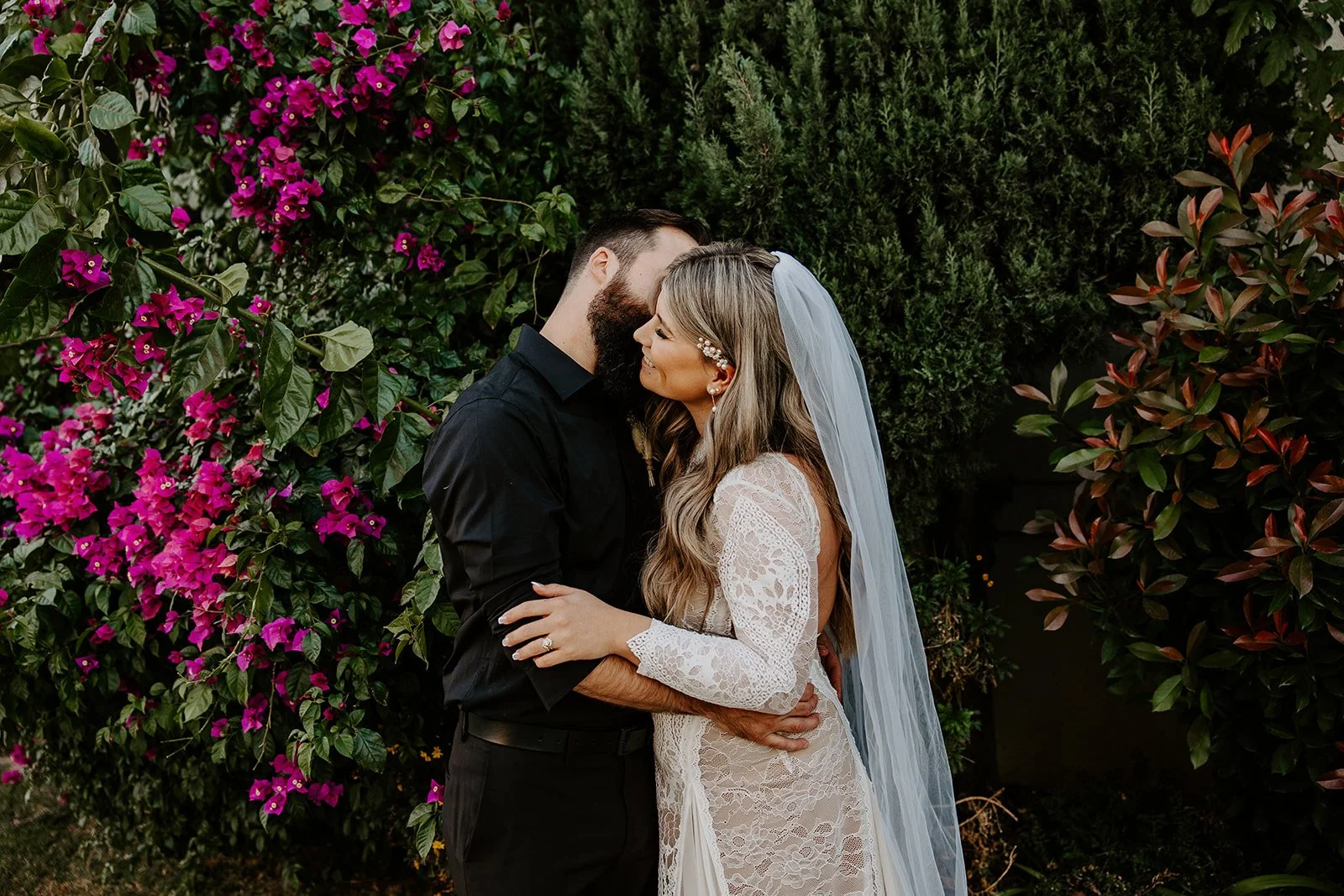
Washington, D.C. Elopements At-a-Glance
Washington, D.C. Elopements At-a-Glance
| Marriage License Fee | $45 |
| Waiting Period | None — same-day marriage is legal |
| Witnesses Required | No |
| Self-Officiating Allowed | Yes — selected directly on the license application |
| Permit Required | Yes — most locations are NPS-managed |
| Best Season | Spring (cherry blossoms) & Fall (color, cooler temps) |
| Best Time of Day | Sunrise / early morning for monuments |
| Elopement Packages Start At | $4,650 |
Why Elope in Washington, D.C.?
Famous Landmarks and Architecture
Washington, D.C. is filled with some of the most recognizable landmarks in the country. From the National Mall to the Lincoln Memorial and the Washington Monument, couples that enjoy history, art, or urban design are drawn here for a reason.
Walkable and Easy to Explore
Many of the city’s most beautiful places are within walking distance of each other. Couples can easily visit monuments, gardens, and parks without needing to travel far or worry about getting a car.
A Mix of History, Gardens, and the City
D.C. is very good at balancing history and green spaces throughout the city. Places like Rock Creek Park, the Tidal Basin, and gardens are right in the middle of the city, giving couples natural backgrounds without traveling far, hiking, or changing shoes.
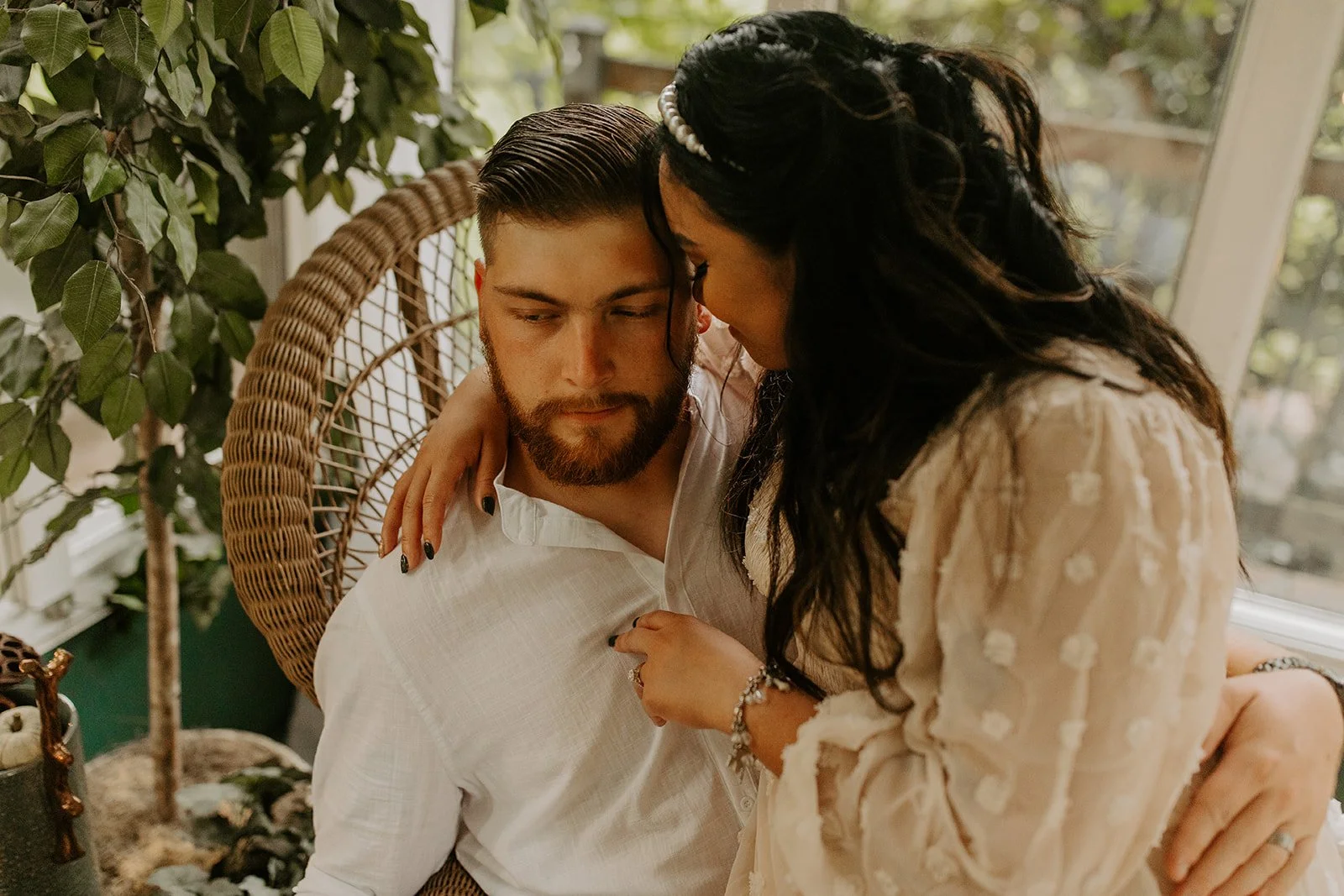
What is Washington, D.C., Known For?
Monuments and National Landmarks
Washington, D.C. is known for the National Mall, lined with some of the most recognizable landmarks in the United States, including the Washington Monument, the Lincoln Memorial, and the U.S. Capitol. In the early morning, before the crowds arrive, memorials are serene, reflecting pools are open for photos, and pathways connect one historic place to another.
Historic Neighborhoods and Architecture
Beyond the monuments, Washington, D.C. is also known for its tree-lined neighborhoods, brick rowhouses, and classic East Coast architecture. Places like Georgetown, Capitol Hill, and Dupont Circle have cobblestone streets and small neighborhood parks for couples who prefer the more historic side of things.
Cherry Blossoms
Each spring, thousands of cherry blossom trees bloom around the Tidal Basin. The trees were originally gifted by Japan in 1912 as a symbol of friendship between the two countries, today, pink blossoms line the water and walking paths, creating one of the most romantic urban settings in the city.
Possible Elopement Wildlife Sightings
Although Washington, D.C. is a major city, it still has a surprising amount of wildlife thanks to its many parks. Couples have a chance to see deer, foxes, beavers, and owls in places like Rock Creek Park and the Anacostia River.
Washington, D.C. Elopement Locations Map
Washington D.C.'s most popular elopement locations are spread across the city, but many are within walking distance of each other — making it easy to combine a ceremony spot with portraits, a celebration dinner, or an afternoon exploring the city together. Use the map below to get a feel for where everything is before diving into the details.
How to Elope in Washington, D.C.
Legal Requirements At-a-Glance:
Know the Requirements:
No Waiting Period: Couples can legally marry the same day their marriage license is issued in Washington, D.C.
No Witnesses Required: D.C. does not require witnesses for a marriage to be legally recognized.
Officiant Optional: Washington, D.C. allows self-officiating, meaning couples can legally marry themselves without an officiant if they choose.
Obtain a Marriage License:
To legally elope in Washington, D.C., couples must apply for a marriage license through the D.C. Superior Court Marriage Bureau. The license fee is typically $45.
Couples should be prepared to bring:
A valid government-issued photo ID
Social Security numbers (or an alternate form if not applicable)
Basic personal information (birthplace, parents’ names, etc.)
Payment for the license fee (many counties require cash or specific payment types)
Applications can be completed online before visiting the court, but couples should confirm with the Marriage Bureau before applying.
Find an Officiant
Do it Yourself, Use a Family Member or Friend
When applying for your marriage license through the D.C. Courts, you’ll have the option to choose self-officiating directly on the application.
The process itself is simple—you’ll complete the online application, select self-officiating, and submit your identification and payment. Once your license is issued, it will reflect that you are authorized to officiate your own marriage. From there, you’re able to sign your own marriage certificate after your ceremony, making it fully legal without any third party involved.
Use a Professional Elopement Officiant
For outdoor and location-based elopements, it helps to have an officiant who is comfortable in various outdoor environments. Since PJ specializes in officiating outdoor elopements, many couples have expressed the simplicity and professional reassurance that it brought to their special day.
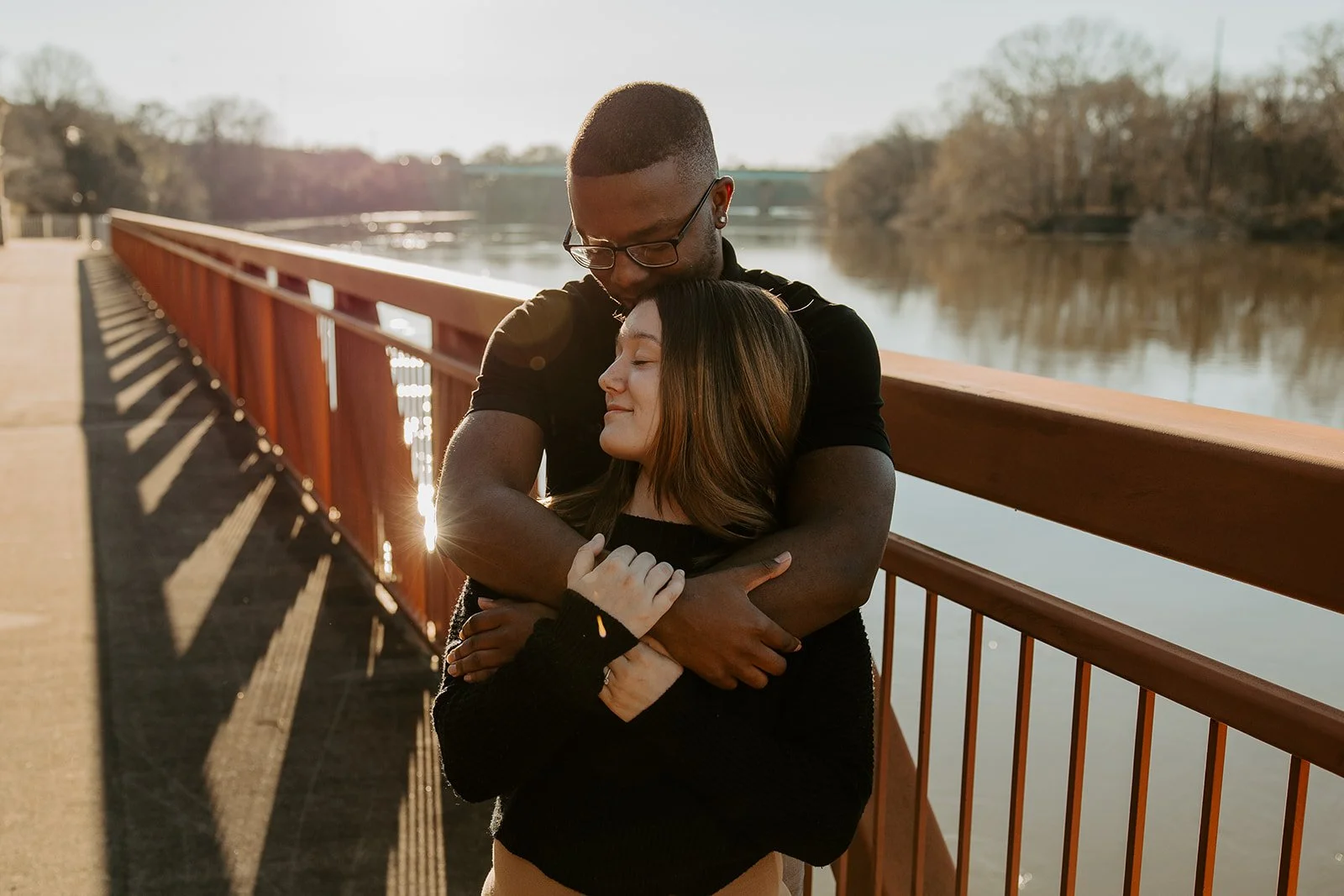
Do You Need a Permit to Elope in Washington D.C.?
Permits in Washington, D.C. are a little different than other states because most locations suitable for elopements are managed by the National Park Service. Ceremonies on the National Mall, memorials, or other federally managed land need a special use permit, regardless of group size. This includes places like the Lincoln Memorial, Jefferson Memorial, and many of the gardens and monuments throughout the city. These permits are meant to manage foot traffic, protect historic spaces, and ensure ceremonies don’t interfere with public access.
Because permit requirements can differ between parks and locations, it’s important to verify the rules with the park office before your elopement day.
Working with an experienced elopement photographer or guide can make the process much easier, especially when it comes to understanding permits, location guidelines, and Leave No Trace practices. When booking with me, permit guidance and location research are already included, so couples don’t have to figure out park rules or logistics on their own.
When is the Best Time to Elope in Washington, D.C.?
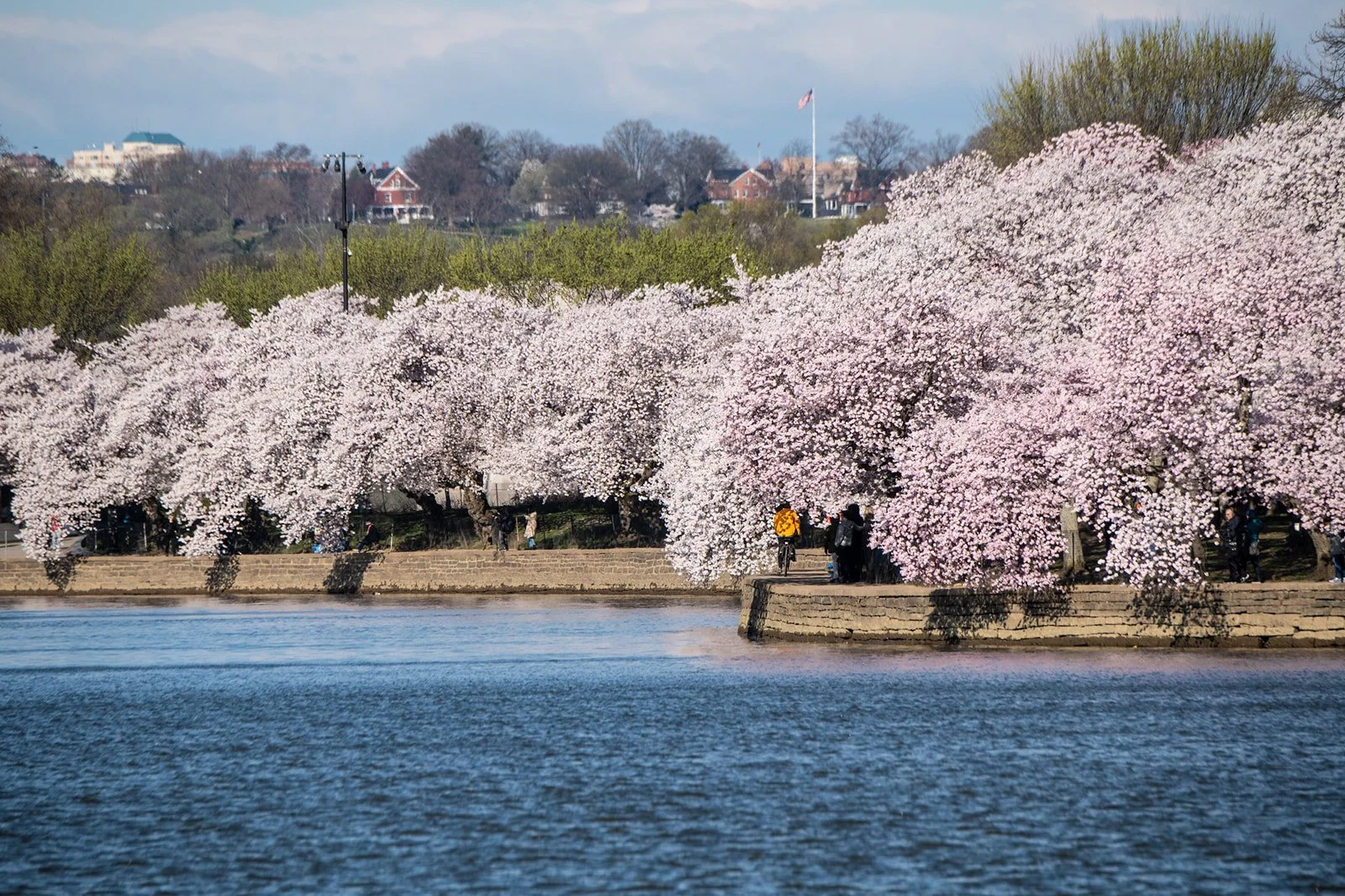
Spring (March–May):
Spring is one of the most romantic times to elope, thanks to the cherry blossoms, the mild temperatures, and spring greenery. Occasional showers are common but usually brief, and average temps range between 50 and 75 degrees.
Best For: Couples who want cherry blossoms, pinks, whites, and light greens, and more private experiences around the city, monuments, and parks.
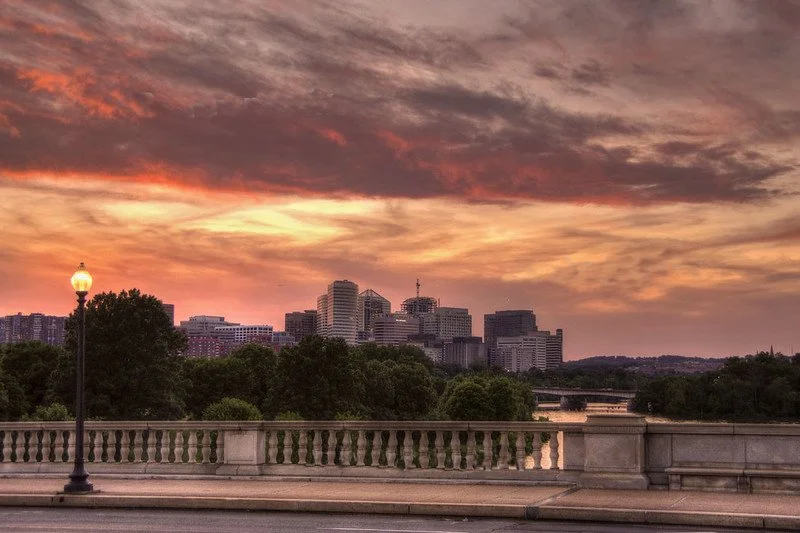
Summer (June–August):
Couples can expect plants full of life throughout parks, gardens, and waterfront areas. Early morning ceremonies are usually the best option due to the crowds. Average summer temperatures are about 70 to 90 degrees.
Best For: Couples who want warm mornings, golden-hour lighting, and ample access to accommodations.
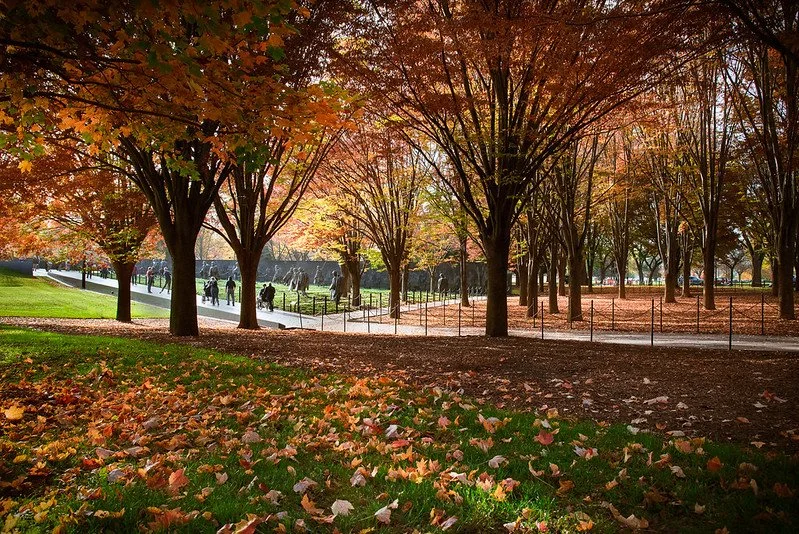
Fall (September–November):
Fall is one of the best times to elope in Washington, D.C., with more comfortable temperatures in the 50s and 70s and colorful leaves throughout the city.
Best For: Couples who want comfortable weather, colorful trees, and autumn-in-the-city experiences.
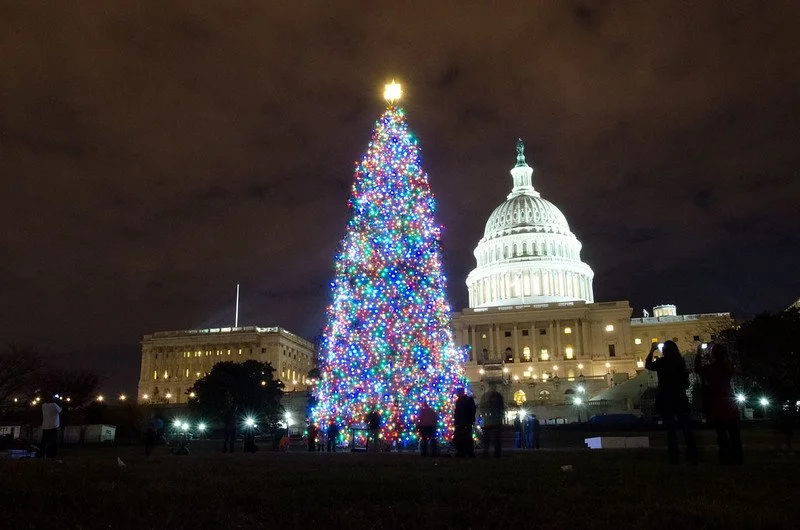
Winter (December–February):
Winter is the emptiest time of year, especially around the monuments early in the morning. With occasional snow, couples can expect fewer crowds and weather in the 30s and 50s.
Best For: Couples who want privacy, fewer crowds, and possible snow.
Weather Warnings:
Washington, D.C. summers can be very hot and humid, so many couples choose sunrise ceremonies to stay comfortable and avoid crowds. In spring, it’s common to experience light rain during cherry blossom season, and afternoon thunderstorms during summer.
However, when planning an outdoor elopement, it’s normal to talk through weather possibilities with your elopement guide so contingency plans are in place before couples ever have a chance to worry. Don’t let weather chances hinder your planning momentum.
Best Time of Day to Elope in Washington, D.C.
For elopements in Washington, D.C., time of day plays a much bigger role than just the places you visit.
Sunrise or early morning is usually the best option, especially for monuments and the National Mall. They’ll give you the most privacy, cooler, more comfortable temperatures, and soft light that’s great for pictures.
Sunset or early evenings can still work in parks, gardens, and waterfront areas, but expect monuments to stay crowded well into the night.
Planning Tip
Tuesday through Thursday elopements at monuments and the Tidal Basin see dramatically fewer crowds than weekends — even during peak cherry blossom season. If your schedule allows for a weekday, it's one of the easiest ways to get a more private experience without changing your location plans at all.
What to Wear for a Washington D.C. Elopement
Washington D.C. is a city elopement at its core, which means attire tends to lean a little more polished than a mountain or forest setting — but that doesn't mean formal is required. The most important thing is that what you wear feels like you, moves comfortably through the city, and works for the conditions on your day.
Dress and Skirt Length
If your ceremony or portrait locations involve grass, gravel paths, or the uneven brick streets of Georgetown, shorter hemlines or tea-length styles will be more practical than a full cathedral train. Flowing fabrics photograph beautifully in open spaces like the Tidal Basin and Constitution Gardens, but be mindful that D.C. can be windy along the water and on the open Mall.
Footwear
You will walk more than you expect. Even if your locations are close together on the map, cobblestone streets in Georgetown, gravel paths around memorials, and soft ground in Rock Creek Park are all easier in a block heel, a low heel, or a stylish flat than in a stiletto. Comfortable footwear is one of the most consistent things couples say they wish they had prioritized.
What to Pack for a Washington D.C. Elopement
Washington D.C. is a walkable, urban environment, which means your packing list is lighter than a backcountry elopement — but there are still a few things worth having with you on the day.
Best Places to Elope in Washington DC (Quick Comparison)
Each location in Washington, D.C., offers different levels of privacy, accessibility, and overall feel, each unique to every couple. This quick comparison makes it easier to see what aligns with your priorities.
Where to Elope in Washington, D.C.
What’s the difference between eloping in a state park versus a national park? Is one easier to plan than the other? Let’s break down the pros and cons of state and national parks so you can decide which option fits your elopement vision best.
National Parks
-
African American Civil War Memorial
Anacostia Park
Capitol Hill Parks
Chesapeake & Ohio Canal National Historical Park
Civil War Defenses of Washington
Constitution Gardens
Dwight D. Eisenhower Memorial
Fort Dupont Park
Franklin Delano Roosevelt Memorial
Kenilworth Park & Aquatic Gardens
Korean War Veterans Memorial
LBJ Memorial Grove on the Potomac
Lincoln Memorial
Martin Luther King, Jr. Memorial
National Mall and Memorial Parks
Rock Creek Park
Theodore Roosevelt Island
Thomas Jefferson Memorial
Vietnam Veterans Memorial
Washington Monument
World War I Memorial
World War II Memorial
State Parks
Not applicable.
USDA Forest Service:
Not applicable.
Bureau of Land Management:
Not applicable.
Where to Stay for a Washington D.C. Elopement
Washington D.C. is a city where neighborhood matters. Where you stay shapes how your day flows — how far you are from your ceremony location, what you can walk to for a celebration dinner, and what the morning of your elopement actually feels like. Here's a breakdown of the most popular areas for elopement couples, along with what to expect from each one.
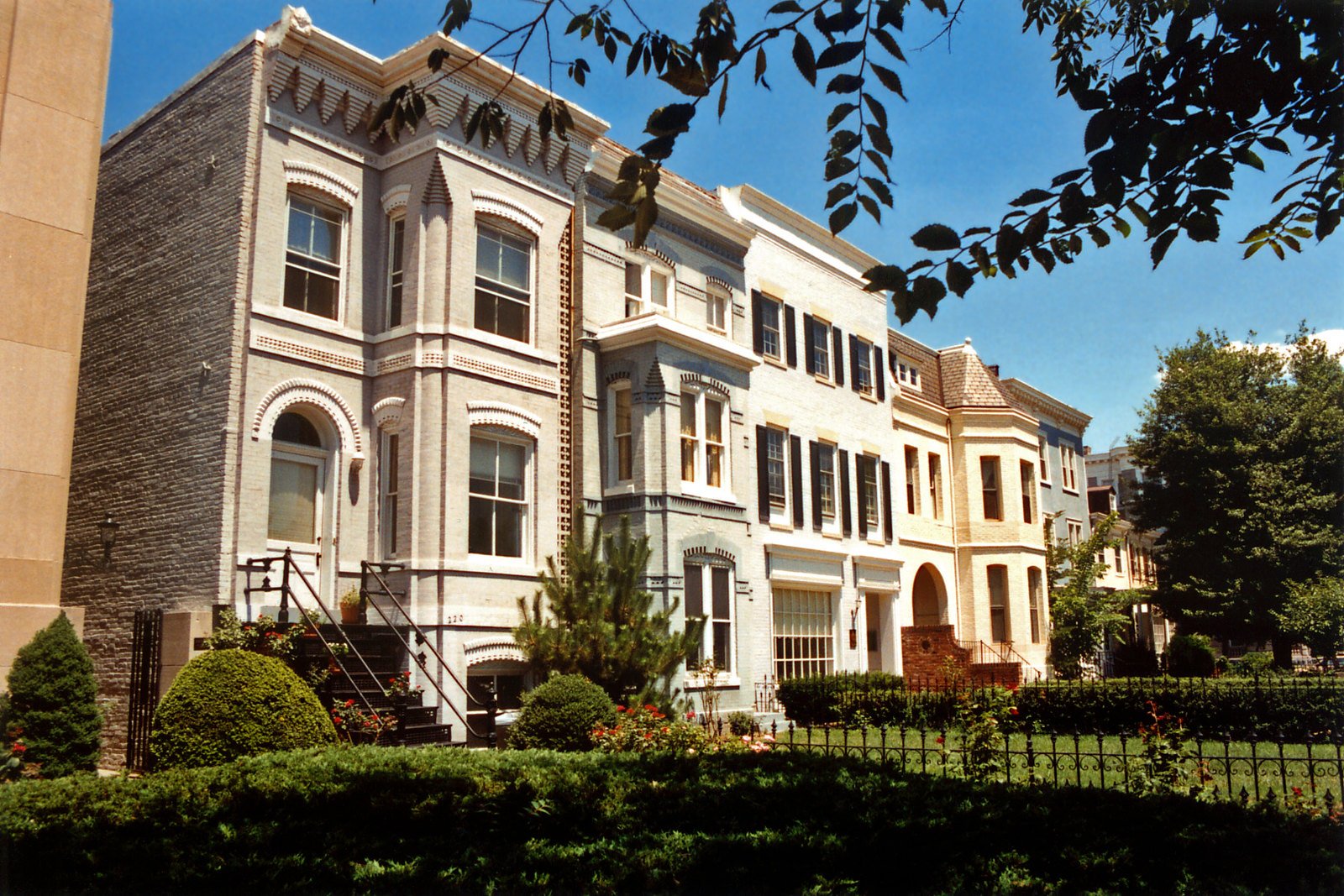
Capitol Hill
Capitol Hill is one of the most walkable neighborhoods in the city and puts you within easy reach of the National Mall, the Lincoln Memorial, and the Tidal Basin without needing a car or a long commute on your elopement morning. The neighborhood itself is full of historic rowhouses, tree-lined streets, and quiet residential blocks that feel a world apart from the tourist corridors a few blocks over. Couples who want to walk out the front door and be in the middle of everything tend to gravitate here. Eastern Market is a short walk away for a low-key breakfast before the ceremony, and the restaurant options along Barracks Row make it an easy choice for a celebration dinner the same evening.
Best for: Couples eloping at the National Mall, Lincoln Memorial, Tidal Basin, or DC War Memorial.
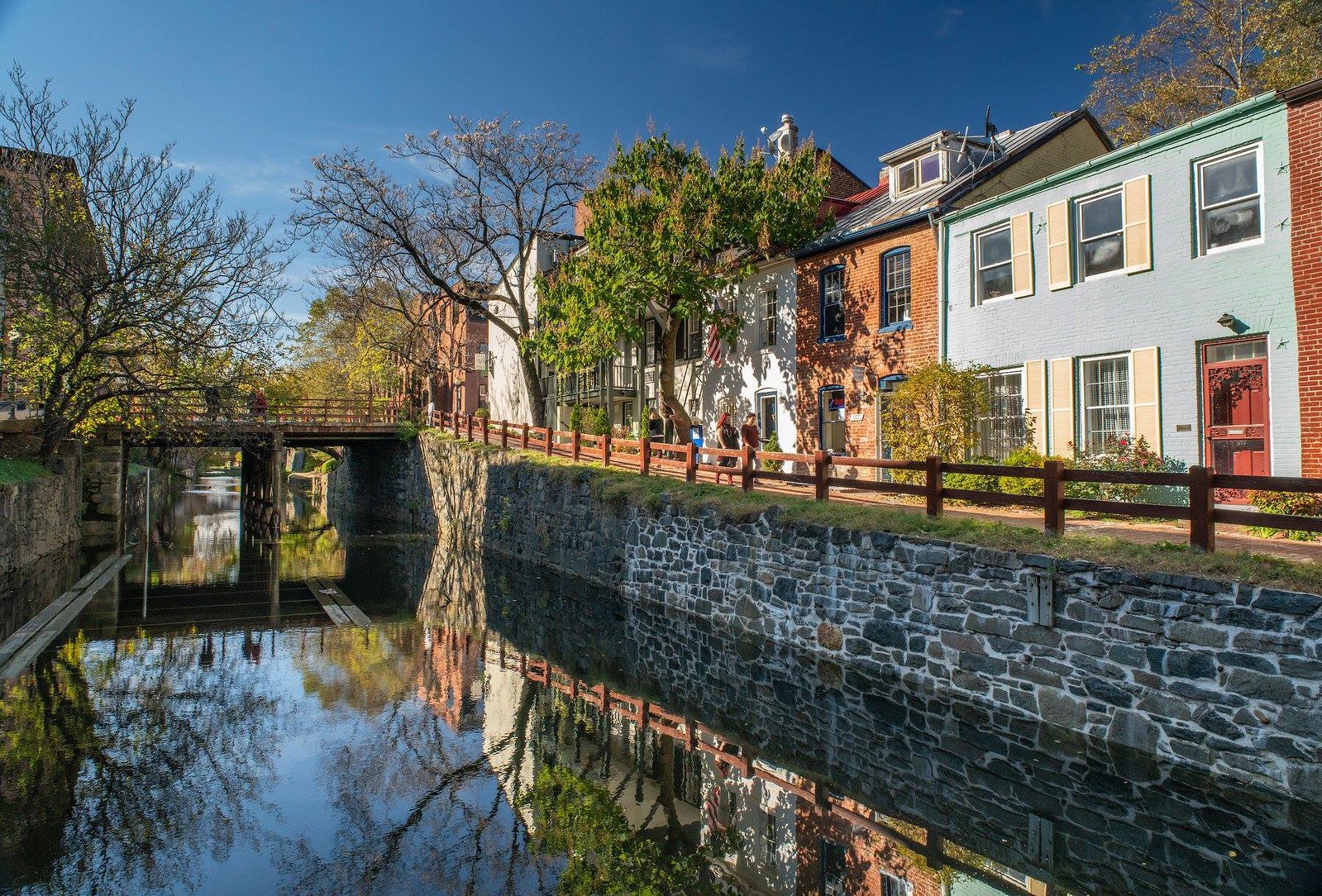
Georgetown
Georgetown is the most atmospheric neighborhood in D.C. for an elopement stay. Cobblestone streets, brick rowhouses, Federal-style architecture, and the C&O Canal towpath running along the waterfront make it feel like a different city entirely. It's quieter than Capitol Hill, more residential in character, and gives the elopement day a slower, more intentional pace. Dumbarton Oaks Gardens and Bishop's Garden at the National Cathedral are both within easy reach, and the neighborhood itself offers beautiful portrait backdrops before or after your ceremony. Georgetown skews toward boutique hotels and upscale Airbnbs, so budget accordingly — but the experience of staying here tends to be a meaningful part of the day for couples who choose it.
Best for: Couples eloping at Dumbarton Oaks, Bishop's Garden, or the C&O Canal. Also ideal for couples who want the neighborhood itself as part of their elopement experience.
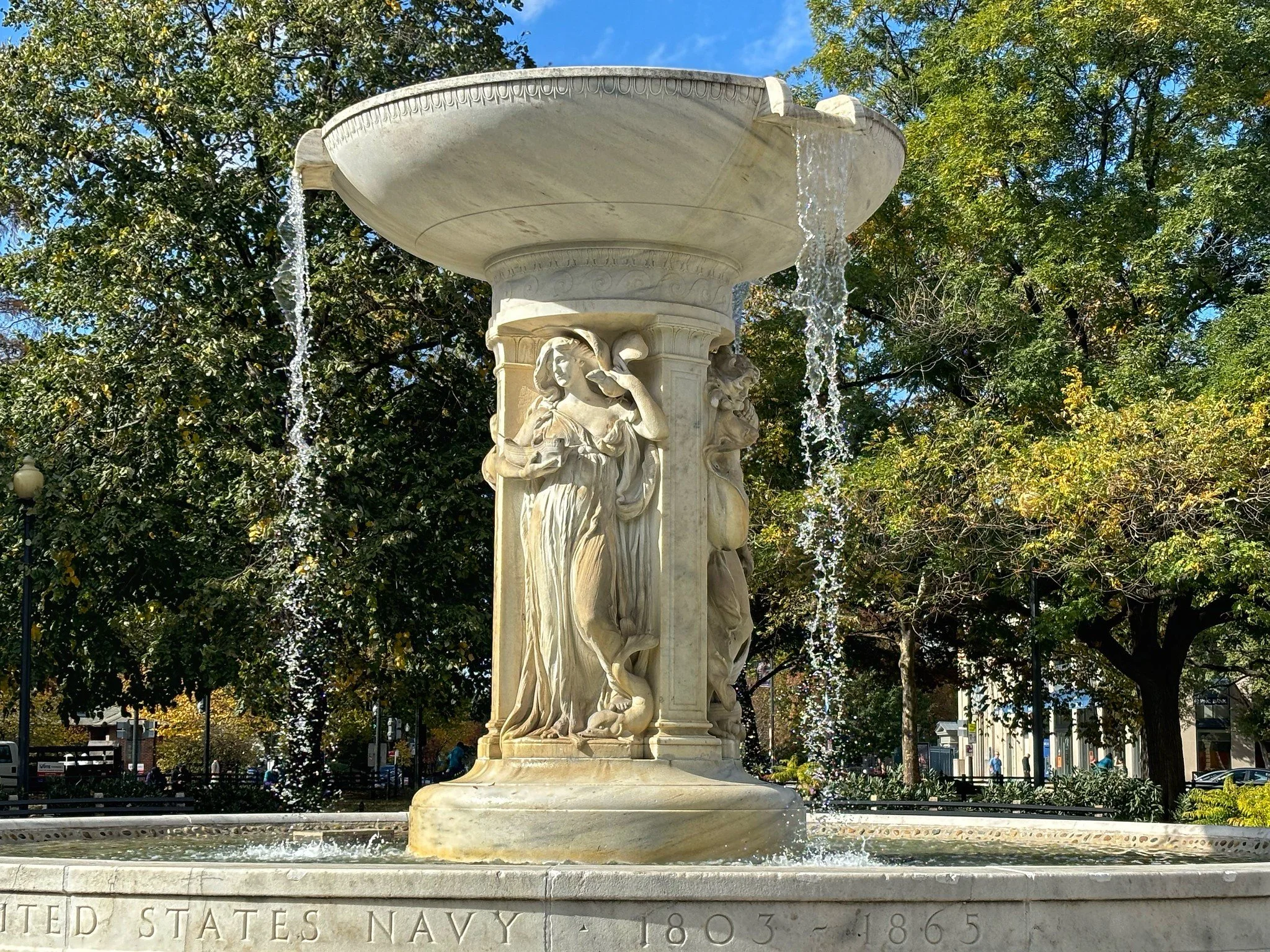
Dupont Circle
Dupont Circle sits in the middle of the city and offers one of the most convenient bases for couples who want flexibility. It's walkable to Rock Creek Park, well-connected by Metro to monument areas, and surrounded by some of the best independent restaurants, wine bars, and coffee shops in D.C. The neighborhood has a lively but not overwhelming energy — enough going on to make a celebration feel effortless, without the tourist density of the Mall area. Accommodations range from historic bed and breakfasts to well-located hotels, and the circle itself is a quiet spot for a morning walk before the ceremony.
Best for: Couples eloping at Rock Creek Park or couples who want a central base with easy access to multiple locations across the city.
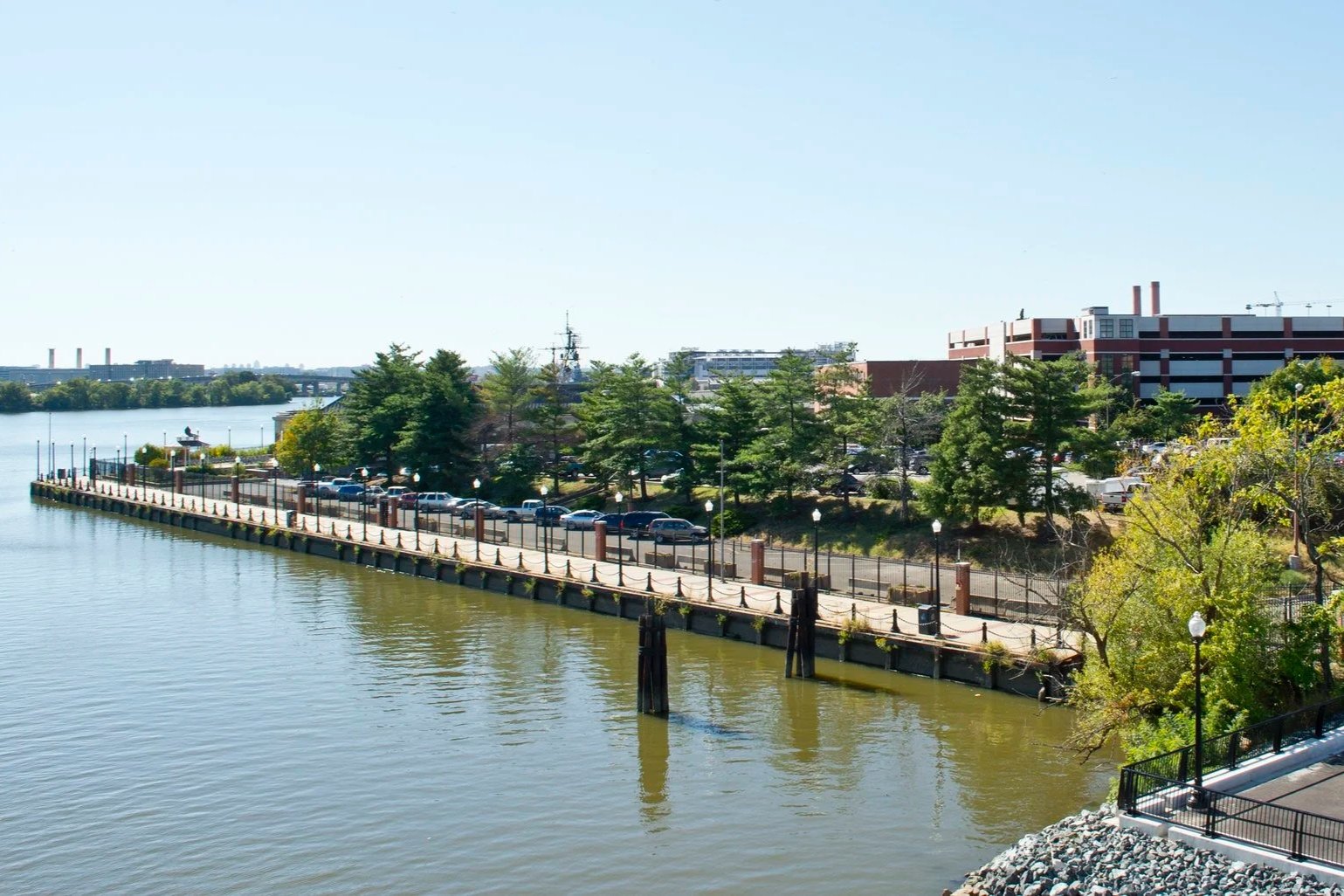
Navy Yard
Navy Yard has become one of the most popular neighborhoods in D.C. over the last several years, and for elopement couples it offers something the older neighborhoods don't — waterfront access, newer construction with modern amenities, and a relaxed post-ceremony atmosphere along the Anacostia Riverfront. Yards Park is steps away from most of the hotels here and offers open lawn space and river views that work well for portraits or a quiet moment together after the ceremony. The rooftop bars and waterfront restaurants in the neighborhood are some of the best celebration dinner options in the city. It's a slightly longer commute to monument areas but well worth considering for couples who want the riverfront experience as part of their day.
Best for: Couples who want waterfront portraits, a modern aesthetic, and easy access to celebration dining. Also ideal for couples including Yards Park Overlook Lawn as one of their locations.
Popular Venues in Washington, D.C.
Most Popular Outdoor Elopement Locations in Washington, D.C.
Tidal Basin
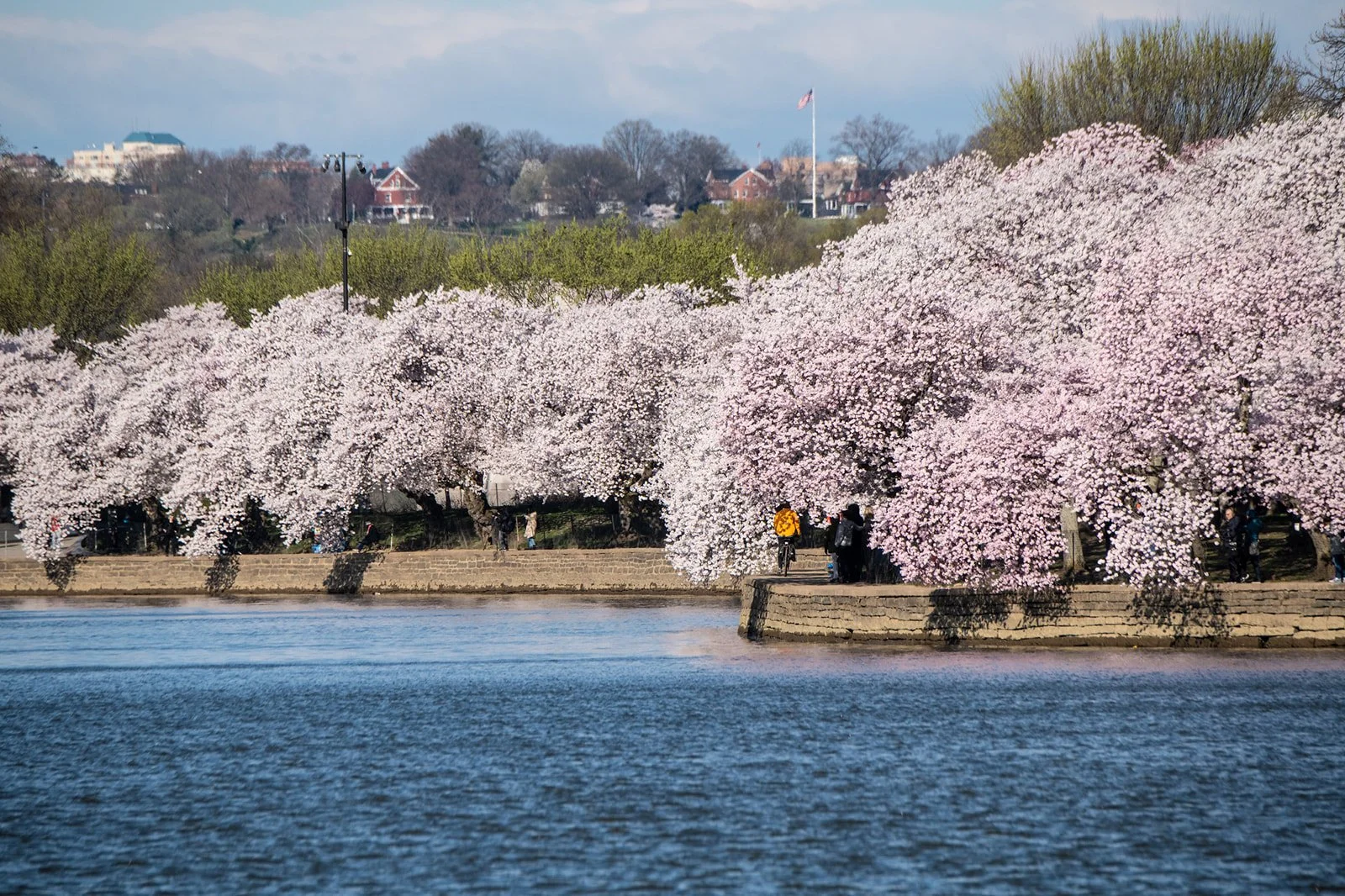
The Tidal Basin is the most recognizable elopement setting in Washington D.C., and for good reason. A two-mile walking path circles the water with views of the Jefferson Memorial, the Washington Monument, and the Martin Luther King Jr. Memorial visible from different points along the route. In spring, the cherry blossom trees that line the basin bloom in soft pinks and whites, creating one of the most romantic urban landscapes in the country. The trees were a gift from Japan in 1912 and today draw visitors from around the world during peak bloom — which is exactly why timing matters here more than almost anywhere else in the city. Early morning arrivals before 7:00 am during cherry blossom season give couples the water, the blossoms, and the light almost entirely to themselves. Outside of cherry blossom season, the Tidal Basin is beautiful year-round, with fall foliage reflecting in the water and winter mornings offering near-complete solitude. The Tidal Basin sits within National Mall and Memorial Parks and is managed by the National Park Service. An NPS Special Use Wedding Permit ($90) is required for ceremonies, and a separate Filming and Photography Permit ($90 application fee plus a $50 location fee for groups of ten or fewer) is required for professional photography outside the designated ceremony footprint. Total permit investment for a standard elopement runs $230.
Lincoln Memorial & National Mall
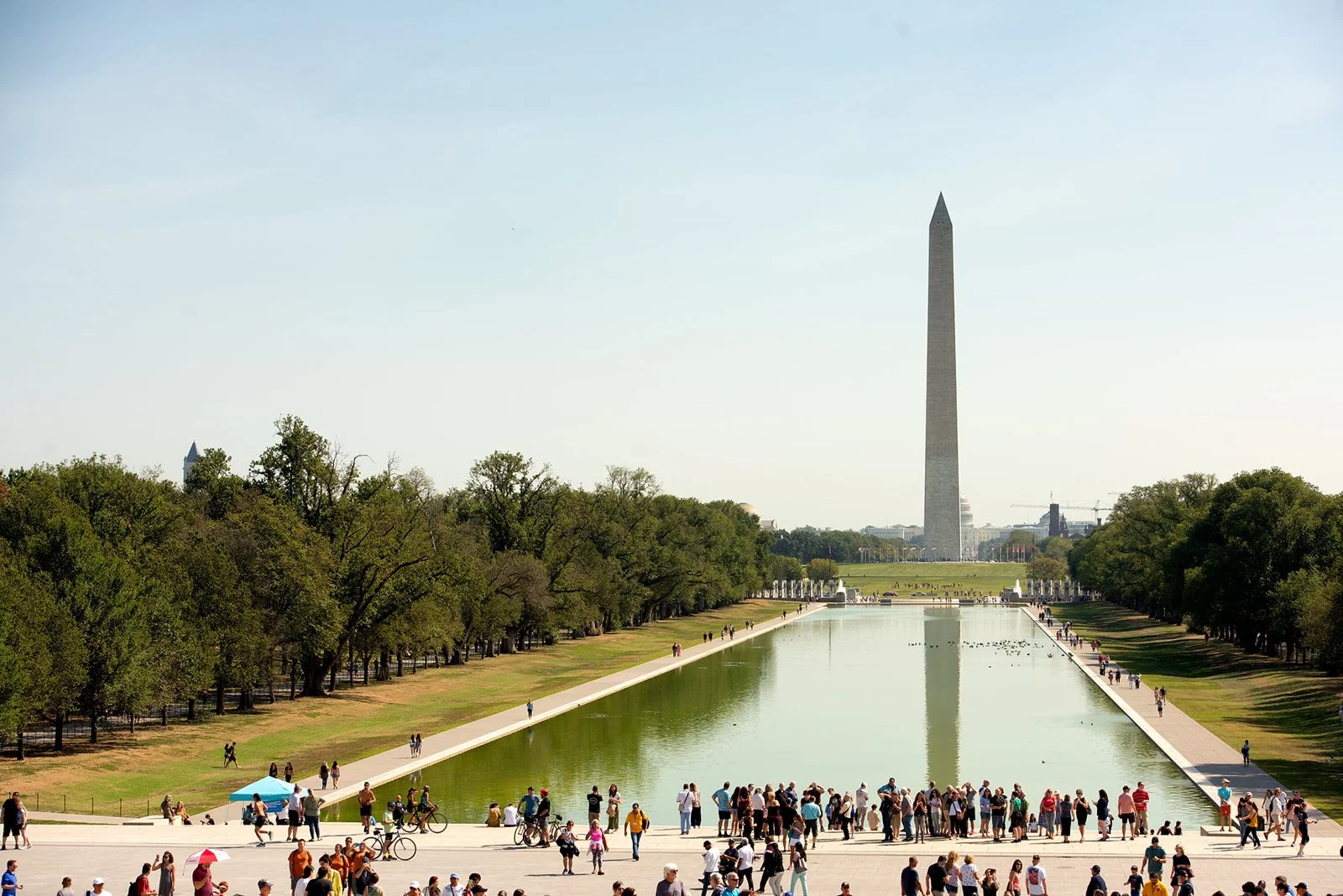
The Lincoln Memorial and the National Mall represent the most iconic version of a Washington D.C. elopement. The Reflecting Pool stretches nearly 2,000 feet between the Lincoln Memorial and the World War II Memorial, and at sunrise the surface of the water mirrors the monuments in a way that simply does not exist at any other time of day. The Mall itself is one of the most walkable corridors in the city, connecting monument after monument along a single open greenway with the Capitol visible at the far eastern end. For couples drawn to history, architecture, and the weight of a place that has witnessed some of the most significant moments in American life, there is nothing quite like exchanging vows here. The two designated ceremony locations within the National Mall and Memorial Parks footprint are the DC War Memorial and the George Mason Memorial. The DC War Memorial accommodates up to 200 guests and allows chairs, a wedding arch, and acoustic musicians. The George Mason Memorial accommodates up to 100 guests with a simpler setup and a one-hour ceremony window. Both require an NPS Special Use Wedding Permit ($90 application fee). Professional photography outside the ceremony location or time also requires a separate Filming and Photography Permit ($90 application fee plus a $50 location fee for groups of ten or fewer), bringing the total permit investment to $230 for a standard elopement. Sunrise is the strongest recommendation for this location in every season. Summer mornings heat up quickly and crowds arrive earlier than most couples expect -- an early start is the single most effective way to get the experience this location is capable of delivering.
Rock Creek Park
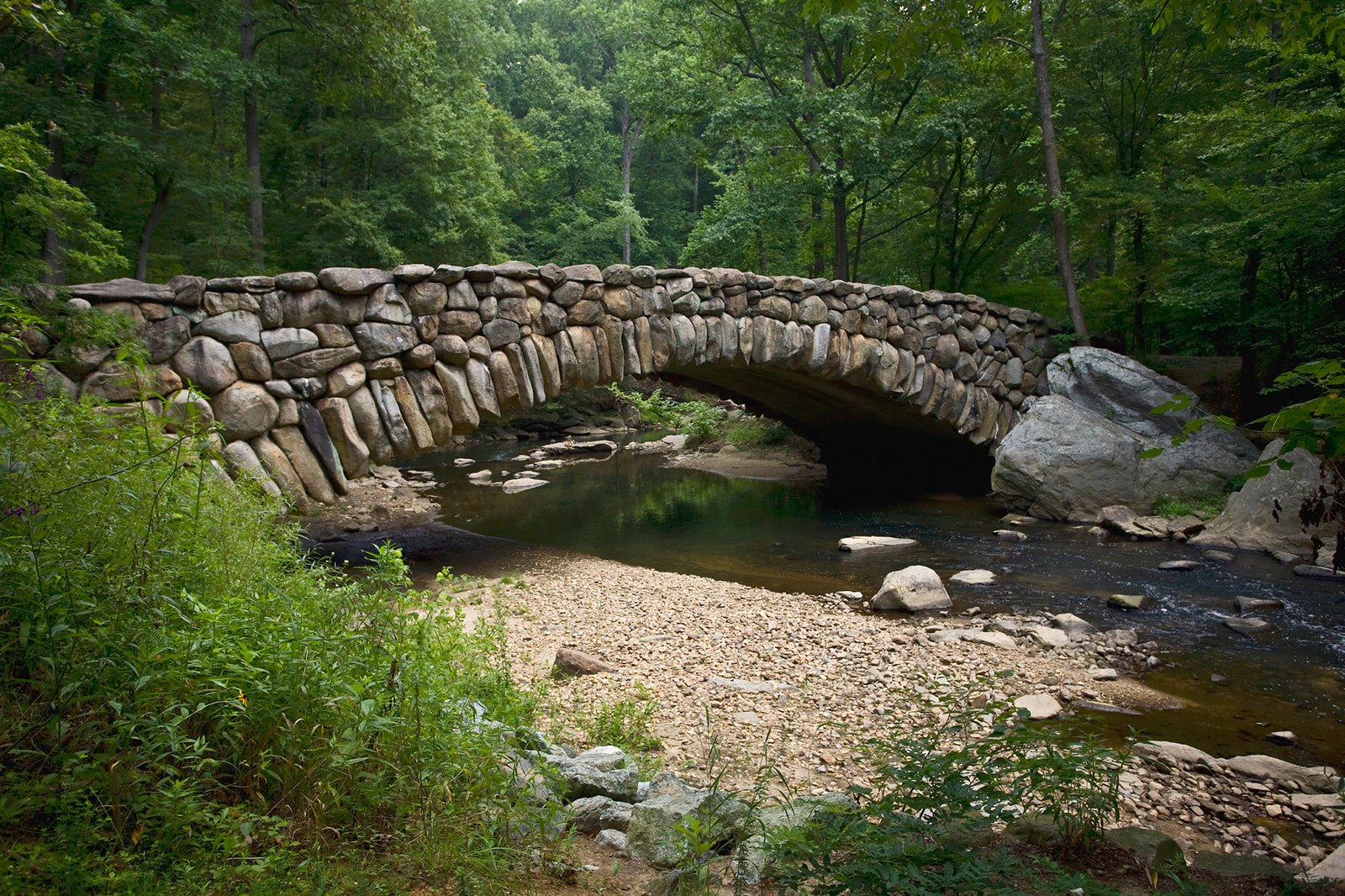
Rock Creek Park is 1,700 acres of forested parkland running through the heart of Washington D.C., and it offers something no monument or garden in the city can -- the feeling of being genuinely removed from urban life without leaving the city limits. Wooded trails wind through the park alongside Rock Creek itself, with stone bridges, forested canopies, and open meadow areas providing a variety of portrait settings within a single location. Privacy here is significantly higher than anywhere on the National Mall, and the park's size means that even on busy weekends couples can find stretches of trail that feel entirely their own. Rock Creek Park is managed by the National Park Service. An NPS Special Use Wedding Permit ($90 application fee) is required for ceremonies, and a Filming and Photography Permit ($90 application fee plus a $50 location fee for groups of ten or fewer) is required for professional photography. Total permit investment for a standard elopement is $230. Fall is the strongest season here -- the tree canopy turns in October and the light filtering through the leaves creates some of the most naturally beautiful portrait conditions of any location in the D.C. area. Spring and summer are also strong, with dense green foliage and creek-level light in the mornings. Winter strips the canopy back and opens up longer sightlines through the woods, which works well for couples who prefer a more minimal, structural landscape.
Theodore Roosevelt Island
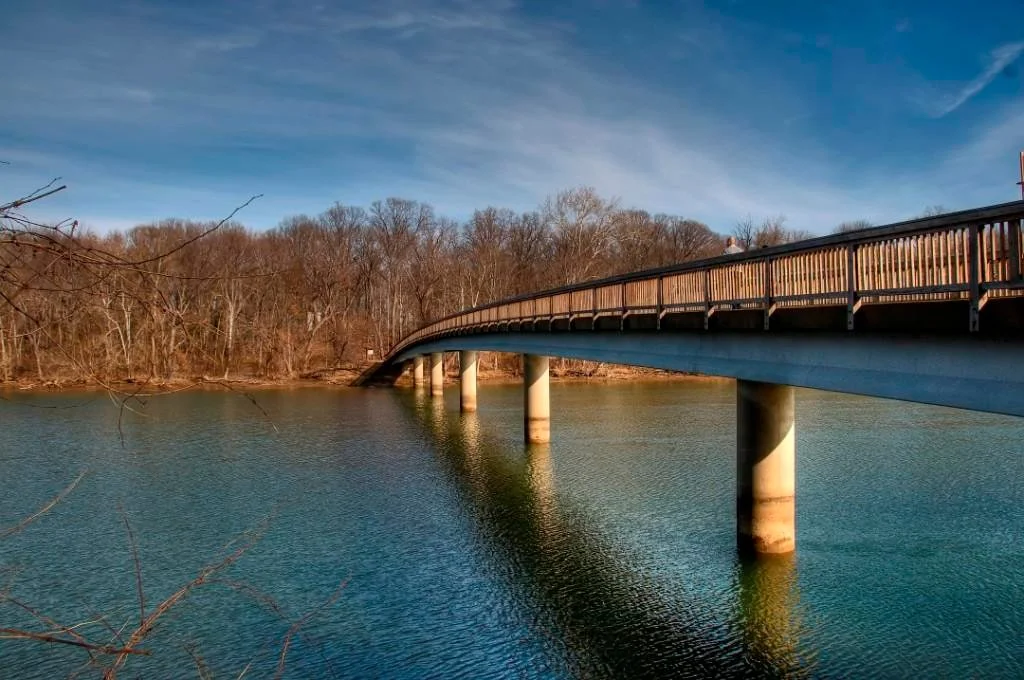
Theodore Roosevelt Island is a forested 91-acre island sitting in the middle of the Potomac River, accessible only by a pedestrian footbridge from the Virginia bank. It is one of the most private ceremony locations available within the D.C. area -- the island sees far fewer visitors than any National Mall location, and the trail system winds through mature forest that feels completely disconnected from the city on either riverbank. The central memorial plaza features a 17-foot bronze statue of Roosevelt surrounded by granite tablets inscribed with his words, which adds a quiet ceremonial weight to the space without feeling overly formal. The forested trails surrounding the plaza offer portrait settings with dappled light, root-covered paths, and occasional water views through the trees toward the Virginia shore. Theodore Roosevelt Island is managed by the National Park Service. An NPS Special Use Wedding Permit ($90 application fee) is required for ceremonies, and a Filming and Photography Permit ($90 application fee plus a $50 location fee for groups of ten or fewer) is required for professional photography. Total permit investment for a standard elopement is $230. Mid-morning to early afternoon works well here in every season -- the island does not offer the same sunrise drama as the open Mall, but the quality of light through the forest canopy is consistently good throughout the day. Fall is the strongest season for foliage and color. Note that the footbridge access point is on the Virginia side near Rosslyn, so couples staying in central D.C. should plan for a short drive rather than assuming walkability.
Kenilworth Aquatic Gardens
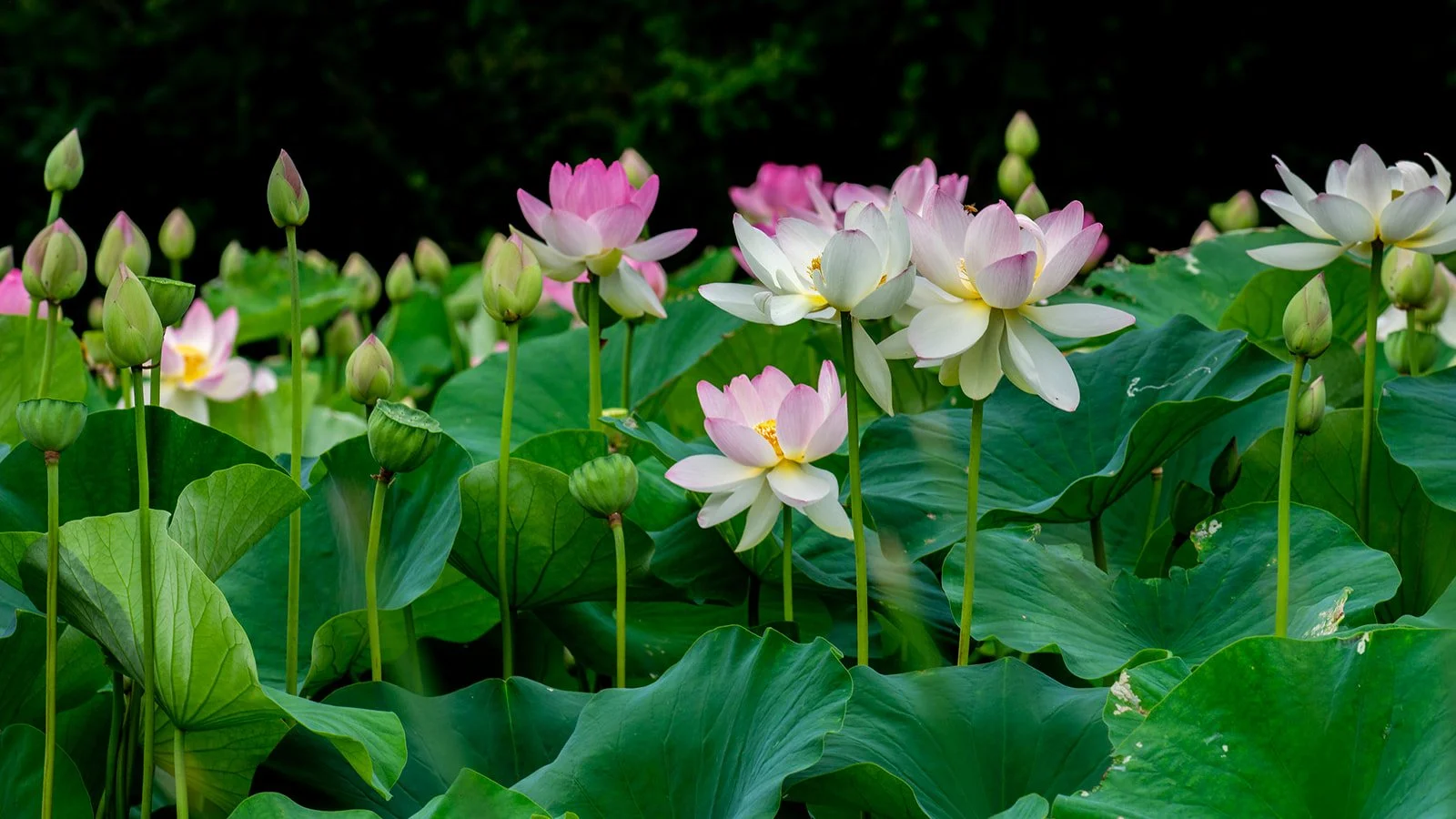
Kenilworth Aquatic Gardens is the only national park in the United States dedicated to the cultivation of aquatic plants, and it is consistently the location that couples say they never would have found without a guide. Located in the northeastern corner of the city along the Anacostia River, Kenilworth feels completely removed from the Washington D.C. that most visitors experience. Boardwalk paths wind through a series of ponds filled with lotus blooms, water lilies, and native aquatic plants, with tidal marsh and wetland habitat surrounding the garden on all sides. The setting is visually unlike anything else in the D.C. area and photographs in a way that surprises most couples -- quiet, layered, and genuinely singular. Bloom timing matters significantly here. Water lilies peak in June and July, and lotus blooms follow closely behind, typically peaking in July and into early August. Morning visits are strongly recommended during bloom season -- lotus flowers open in the morning and begin closing in the afternoon heat, and the light over the water is softest and most flattering in the first hours of the day. Kenilworth Aquatic Gardens is managed by the National Park Service under National Capital Parks-East. An NPS Special Use Wedding Permit ($90 application fee) is required for ceremonies, and a Filming and Photography Permit ($90 application fee plus a $50 location fee for groups of ten or fewer) is required for professional photography. Total permit investment for a standard elopement is $230.
Constitution Gardens
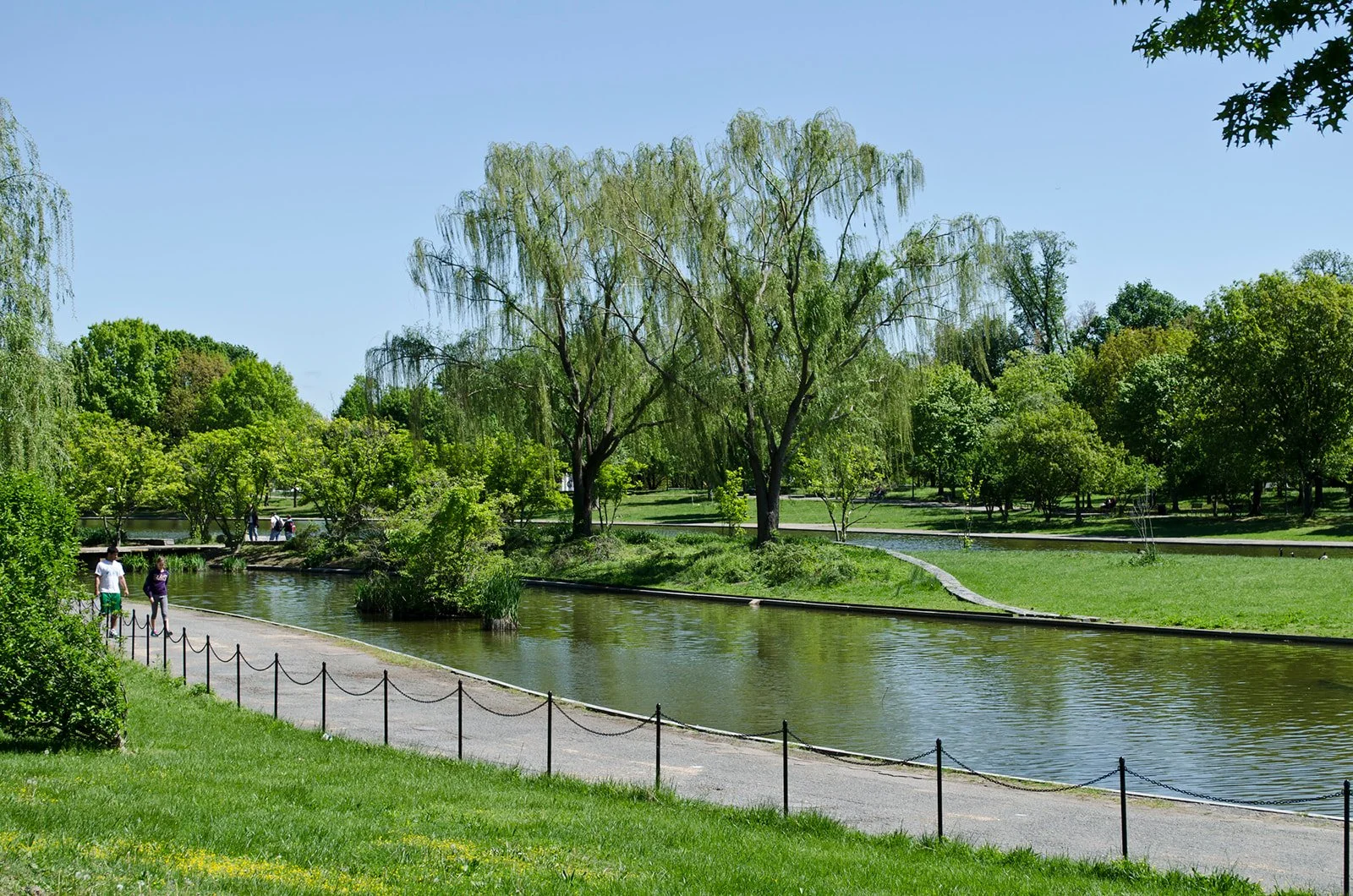
Constitution Gardens sits quietly between the Lincoln Memorial and the Washington Monument, and it offers something the open Mall does not -- a sense of enclosure and softness in the middle of one of the most visited public spaces in the country. A small lake anchors the center of the garden, surrounded by mature trees, winding paths, and open lawn areas that provide natural separation from the broader tourist corridors nearby. It is not as visually dramatic as the Tidal Basin or as iconic as the Lincoln Memorial, but that is part of what makes it work well for elopements. The more human scale of the space, the shade from the tree canopy, and the relative quiet compared to surrounding areas create a ceremony environment that feels genuinely intimate despite being steps away from some of the most visited landmarks in the world. Constitution Gardens is managed by the National Park Service within the National Mall and Memorial Parks system. An NPS Special Use Wedding Permit ($90 application fee) is required for ceremonies, and a Filming and Photography Permit ($90 application fee plus a $50 location fee for groups of ten or fewer) is required for professional photography. Total permit investment for a standard elopement is $230. Constitution Gardens works well as either a primary ceremony location or as a post-ceremony portrait stop following a ceremony at the DC War Memorial or George Mason Memorial, both of which are within easy walking distance. Spring and fall are the strongest seasons here, with flowering trees in April and turning foliage in October adding color to the garden's otherwise understated palette.
Bishop's Garden (National Cathedral)
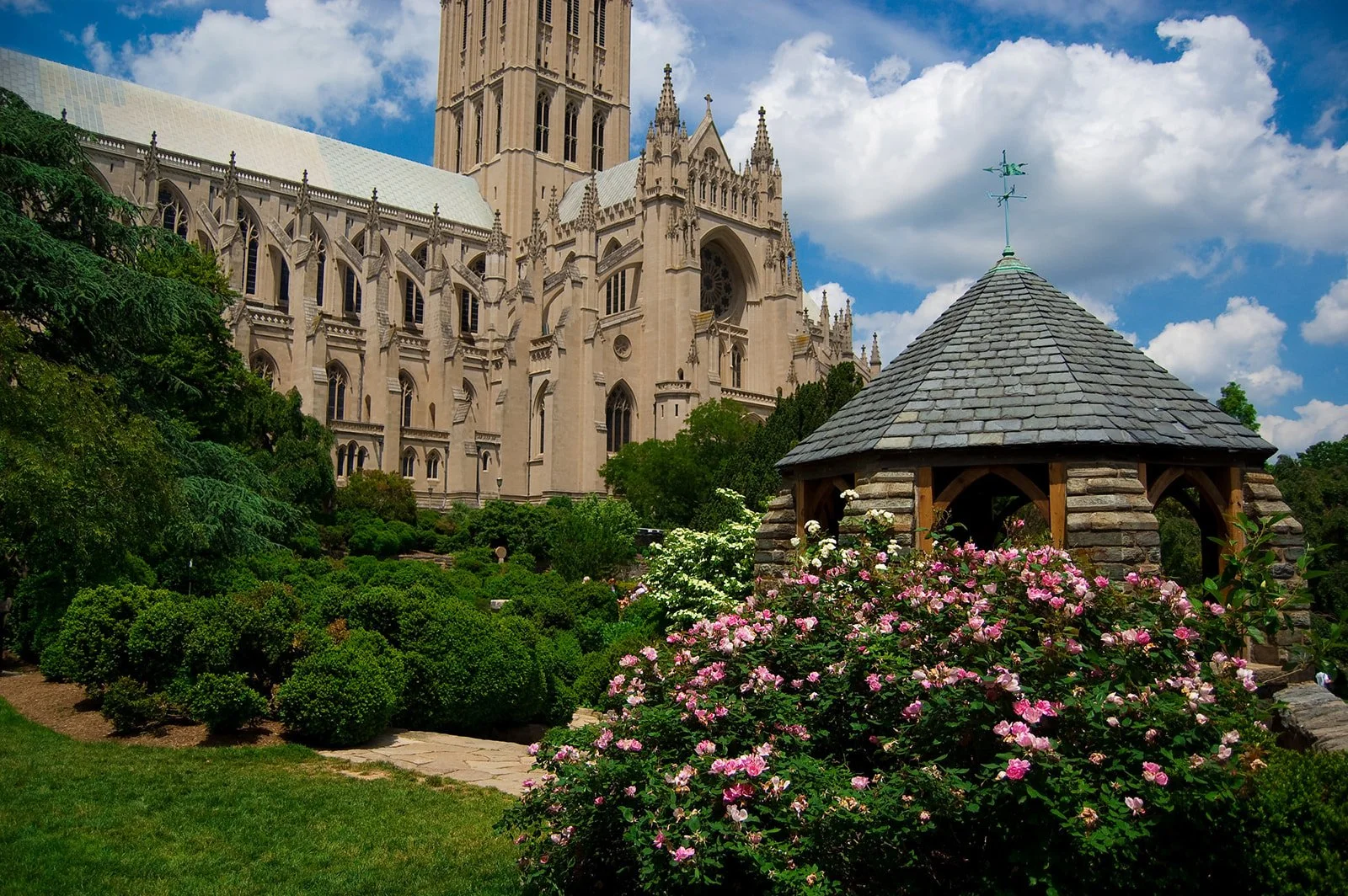
Bishop's Garden sits on the grounds of the Washington National Cathedral in the upper northwest corner of the city, enclosed by stone walls and planted with medieval-inspired gardens that have been cultivated since the early twentieth century. Box hedges, stone pathways, magnolia trees, a birdbath fountain, and shadow box niches with carved stone figures create a setting that feels more like a private English garden than anything typically associated with Washington D.C. The Gothic towers of the cathedral rise above the garden walls and are visible from several points within the space, adding an architectural backdrop that is entirely unlike the monuments and memorials of the Mall. Privacy is high -- the garden is separated from the broader cathedral grounds and typically sees far fewer visitors than public parks in the city. Bishop's Garden is privately managed by the Washington National Cathedral and is not National Park Service land. Permit requirements and photography policies are set by the Cathedral directly and should be verified with the Cathedral office well in advance of your elopement date, as policies and availability can change. Spring is the strongest season here, with magnolia and cherry trees blooming within the garden walls in late March and April, followed by flowering perennials through May and June. Fall is also beautiful, with the enclosed garden holding color longer than open parkland nearby. Bishop's Garden is best suited for couples who want an intimate, enclosed ceremony space with architectural character rather than an open landscape -- it rewards slow movement and close attention in a way that larger locations do not.
Dumbarton Oaks Gardens
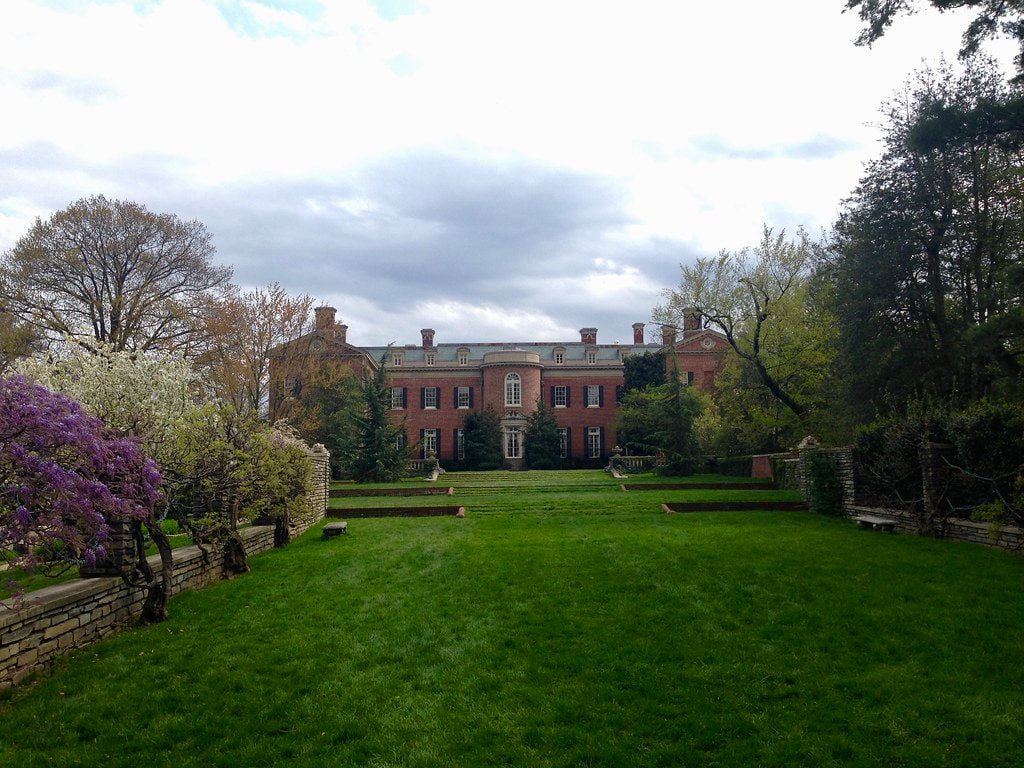
Dumbarton Oaks is a ten-acre estate garden in the heart of Georgetown maintained by Harvard University, and it is one of the most formally designed and visually layered outdoor spaces available for elopements in the entire D.C. area. The gardens descend in terraced levels from the main house down toward the lower garden areas, with each terrace offering a distinct character -- a rose garden, a pebble garden, a swimming pool terrace framed by cherry trees, a kitchen garden enclosed by brick walls, and a lower garden with stepped stone paths and seasonal perennial plantings. The combination of formal structure, mature plantings, and the layered intimacy of moving from one enclosed space to another creates portrait opportunities that feel genuinely editorial without requiring any production. Georgetown itself surrounds the property, and the cobblestone streets and brick rowhouses of the neighborhood add a second layer of portrait settings within easy walking distance before or after time in the gardens. Dumbarton Oaks is privately managed and is not National Park Service land. Ceremony and photography permit requirements are set by the institution directly and should be confirmed with Dumbarton Oaks well in advance of your elopement date. The gardens are also closed on Mondays and charge a general admission fee, so logistics require more advance coordination than NPS locations. Spring is the strongest season by a significant margin -- the cherry trees along the swimming pool terrace and the wisteria arbor near the entrance bloom in April and create portrait conditions that draw couples from across the country specifically to this location. Fall offers a second strong window with turning foliage and comfortable temperatures.
National Arboretum
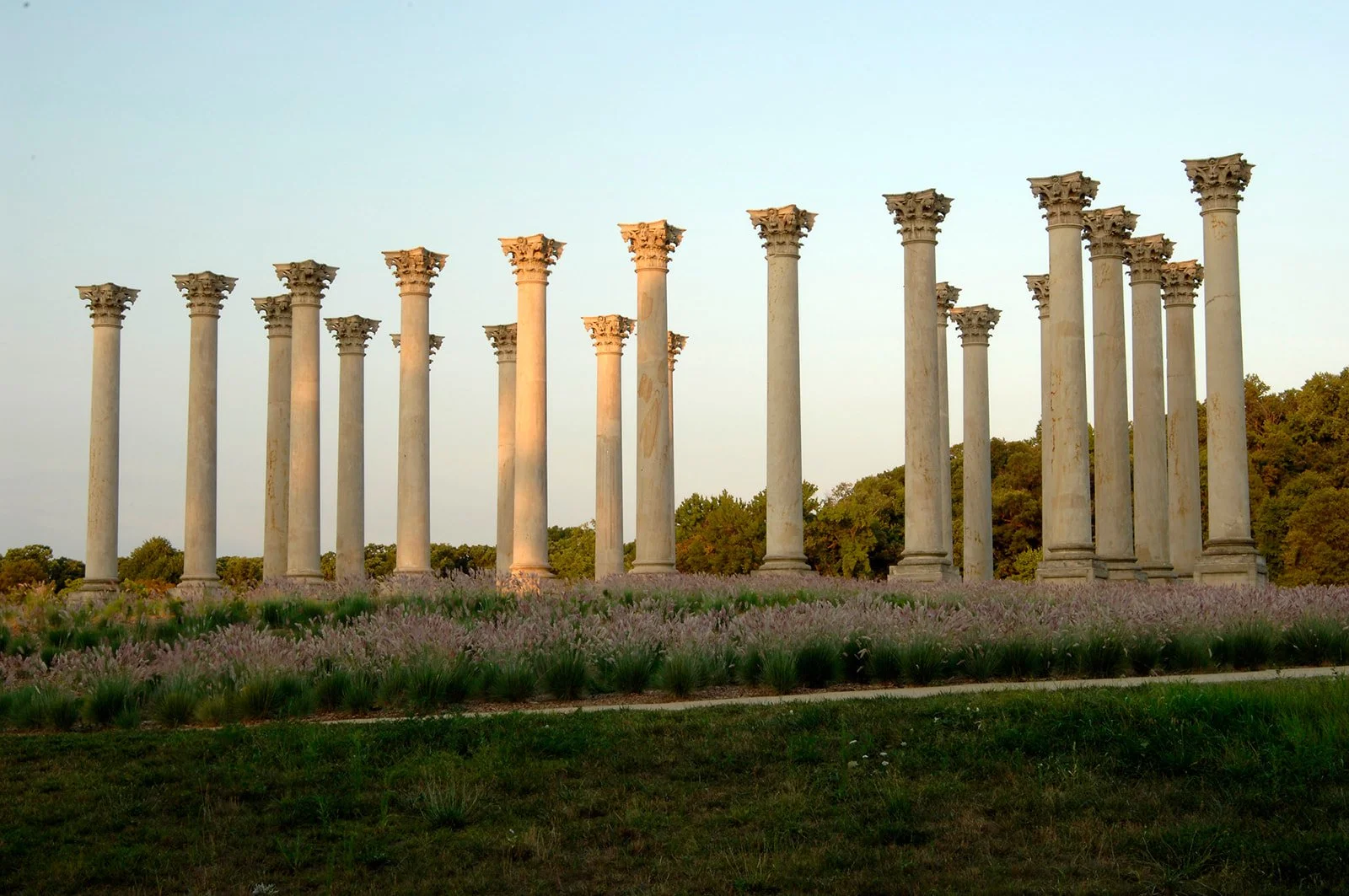
The United States National Arboretum is 446 acres of open grounds, collections, and garden spaces in the northeastern corner of the city, managed by the USDA rather than the National Park Service. It operates more like a research institution and botanical garden than a traditional park, which means it sees dramatically fewer visitors than comparable green spaces in D.C. and offers a level of openness and quiet that is genuinely rare this close to the city center. The most visually distinctive feature of the Arboretum is the Capitol Columns -- twenty-two sandstone columns that formed the east portico of the United States Capitol building during the 1820s and were removed during a renovation in the 1950s. They now stand in a open meadow on a low granite base, surrounded by grass and sky, with nothing else in the frame. For couples who want an architectural backdrop with history and weight behind it but without the crowd management that comes with National Mall locations, the Capitol Columns offer something that exists nowhere else in the D.C. area. Beyond the Columns, the Arboretum also contains an azalea collection, a bonsai museum, a dogwood collection, a native plant garden, and several miles of driving and walking routes through open landscape. Ceremony and photography permit requirements are managed by the Arboretum directly and should be confirmed well in advance. Spring is the strongest season, with the azalea collection typically peaking in late April and the dogwood collection following closely behind. Fall brings strong color across the grounds and cooler temperatures that make longer exploring days more comfortable. Early morning visits are recommended year-round -- the Arboretum opens at 8:00 am and the first hour of the day across the open meadow areas and tree collections is consistently the quietest and most photographically rewarding.

My Recommendations for Locations in Washington, D.C.
Working with an elopement guide opens the door to lesser-known locations that still provide amazing experiences and memorable photos–sometimes even better than state or national parks.
Below are just a few of my favorite spots in Washington, D.C. Every itinerary is customized for each couple, so if you want to explore more options, we can start planning your elopement before you decide to book.
Bishop’s Garden (Washington National Cathedral)
Dumbarton Oaks Gardens (Georgetown)
Yards Park Overlook Lawn
Kenilworth Aquatic Gardens Boardwalk Area
How Much Does It Cost to Elope in Washington, D.C.?
How much does it cost to elope? Costs can vary depending on permits, locations, vendors, and overall vision. This guide breaks down how to budget for your elopement.
-
$45 — marriage license
$600 — 3 night airbnb stay
$4650 — photographer
$350 — bouquet + boutonniere
$500 — wedding dress
$200 — suit rental
$200 — restaurant dinner + drinks
$230 – Meridian Hill Park permit fee (1-10 people) + photography permit
free — DIY hair + makeup
Total: $6,775
-
marriage license — $45
4 night luxury airbnb stay — $2,700
photographer — $10,400
bouquet, boutonniere, florals for ceremony and dinner — $1,000
wedding dress — $3,000
suit purchase — $1,000
private chef — $800
5-6” custom cake — $350
hair + makeup — $800
Meridian Hill Park permit fee + photography permit — $290
Total: $20,385
Unique Things to Do in Washington, D.C. as a Couple
Whether you want to celebrate a honeymoon or get off the tourist path with your elopement experience, there are a variety of things to do around the state that will add to your fun. Here are some of my personal favorites in Washington, D.C.
Enjoy the View at Top of the Gate
Top of the Gate is a rooftop bar at the Watergate Hotel with panoramic views over the Potomac River, the Kennedy Center, and the Washington Monument. Relax and unwind together with unforgettable views of the skyline.
Spend the Evening at Blues Alley Jazz Club
Tucked in the streets of Georgetown, Blues Alley Jazz Club has been part of the city’s music scene since the 1960s. Inside, it’s a small space filled with candlelit tables and live jazz most nights.
Dine in the Dark
Okay, now hear me out.
Share a fancy dinner while blindfolded! Experience your senses together while you delight in a three-course meal like never before.
Washington D.C., Elopement Timeline Examples
There’s not a “right way” to plan your day in Washington, D.C., it really just depends on what you prioritize and what you want your day to feel like. These examples will give you a few ideas of how you could spend your time!
-
12 Hours of Coverage
8:30 – 10:15 am: Getting ready at your accommodations with detail photos, candid moments, and finishing touches — unhurried time to settle into the morning before the day begins
10:15 am: Depart for ceremony location 10–15 minute commute
10:30 – 11:15 am: Ceremony and vow exchange at the DC War Memorial or George Mason Memorial, plus license signing and immediate celebration moments Both locations sit within the National Mall footprint and require an NPS Special Use Permit
11:15 am – 12:15 pm: Post-ceremony portraits and relaxed walk through the Tidal Basin and Constitution Gardens The ceremony energy is still fresh — this is documentary time, not a formal portrait session Approx. 0.5–0.75 miles at a relaxed pace
12:15 pm: Depart for lunch 10–15 minute commute
12:30 – 2:00 pm: Sit-down lunch in Capitol Hill or Georgetown — no agenda, just a proper meal and time to let the morning land as a married couple for the first time
2:00 pm: Return to accommodations 10–15 minute commute
2:15 – 4:30 pm: Rest at your hotel or Airbnb — change into something comfortable, take a nap, and recharge. The evening ahead is worth saving energy for. Photographer breaks here as well.
4:30 pm: Depart for afternoon portrait location 15–20 minute commute
4:45 – 6:15 pm: Afternoon portraits at Rock Creek Park Wooded trails, dappled light, and a nature-in-the-city setting that feels entirely removed from the monument corridor of the morning Approx. 0.5–1 mile selective trail route at portrait pace
6:15 pm: Move toward golden hour location 10–15 minute commute or short walk
6:30 – 8:00 pm: Golden hour and sunset portraits at the Lincoln Memorial Reflecting Pool or Yards Park Overlook Warm evening light, long shadows, and a city that looks completely different from how it looked at sunrise — blue hour portraits follow as the light fades Note: sunset times shift significantly by season. This window reflects spring and fall. Summer sunset runs closer to 8:00–8:30 pm and winter closer to 5:00–5:30 pm — timelines are adjusted accordingly for your specific date.
8:00 pm: Coverage ends The rest of the evening is yours — a dinner reservation, a nightcap on a rooftop, or a quiet celebration back at your accommodations
-
16 Hours of Coverage Across 2 Days
Day One — The Garden & Neighborhood Day
8 Hours of Coverage
This day stays entirely off the National Mall. No monuments, no tourist corridors — just the quieter, more intimate version of D.C. that most visitors never find.
9:00 – 10:30 am: Slow morning at your Georgetown Airbnb — coffee, breakfast together, and relaxed getting-ready coverage in a private rowhouse or garden apartment setting Detail photos, candid moments, and time to ease into the day without an alarm driving the pace
10:30 – 11:00 am: First look and portraits in the Georgetown neighborhood Cobblestone streets, brick facades, and the kind of quiet residential character that photographs completely differently from anything on the Mall Approx. 0.25–0.5 mile walking at a relaxed pace
11:00 am: Depart for Dumbarton Oaks Gardens 10 minute walk or short drive
11:15 am – 12:15 pm: Ceremony and vow exchange at Dumbarton Oaks Gardens or Bishop's Garden at the National Cathedral, plus license signing and celebration moments Walled gardens, stone paths, and Gothic architecture in the background — an intimate setting with no open public sightlines Verify ceremony permit requirements directly with each location before booking
12:15 – 1:15 pm: Post-ceremony portraits and unhurried exploring through the gardens Terraced levels, seasonal blooms, and a setting that rewards slow movement Approx. 0.25–0.5 mile at portrait pace
1:15 pm: Walk to lunch in Georgetown 10–15 minute walk
1:30 – 3:00 pm: Sit-down lunch in Georgetown — documentary coverage of the celebration, relaxed and unobtrusive, or no cameras at all depending on your preference
3:00 – 4:00 pm: Afternoon walk along the C&O Canal towpath Flat, shaded, and running right through the heart of Georgetown — an easy post-lunch wander with portraits woven in naturally along the water Approx. 0.75–1 mile at a relaxed pace
4:00 pm: Return to accommodations to rest and freshen up 10–15 minute commute
4:15 – 6:30 pm: Downtime at accommodations — rest, change outfits if desired, and take a break together. Photographer breaks here.
6:30 pm: Depart for evening location 10–15 minute commute
6:45 – 8:00 pm: Sunset portraits along the Georgetown waterfront and Key Bridge Warm evening light over the Potomac with the city reflected in the water below Note: timing shifts by season — adjusted for your specific date
8:00 pm: Day One coverage ends Evening is yours — Blues Alley Jazz Club in Georgetown for candlelit live music, or a private dinner reservation along the waterfront
Day Two — The Wild Side of D.C.
8 Hours of Coverage
Day Two leaves the city behind almost entirely. These are the locations that require a drive — and are worth every minute of it.
7:30 – 8:00 am: Quick coffee and a slow start at accommodations before heading out No formal coverage at the start of Day Two — just an easy departure
8:00 am: Depart for Great Falls Park, Virginia 40–45 minute drive from central D.C.
8:45 am: Arrive at Great Falls Park and begin walk toward the overlooks Approx. 0.5–1 mile to primary overlook areas, 20–25 minutes at a relaxed pace
9:00 – 11:00 am: Portraits and exploring at Great Falls Park The Potomac River narrows into a dramatic series of falls and gorges here — rugged rock formations, roaring water, and a landscape that feels completely unlike anything else within an hour of the city Approx. 1–1.5 miles of selective trail at portrait pace
11:00 am: Depart back toward D.C. 40–45 minute drive
11:45 am – 1:00 pm: Relaxed lunch — sit down somewhere unhurried and let the morning settle. Photographer breaks here. No cameras, no agenda.
1:00 pm: Depart for Kenilworth Aquatic Gardens 20–25 minute commute
1:20 pm: Arrive and begin boardwalk loop Approx. 0.75–1 mile easy walking, flat terrain
1:30 – 2:30 pm: Boardwalk and pond portraits at Kenilworth Aquatic Gardens Lotus blooms, water lilies, and a setting that feels completely removed from the city surrounding it — one of the most visually unique locations in the entire D.C. area and consistently the one couples say they never would have found on their own
2:30 pm: Depart for the National Arboretum 10 minute commute
2:45 – 4:00 pm: Exploring and portraits at the National Arboretum 446 acres of open grounds and the Capitol Columns — the original sandstone columns from the U.S. Capitol now standing alone in an open meadow in one of the most quietly dramatic settings anywhere in D.C. Approx. 0.5–1 mile selective route at a relaxed pace
4:00 pm: Depart for Theodore Roosevelt Island 25–30 minute commute
4:30 pm: Arrive at Theodore Roosevelt Island footbridge and begin walk in Approx. 0.25 mile to interior trails, 10 minutes
4:45 – 6:00 pm: Afternoon portraits on Theodore Roosevelt Island A forested island in the middle of the Potomac, accessible only by footbridge — secluded, quiet, and completely unlike anywhere else visited across both days Approx. 0.5–1 mile selective trail route at portrait pace
6:00 pm: Depart for sunset location 10–15 minute commute
6:15 – 7:45 pm: Sunset and blue hour portraits along the Navy Yard waterfront or from the Top of the Gate rooftop at the Watergate Hotel The last images of the entire experience — two full days in, the ease in front of the camera is something that simply cannot be replicated in a single session Note: timing shifts by season — adjusted for your specific date
7:45 pm: Coverage ends The rest of the evening is yours — a reservation at Pineapple & Pearls, a private chef dinner back at your Airbnb, or a quiet night together in a city that now holds something permanent for the two of you
Every elopement timeline is built around your priorities and pace.
Is Eloping in Washington, D.C. Right for Me?
Quiz
Not the perfect fit? Try these similar states instead:
Virginia
Maryland
Pennsylvania
Massachusetts
New York
South Carolina
Current Specials for Washington, D.C. Bookings:
Washington D.C. is a destination I travel to for elopements throughout the year. When I have existing bookings in the area, I occasionally open limited availability for shorter-duration experiences that are not part of my standard packages — a way for couples who want something simple and intimate to access the same guided, fully planned experience at a reduced coverage length. These openings are not listed publicly and are offered to subscribers first. If a D.C. elopement is on your radar, getting on the list is the best way to know when one becomes available.
Washington, D.C. Elopement Packages
My Washington, D.C elopement experiences are designed for couples who want planning support, location expertise, timeline design, and contingency planning handled in advance, on top of beautiful pictures to last a lifetime.
Your elopement experience is fully customized from the very beginning.
All Washington, D.C elopement packages include:
What’s Included:
Planning & Location Guidance
• All travel around Washington D.C., — your investment does not change based on location
• Personalized location recommendations based on season, accessibility needs, privacy preferences, and visual atmosphere
• Permit research and guidance, including site-specific rules and low-impact ceremony requirements when applicable
• Leave No Trace and public-lands best-practice guidance
Logistics & Vendor Support
• Ceremony logistics guidance and officiant coordination support if needed
• Curated vendor recommendations (florals, hair + makeup, lodging, private chefs, etc.)
• Backup location and weather contingency planning in advance
Your Experience
• Activity ideas tailored to your relationship and how you want your day to feel
• A handcrafted elopement timeline built for a relaxed, spacious pace
Photography & Delivery
• High-resolution digital images with printing rights
• A private online gallery for viewing, downloading, sharing, and ordering prints
Each elopement experience is custom-designed around your priorities, energy, and environment. If you’re unsure how much coverage you need yet, we’ll determine that together after we talk through your vision and location options.
Washington D.C. elopement experiences begin at $4,650 for 4 hours of coverage.
Washington, D.C. Elopement Checklist
Planning an elopement can feel overwhelming at first, especially if you’re doing it somewhere new. This checklist is designed to simplify the process and help you focus on what actually matters.
This all-in-one elopement checklist walks you through:
Choosing a location that fits your vision and accessibility needs
Understanding permit requirements (if applicable)
Booking vendors that align with your priorities
Building a timeline that feels relaxed and intentional
Preparing for travel, lodging, and day-of logistics
Whether you’re eloping in Washington, D.C or somewhere completely different, this checklist is meant to guide you step-by-step without overcomplicating the experience.
What Elopement Coverage Is Right for Me?
Multi-Day Elopement Experience
This experience is ideal for couples who want their elopement to feel like a once-in-a-lifetime journey rather than a single moment.
This experience is right for you if:
You want to combine your elopement with a getaway or honeymoon
You’re drawn to multiple Washington D.C. landscapes and don’t want to choose just one
You value slow mornings, golden evenings, and complete storytelling
You want space for both adventure and restoration
Full-Day Elopement Experience (Up to 12 Hours)
This experience offers the most flexibility and creative freedom within a single day.
This experience is right for you if:
You want to document your entire day from start to finish
You’re planning multiple locations, activities, or longer hikes
You want time for getting ready, your ceremony, portraits, and a celebration
You prefer a relaxed flow rather than a tightly scheduled timeline
Half-Day Elopement Experience (Up to 6 Hours)
This experience is best suited for couples who want something intimate, meaningful, and beautifully simple.
This experience is right for you if:
You want a short, intimate ceremony
You prefer minimal transitions and a calm pace
You plan to stay close to your accommodations
You envision one primary location with little to no driving
FAQs About Eloping in D.C.
-
You’ll need to apply for a marriage license through the D.C. Superior Court, choose whether you want to self-officiate or use an officiant, and select a location. Many popular spots require permits, especially on National Park Service land.
-
Yes. Washington, D.C. allows self-officiating, meaning you can legally marry yourselves without needing an officiant or witnesses.
-
No. Witnesses are not required for a legal marriage in Washington, D.C.
-
A marriage license in Washington, D.C. typically costs around $45.
-
No. You can legally get married the same day your marriage license is issued.
-
Yes, in most cases. Many popular locations like the National Mall, memorials, and gardens are managed by the National Park Service and require a special use permit, regardless of group size.
-
Couples can elope at monuments like the Lincoln Memorial, around the Tidal Basin, in Rock Creek Park, historic neighborhoods like Georgetown, or quieter areas like the National Arboretum and Kenilworth Aquatic Gardens.
-
The best place depends on your priorities. Monuments are the most popular, gardens offer more privacy, and parks like Rock Creek is great if you want a nature-in-the-city experience.
-
Spring (late March through early April) is popular for cherry blossoms, while fall (October through November) offers comfortable weather and lots of color.
-
Costs vary widely, but most couples spend anywhere from $5,000 to $20,000+, depending on lodging, photography, vendors, and overall experience.
-
Yes. Washington, D.C., is ideal for couples who want city architecture, walkable locations, and a mix of city and nature without needing to travel far between spots.
-
Yes, but you’ll need a permit since these locations are managed by the National Park Service.
Ready to Start Planning Your Washington D.C. Elopement?
Washington D.C. is one of those places that feels completely different when you experience it as a couple on your own terms — no schedule, no crowd, just the two of you and the city at its best. From permit research and location scouting to timeline design and contingency planning, everything is handled before your elopement day begins so you can be fully present for it. If D.C. feels like the right place to start your marriage, reach out and let's start building your experience. You don't have to have everything figured out yet — that's what the planning process is for.